Supreme Court stays disproportionate assets case against minister
Source:The Hindu ↗
Why It Matters
The case highlights the procedural complexities and prolonged timelines in prosecuting public servants for corruption. It touches upon the judicial hierarchy, the powers of revision by High Courts versus stays by the Supreme Court, and underscores broader ethical issues regarding probity and accountability in public office under the Prevention of Corruption Act.
Summary
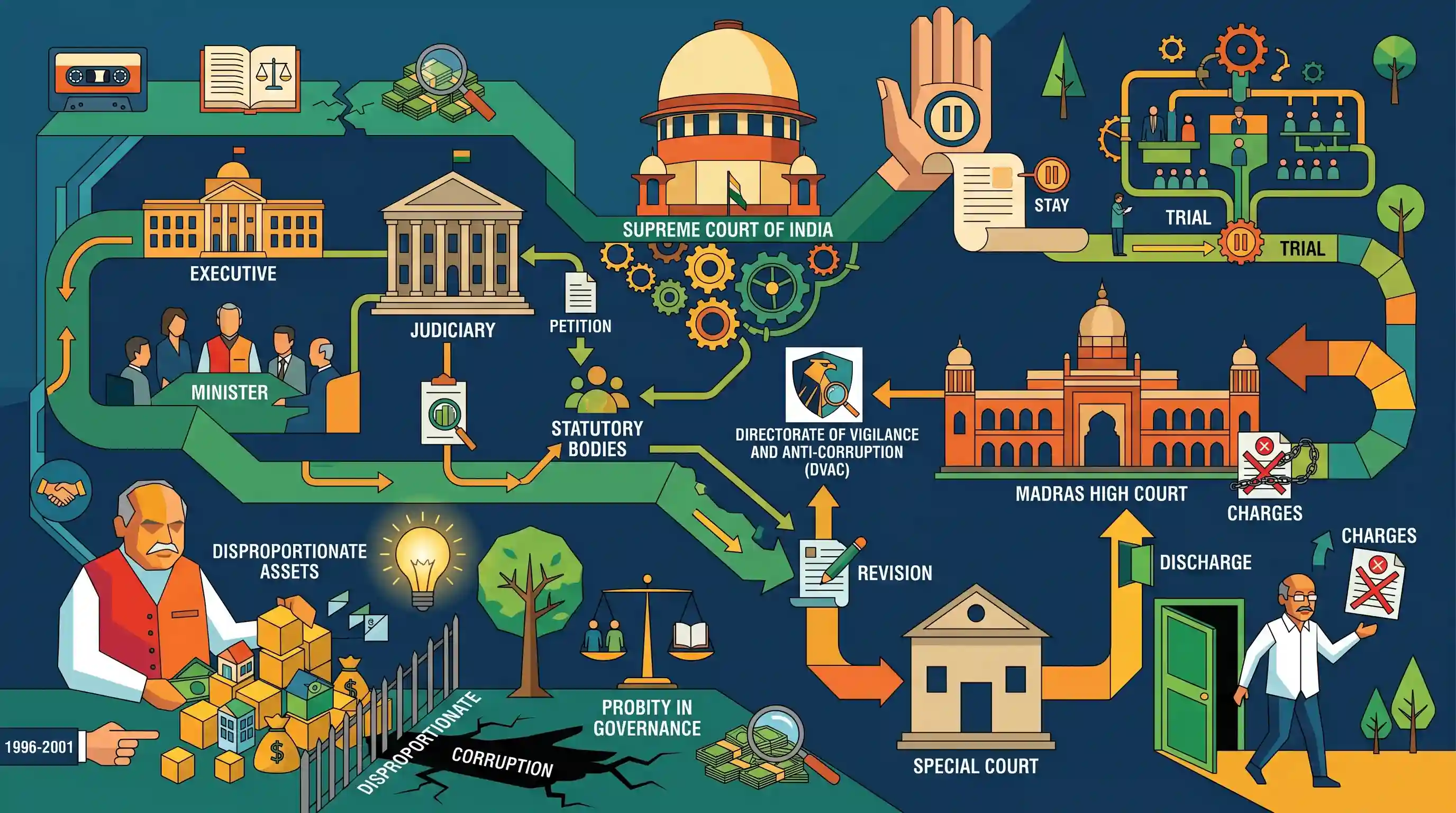
The Supreme Court has stayed criminal proceedings and the framing of charges against Tamil Nadu Minister Duraimurugan in a longstanding disproportionate assets case. Booked under the Prevention of Corruption Act for allegedly amassing illicit wealth between 1996 and 2001, the Minister had been discharged by a Special Court before the Madras High Court reversed the decision upon a revision petition by the Directorate of Vigilance and Anti-Corruption. The apex court's stay pauses the trial while it hears the appeal.
Key Points
- The Supreme Court stayed criminal proceedings against Tamil Nadu Minister Duraimurugan in a disproportionate assets case.
- The allegations relate to amassing wealth disproportionate to known sources of income under the Prevention of Corruption Act during his 1996-2001 tenure as PWD Minister.
- A Special Court had earlier discharged him, but the Directorate of Vigilance and Anti-Corruption filed revision petitions leading the Madras High Court to order the framing of charges.
- The Supreme Court has now issued notice to the Tamil Nadu government and paused the High Court's directive pending the appeal.
Important Terms
Prevention of Corruption Act

A 1988 statute (amended 2018) aimed at combating corruption in public service. It criminalises bribery, criminal misconduct, and possession of assets disproportionate to a public servant's known income.
UPSC context
GS Paper II (Governance) & GS IV (Probity); tests understanding of legal frameworks for accountability and administrative integrity.
Directorate of Vigilance and Anti-Corruption (DVAC)
The premier anti-corruption agency of the Tamil Nadu government. It investigates allegations of bribery, corruption, and illicit wealth against state public servants under the Prevention of Corruption Act.
UPSC context
GS Paper II; tests knowledge of state-level institutional mechanisms for tackling corruption and ensuring administrative transparency.
Supreme Court
The highest judicial body in India with original, appellate, and advisory jurisdiction. It can issue 'stays' to pause lower court proceedings during the pendency of an appeal.
UPSC context
GS Paper II (Judiciary); tests understanding of the appellate hierarchy, Article 136, and the court's supervisory role.
Madras High Court
The apex court for Tamil Nadu and Puducherry. It exercises revisional jurisdiction to review and correct legal or jurisdictional errors in the orders of subordinate special courts.
UPSC context
GS Paper II (Judiciary); tests the functional relationship between High Courts and lower trial courts in criminal proceedings.
Revision Petition
A legal remedy (under Section 397 CrPC/BNSS) where a higher court examines the records of a lower court to ensure the legality, propriety, and correctness of an order.
UPSC context
GS Paper II; tests comprehension of legal procedures used by the State to challenge discharge orders in corruption cases.
Prelims Trap
A sitting legislator is automatically disqualified the moment charges are framed under the Prevention of Corruption Act.
Disqualification under Section 8 of the RPA 1951 requires a formal conviction, not merely the framing of charges, an FIR, or an ongoing trial.
Static Concepts Connected
What is the Revisional Jurisdiction of a High Court?
- Meaning: The power (under CrPC/BNSS) to call for and examine the records of subordinate criminal courts to check for legality and propriety.
- Application: Often used to correct patent errors by lower courts, such as an improper discharge or framing of charges before a trial commences.
- Discretionary Nature: Unlike an appeal, revision is a discretionary power of the High Court and not a statutory right of the accused or prosecution.
How is 'Criminal Misconduct' handled under the Prevention of Corruption Act?
- Legal Definition: Section 13 defines it to include a public servant intentionally enriching themselves illicitly during their period of office.
- Disproportionate Assets: Holding assets disproportionate to known, lawful sources of income that the servant cannot satisfactorily account for constitutes criminal misconduct.
- Prior Sanction: Following 2018 amendments, investigating agencies require prior sanction/approval from the competent authority to initiate an inquiry against a public servant.
Cross-Topic Patterns
RPA Disqualification & Anti-Corruption Law
Cases involving sitting ministers often test the intersection of the Prevention of Corruption Act and Section 8(1) of the Representation of the People Act, which mandates immediate disqualification upon conviction.
Federal Vigilance: DVAC vs CBI/CVC
While the CBI operates under the DSPE Act and CVC at the Centre, states have parallel Directorate of Vigilance and Anti-Corruption (DVAC) bodies answering to State Vigilance Commissions.

Expect a prelims statement comparing a High Court's revisional jurisdiction with appellate powers, alongside RPA disqualification triggers.
Linked PYQs · 4
Linked PYQs · 4
- 2025MainsGS2
Discuss the 'corrupt practices' for the purpose of the Representation of the People Act, 1951. Analyze whether the increase in the assets of the legislators and/or their associates, disproportionate to their known sources of income, would constitute 'undue influence' and consequently a corrupt practice.
- 2020MainsGS2
There is a need for simplification of procedure for disqualification of persons found guilty of corrupt practices under the Representation of Peoples Act". Comment.
- 2019MainsGS4
What do you understand by probity in governance ? Based on your understanding of the term, suggest measures for ensuring probity in government.
- 2019MainsGS4
"Non-performance of duty by a public servant is a form of corruption". Do you agree with this view? Justify your answer.
