Supreme Court Stays Assam Deportation Over Citizenship Proof
Source:The Hindu ↗
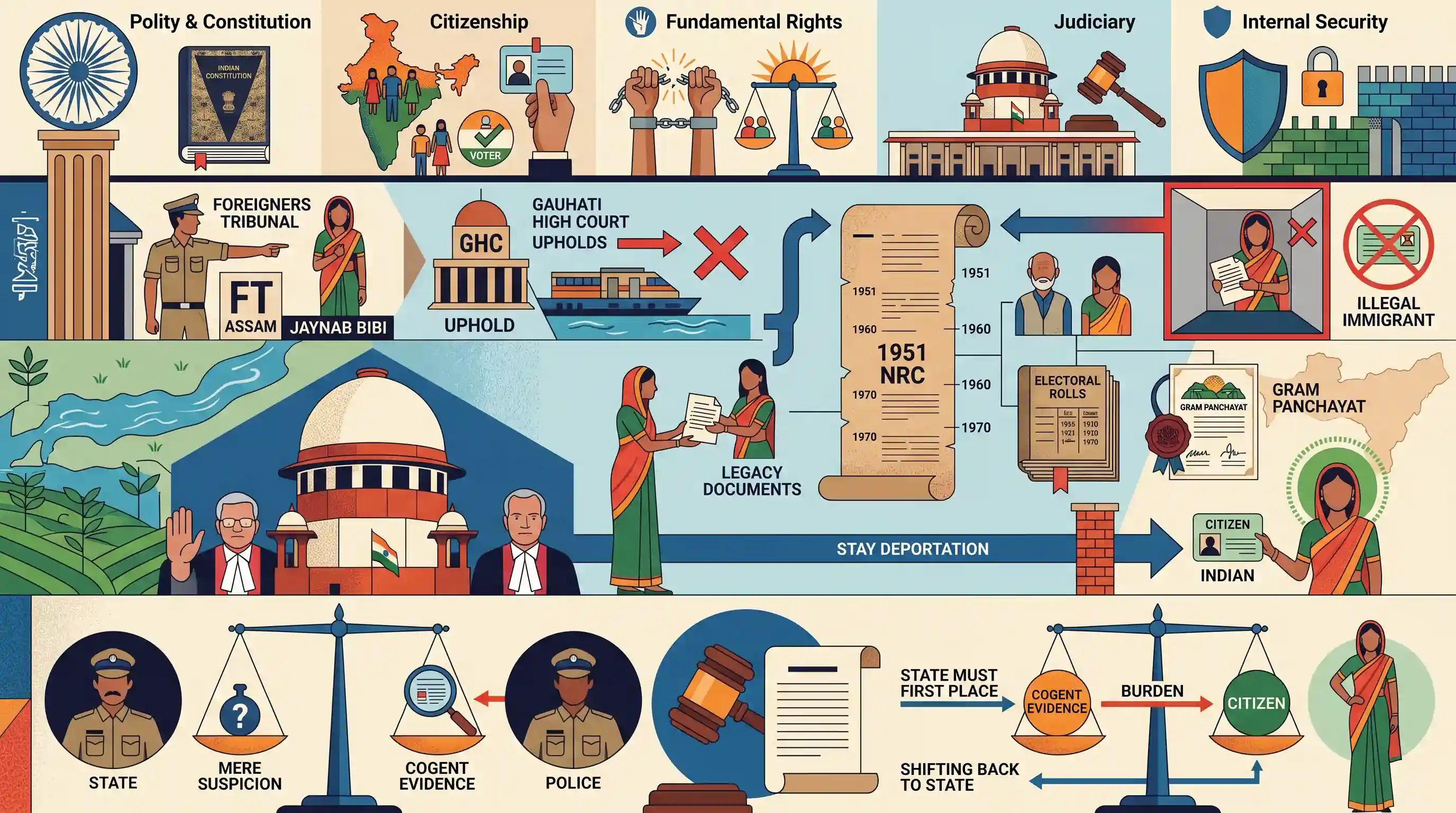
Why It Matters
The article addresses a critical constitutional and administrative issue regarding the burden of proof in citizenship determination via Foreigners Tribunals in Assam. It highlights the intersection of fundamental rights (protection from arbitrary state action) with the state's internal security imperatives, directly relevant to Mains GS2 (Constitution) and GS3 (Border Management).
Summary
The Supreme Court has stayed the deportation of Jaynab Bibi, an Assam resident, after a Foreigners Tribunal and the Gauhati High Court had previously declared her an illegal immigrant. The petitioner countered the claim by providing legacy documents, including her grandfather's name in the 1951 National Register of Citizens (NRC), alongside old electoral rolls and gram panchayat certificates establishing her lineage. The Supreme Court relied on a 2024 precedent emphasizing that authorities cannot randomly suspect citizens in Assam of being foreigners without cogent evidence, thereby shifting the immediate burden of establishing reasonable suspicion to the State before arbitrary deportation processes are initiated.
Key Points
- The Supreme Court stayed the deportation of Jaynab Bibi, a woman from Assam, who had been declared an illegal immigrant by a Foreigners Tribunal.
- The woman presented legacy documents to establish citizenship, including the 1951 NRC list and voters\' lists spanning multiple decades (1965, 1970, 1989, 1997).
- The Supreme Court emphasized that the State cannot declare individuals as foreigners based on mere random suspicion without providing cogent evidence.
- The court noted the failure of the Tribunal and the Gauhati High Court to properly weigh the gram panchayat certificates and legacy linkage documents provided by the petitioner.
Important Terms
National Register of Citizens (NRC)

A register of genuine Indian citizens, updated specifically in Assam to detect illegal immigrants based on the March 24, 1971, cut-off date.
UPSC context
GS Paper II: Citizenship, Governance; tests knowledge of the 1985 Assam Accord and the 1971 cut-off.
Foreigners Tribunal
Quasi-judicial bodies in Assam, established under the Foreigners (Tribunals) Order, 1964, to determine the citizenship status of individuals suspected of being foreigners.
UPSC context
GS Paper II: Statutory/Quasi-judicial bodies; tests understanding of judicial oversight in citizenship determination.
Legacy Documents
Pre-1971 records, such as the 1951 NRC or voter lists, used by applicants in Assam to prove their or their ancestors' presence in India.
UPSC context
GS Paper II: Citizenship; tests technical knowledge of the documentation required to establish lineage in Assam.
Gram Panchayat Certificate
A supporting document used to prove 'linkage' to a legacy bearer, primarily for married women migrating between villages to establish ancestry.
UPSC context
GS Paper II: Citizenship; tests awareness of the 'Rupajan Begum' case regarding linkage document validity.
Section 9, Foreigners Act, 1946
Mandates that the burden of proving citizenship lies on the individual rather than the State, though the Supreme Court (2024) requires 'material basis' for suspicion.
UPSC context
GS Paper II: Fundamental Rights and Judiciary; tests the balance between State power and individual rights.
Prelims Trap
"Under the Foreigners Act, 1946, the burden of proving that a person is a foreigner lies primarily upon the State."
Section 9 of the Act actually places the burden of proof on the accused (reverse burden), though the SC rules the State must first establish initial reasonable suspicion.
Static Concepts Connected
How are Foreigners Tribunals constituted and what is their legal mandate?
- Executive origin: They are established under the Foreigners (Tribunals) Order, 1964, via a Home Ministry executive action, not through a legislative enactment under Article 323B.
- Quasi-judicial nature: They are quasi-judicial bodies tasked with determining whether a person is a foreigner under the Foreigners Act, 1946.
- Reverse burden of proof: Under Section 9 of the Foreigners Act, the ultimate onus of proving one is not a foreigner lies strictly on the accused individual.
What governs the special citizenship provisions for Assam?
- Assam Accord cut-off: March 24, 1971 is the baseline; those arriving on or after March 25, 1971, are deemed foreigners and liable for deportation.
- Section 6A validity: Inserted into the Citizenship Act, 1955 to enforce the Accord. It was recently upheld as constitutionally valid by a Constitution Bench of the Supreme Court.
- Legacy documents: Pre-1971 electoral rolls and the 1951 National Register of Citizens (NRC) act as primary proof to establish historical lineage and citizenship claims.
Cross-Topic Patterns
Reverse burden vs. Natural Justice
The SC's insistence on primary evidence before invoking reverse burden clauses highlights the ongoing judicial balancing act between stringent border/security laws and the fundamental right to life under Article 21.
Citizenship + Internal Security linkage
Demographic shifts and resource strains in border states are framed by UPSC as internal security challenges, directly linking Polity (Citizenship Act) to border management and cross-border insurgencies.

Expect a multi-statement question on Foreigners Tribunals combining their executive origin (1964 Order) and the reverse burden of proof.
Linked PYQs · 2
Linked PYQs · 2
- 2022MainsGS2
“Right of movement and residence throughout the territory of India are freely available to the Indian citizens, but these rights are not absolute.” Comment.
- 2014MainsGS3
How does illegal transborder migration pose a threat to India's security? Discuss the strategies to curb this, bringing out the factors which give impetus to such migration.
