Rajasthan Border Demolitions Stayed by Supreme Court
Source:The Hindu ↗
Why It Matters
This case highlights the delicate balance between national security in sensitive border areas and constitutional protections of properties and minority institutions. It also underscores judicial federalism and the division of jurisdiction between the Supreme Court and State High Courts.
Summary
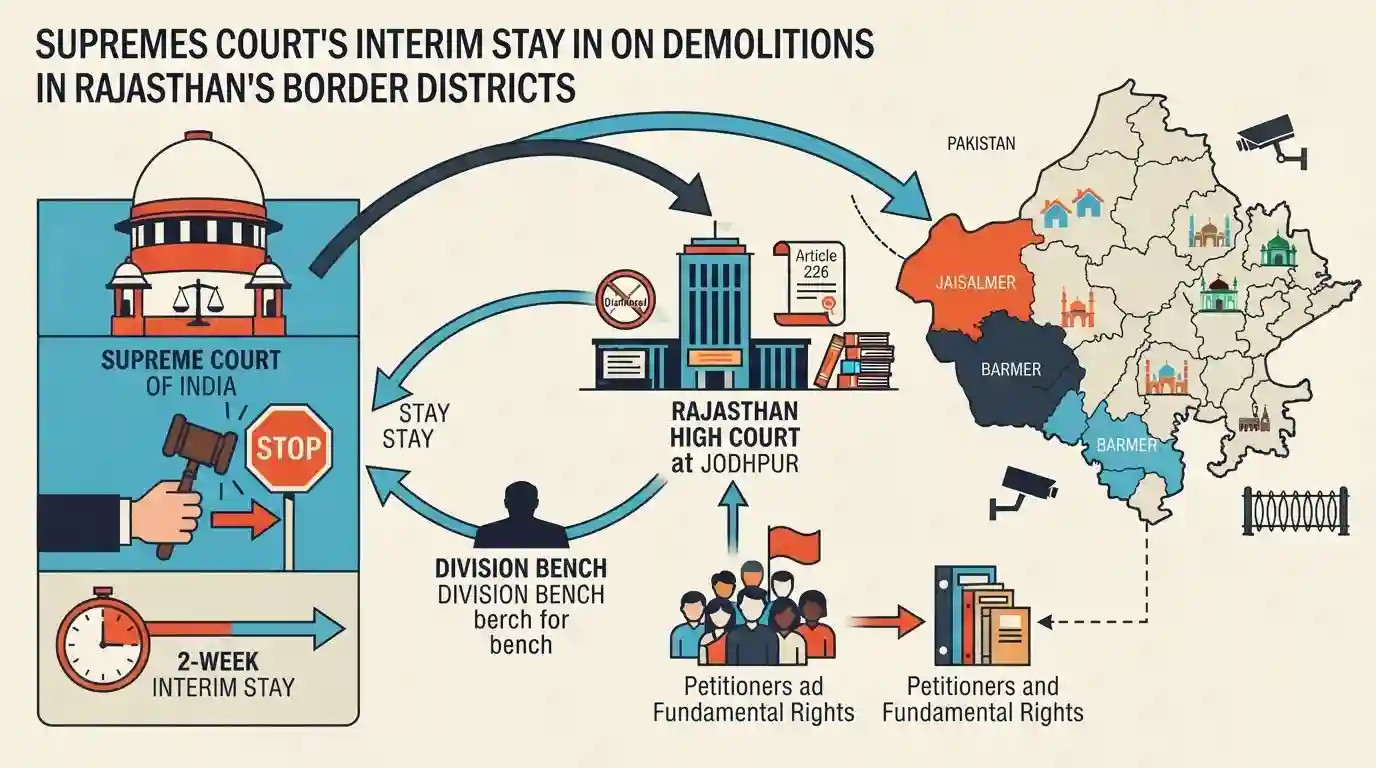
The Supreme Court of India issued a two-week interim stay on the demolition of mosques, madrasas, dargahs, and residential homes in the border districts of Barmer and Jaisalmer in Rajasthan. The petition, filed by Jamiat Ulama-i-Hind, challenged a Rajasthan High Court order that had dismissed concerns over the demolitions by citing national security along the international border. While staying the demolitions temporarily, the Supreme Court bench directed the petitioners to approach the Division Bench of the Rajasthan High Court at Jodhpur, noting that disputed questions of fact are best adjudicated by the jurisdictional High Court.
Key Points
- The Supreme Court of India granted a two-week interim stay on the demolition of mosques, madrasas, dargahs, and houses in Rajasthan's border districts of Barmer and Jaisalmer.
- The stay order was issued by a bench of Justices P.S. Narasimha and Alok Aradhe on a petition filed by Jamiat Ulama-i-Hind, represented by senior advocate Kapil Sibal.
- Earlier, the Rajasthan High Court at Jodhpur had dismissed the petition, citing national security concerns and religious non-discrimination along the international border.
- The Supreme Court observed that contested questions of fact should be resolved by the jurisdictional High Court, allowing the petitioners to approach the Division Bench of the Rajasthan High Court at Jodhpur for appropriate relief.
Important Terms
Supreme Court of India

The apex judicial body in India. It possesses appellate jurisdiction to review High Court judgments and the authority to issue immediate interim relief to protect fundamental rights against arbitrary executive actions.
UPSC context
GS Paper 2 (Judiciary). Tests the Court's appellate powers (Article 136) and its role in protecting minority rights against state overreach.
Rajasthan High Court
The highest judicial authority in Rajasthan. The Supreme Court often relies on its writ jurisdiction (Article 226) to adjudicate complex, fact-heavy disputes rooted in local administrative actions.
UPSC context
GS Paper 2 (State Judiciary). Highlights the relationship between the apex court and state High Courts in fact-finding and resolving local disputes.
Jamiat Ulama-i-Hind
A prominent socio-religious organization of Islamic scholars in India. It actively engages in legal advocacy and public interest litigation to defend the constitutional and legal rights of the Muslim minority.
UPSC context
GS Paper 2 (Role of NGOs). Tests civil society's function in safeguarding vulnerable sections and ensuring adherence to the constitutional rule of law.
Interim Stay
A temporary court order suspending an executive action, such as a demolition drive. It prevents immediate, irreversible harm while the court deliberates the final legal and constitutional merits.
UPSC context
GS Paper 2 (Judiciary). Essential for understanding preventive legal remedies, natural justice, and judicial safeguards against arbitrary state power.
Division Bench
A High Court or Supreme Court bench consisting of two judges. It typically hears complex cases or appeals against single-judge rulings, providing a more comprehensive judicial review before further escalation.
UPSC context
GS Paper 2 (Structure of Judiciary). Tests knowledge of court hierarchies, bench compositions, and intra-court appellate procedures.
Prelims Trap
The right to freely profess and practice religion under Article 25 is expressly subject to 'Security of the State'.
Article 25 restrictions explicitly include public order, morality, and health. Unlike Article 19(2), 'Security of the State' is not an expressly listed ground for restricting religious freedom.
Static Concepts Connected
What is the constitutional protection against arbitrary property demolition?
- Article 300A: No person shall be deprived of property save by authority of law. While not a fundamental right (post-44th Amendment), it requires statutory procedure.
- Article 21 (Shelter): The Supreme Court has expanded the right to life to include the right to shelter, mandating fair procedure and adequate notice before evictions or demolitions.
- Statutory Due Process: Municipal and land revenue codes strictly mandate serving statutory notice and providing an opportunity to be heard before a structure is demolished.
What is an intra-court appeal in High Courts?
- Division Bench Appeal: An appeal from the judgment of a Single Judge to a Division Bench (two or more judges) of the same High Court.
- Letters Patent Appeal: Not universally available; it exists in High Courts established by Letters Patent (e.g., Bombay, Madras, Calcutta) or where specific state legislation allows it.
- Exhaustion of Remedies: The Supreme Court often directs petitioners invoking Article 136 (SLP) to first exhaust this intra-court remedy, especially when disputed questions of fact are involved.
Cross-Topic Patterns
Border Security vs Constitutional Safeguards
The invocation of "national security" in border districts to justify rapid demolitions creates a friction point with Article 25 (religion) and Article 300A (property rights).
Punitive Demolitions and Rule of Law
This connects to the broader national trend of punitive "bulldozer justice," where municipal demolition powers intersect with criminal law, bypassing standard judicial oversight and due process.

Expect a 2026 Mains question balancing state border-security imperatives with constitutional safeguards against arbitrary demolitions.
Linked PYQs · 4
Linked PYQs · 4
- 2013RPSC_PRELIMSGS1
List-1 is matched with List-2 and the correct answer is selected using the codes given below - List-1 – List-2 Constitutional Article – Provision A. 215 1. Transfer of a judge from one High Court to another High Court B. 222 2. Power of superintendence over all courts C. 226 3. Power of the High Court to issue certain writs D. 227 4. The High Court as a court of record Code:
- 2024RPSC_PRELIMSGS1
Which of the following group of districts/cities of Rajasthan are arranged in ascending order as per their distance from the border with Pakistan?
- 2024RPSC_PRELIMSGS1
Fundamental Rights provided by which of the following groups of Articles are granted only to 'Citizens' of India?
- 2021RPSC_PRELIMSGS1
Which of the following districts is not part of the ‘Maru Triangle’ in Rajasthan?
