Criminal Defamation Proceedings and Political Speech Protections
Source:The Hindu ↗
Why It Matters
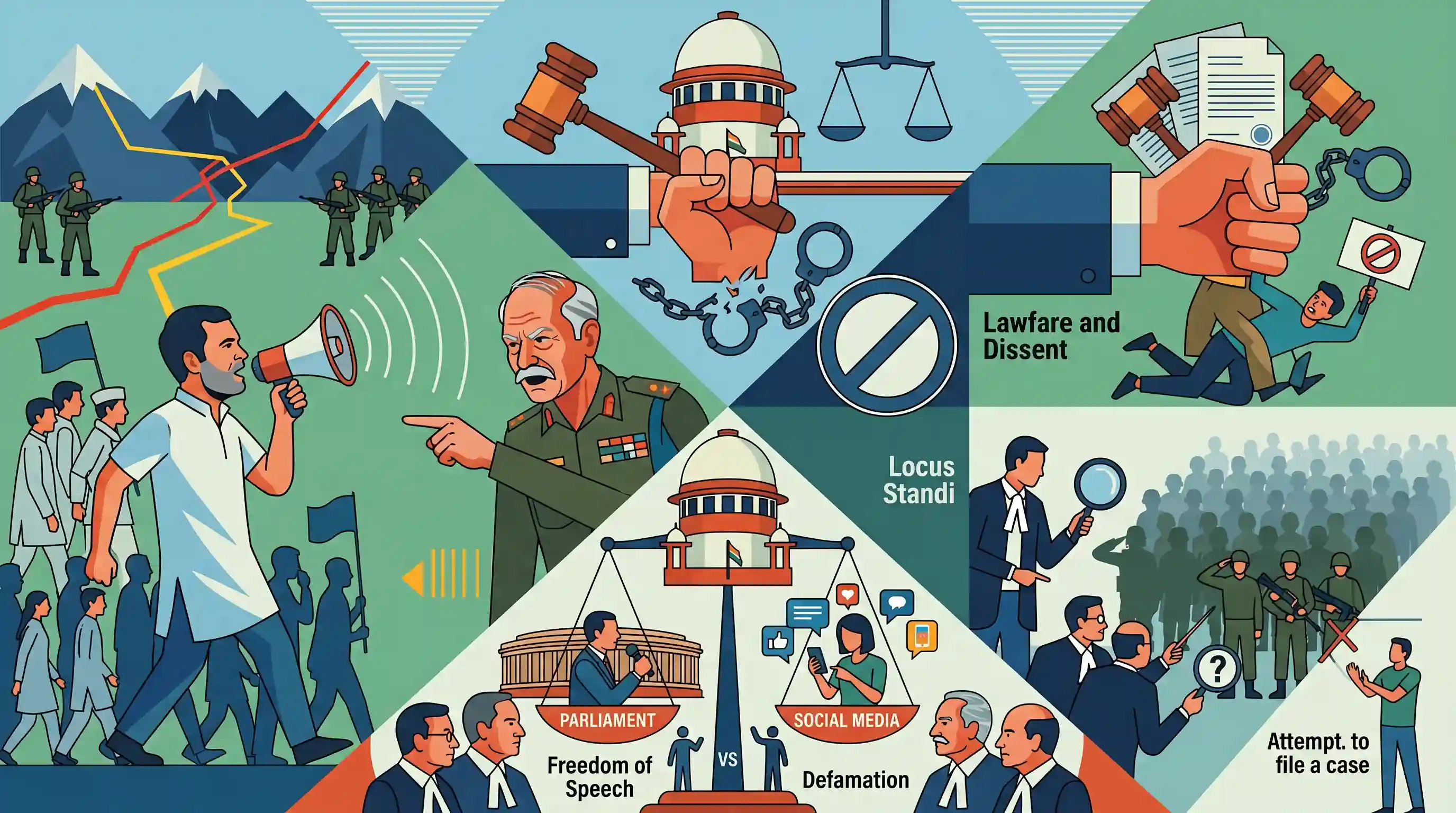
The case highlights the constitutional tension between Article 19(1)(a) (Freedom of Speech) and Section 499 IPC (Defamation), particularly concerning political figures. It underscores the phenomenon of "lawfare" (using legal tools to silence political dissent) and touches on the procedural mandate of locus standi ("person aggrieved") in defamation suits, questioning the appropriate forum for political critiques.
Summary
The Supreme Court stayed criminal defamation proceedings against Leader of the Opposition Rahul Gandhi regarding remarks he made about India-China border clashes during the Bharat Jodo Yatra. The complainant, a retired Border Roads Organisation (BRO) officer, alleged the remarks defamed the Indian Army and lowered his personal reputation. Gandhi's legal team argued the case was an example of "lawfare" aimed at muzzling dissent, emphasizing the complainant lacked *locus standi* because defamation legally requires an identifiable target or determinate body. During the hearing, the Supreme Court bench debated the boundaries of a responsible opposition leader's freedom of speech outside Parliament, questioning the use of social media for such claims instead of parliamentary debates.
Key Points
- The Supreme Court stayed criminal defamation proceedings against Leader of Opposition Rahul Gandhi over remarks on India-China border skirmishes.
- The complaint, filed by a retired BRO officer in a Lucknow court, alleged the comments defamed the Indian Army and his personal reputation.
- Gandhi's counsel argued that the complainant lacked locus standi, citing settled law that defamation must relate to an identifiable individual or determinate body.
- The defense characterized the proceedings as "lawfare" and a "heckler's veto" aimed at muzzling political dissent and restricting the Opposition's freedom of speech.
- The Supreme Court Bench questioned the appropriateness of an opposition leader raising sensitive national security issues on social media rather than inside Parliament.
Important Terms
Supreme Court of India

The apex judicial body in India, established under Article 124, serving as the final court of appeal and the guardian of the Constitution.
UPSC context
GS Paper II (Judiciary): Tests understanding of judicial review, appellate jurisdiction, and the protection of fundamental rights.
Border Roads Organisation (BRO)
A statutory body under the Ministry of Defence responsible for constructing and maintaining road infrastructure in India’s strategic border areas and friendly neighboring countries.
UPSC context
GS Paper III (Security/Infrastructure): Relevant for border management, strategic mobility, and internal security challenges.
Freedom of Speech and Expression
A fundamental right under Article 19(1)(a) allowing citizens to express views freely, subject to reasonable restrictions like public order, security, and defamation.
UPSC context
GS Paper II (Fundamental Rights): Tests the balance between individual liberty and societal/national interests.
Criminal Defamation
An offense under Section 499/500 IPC (now Section 356 BNS) involving false statements made with malicious intent to harm a person's reputation.
UPSC context
GS Paper II (Polity): Important for debates on muzzling dissent versus protecting individual dignity and reputation.
Locus Standi
The legal right or capacity of a party to bring an action to court, requiring proof of direct interest or harm from the contested action.
UPSC context
GS Paper II (Judiciary): Relates to judicial process and exceptions like Public Interest Litigation (PIL).
Lok Sabha
The lower house of India's bicameral Parliament, where the Leader of the Opposition plays a critical role in ensuring executive accountability.
UPSC context
GS Paper II (Parliament): Focuses on the structure and functioning of the legislature and the role of opposition.
Prelims Trap
"MPs enjoy absolute immunity from defamation for political statements regarding national security, regardless of the medium."
Article 105 provides absolute immunity from court proceedings only for speech and votes made inside Parliament or its committees. Statements made outside are subject to standard laws.
Static Concepts Connected
How does the Constitution balance Freedom of Speech with Defamation?
- Article 19(2): Defamation is explicitly listed as a "reasonable restriction" on the Freedom of Speech and Expression under Article 19(2).
- Article 21: The Supreme Court (Subramanian Swamy case, 2016) upheld criminal defamation, ruling that the "Right to Reputation" is an inherent part of the Right to Life.
What is the scope of an MP's freedom of speech under Article 105?
- Absolute Immunity: MPs are protected from civil and criminal proceedings for anything said or any vote given inside the Parliament or its committees.
- Geographical Limit: This immunity does not extend to statements made outside Parliament, such as at public rallies, press conferences, or on social media.
Cross-Topic Patterns
Locus Standi: Defamation vs. PILs
Unlike Public Interest Litigations (PILs) where locus standi is relaxed to allow third-party intervention, criminal defamation strictly limits the right to file a complaint to the directly "aggrieved person."
Defamation of 'Determinate Bodies'
The legal debate over defaming a 'determinate body' parallels how hate speech laws are applied. Vague political commentary on broad groups rarely qualifies as actionable criminal defamation for a single proxy individual.

Expect a 2026 Prelims question testing the exact boundaries between Art 105 (Parliamentary Privileges) and Art 19(2) speech restrictions.
Linked PYQs · 3
Linked PYQs · 3
- 2014MainsGS2
What do you understand by the concept "freedom of speech and expression"? Does it cover hate speech also ? Why do the films in India stand on a slightly different plane from other forms of expression ? Discuss.
- 2019MainsGS2
On what grounds a people's representative can be disqualified under the Representation of Peoples Act, 1951? Also mention the remedies available to such person against his disqualification.
- 2019MainsGS2
Individual Parliamentarian's role as the national law maker is on a decline, which in turn, has adversely impacted the quality of debates and their outcome. Discuss.
