Supreme Court Stay on Maharashtra Local Body Reservations
Source:Indian Express ↗
Why It Matters
Crucial for understanding the constitutional bounds of political reservations in local governance, federal dynamics, and judicial oversight over municipal and panchayat elections in Maharashtra.
Summary
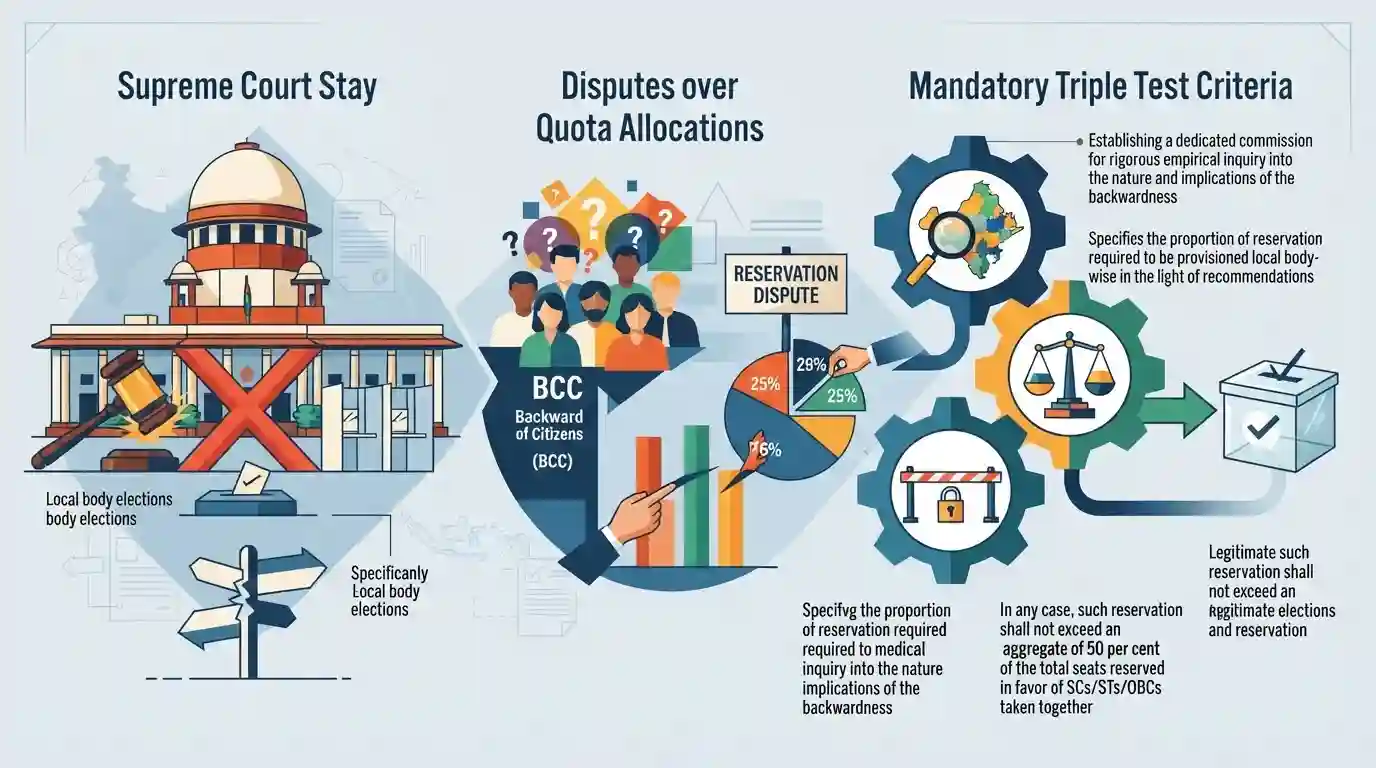
The Supreme Court of India stayed the local body elections and associated reservations in Maharashtra following disputes over quota allocations for Backward Classes of Citizens (BCC). The stay highlights the necessity of fulfilling the mandatory 'triple test' criteria before implementing political reservations in local government bodies.
Key Points
- The Supreme Court stayed local body elections and reservations in Maharashtra pending legal challenges regarding quotas for Backward Classes of Citizens (BCC).
- The court emphasized compliance with the strict conditionalities, known as the 'triple test', required for providing political reservations in local self-government institutions.
- The delay impacts upcoming elections for municipal corporations, councils, and panchayats across Maharashtra.
Important Terms
Supreme Court of India

The apex judicial institution of India, responsible for interpreting the Constitution, safeguarding fundamental rights, and arbitrating constitutional disputes regarding local body governance and reservations.
UPSC context
MPSC Polity & Governance: Tests knowledge of the Indian judicial system, judicial review, and federal structure.
State Election Commission Maharashtra
An autonomous constitutional body responsible for superintendence, direction, and conduct of elections to rural and urban local self-government bodies in Maharashtra under the 73rd and 74th Amendments.
UPSC context
MPSC Maharashtra Governance: Tests understanding of decentralization, local body polls, and state constitutional authorities.
Static Concepts Connected
What are the three components of the Supreme Court's mandatory 'triple test' for local body political reservations?
- Dedicated Commission: Empirical Inquiry: Appoint a dedicated commission to conduct a rigorous contemporaneous empirical inquiry into the nature of backwardness in local bodies.
- Proportion Sizing: Proportional Quota: Specify the proportion of reservation required for each local body based on the commission's empirical findings.
- Aggregate Cap: 50% Ceiling: Ensure that aggregate reservations for SC, ST, and OBC combined do not exceed the 50% cap.
Cross-Topic Patterns
Panchayati Raj Quotas vs. Judicial Review
Local body quotas link Panchayati Raj devolution (Article 243) directly with constitutional equality guarantees under Article 14 and 16, frequently tested via landmark judicial interventions.

Expect a MPSC statement-based question testing the 3 mandatory conditions of the 'triple test' for OBC political reservations in local bodies.
Linked PYQs · 2
Linked PYQs · 2
- 2026MPSC_PRELIMSGS1
As per the Government Resolution dated October 9, 2024, what is the minimum population requirement for establishment a 'Gram Panchayat' in Banjara/Laman/Labhan Tanda areas ?
- 2023MPSC_PRELIMSGS1
Match the pairs correctly. | Column A | Column B | |---|---| | A. Part - I | i. Fundamental Rights | | B. Part - III | ii. Panchayat Raj | | C. Part - IX | iii. Citizenship | | D. Part - II | iv. The Union and its territory | Code: A B C D
