Supreme Court Review of Split Verdicts in Constitutional Matters
Source:Indian Express ↗
ఇది ఎందుకు ముఖ్యం
It addresses critical questions on judicial functioning, resolution of split verdicts in apex courts, and institutional independence of bodies like the Election Commission.
సారాంశం
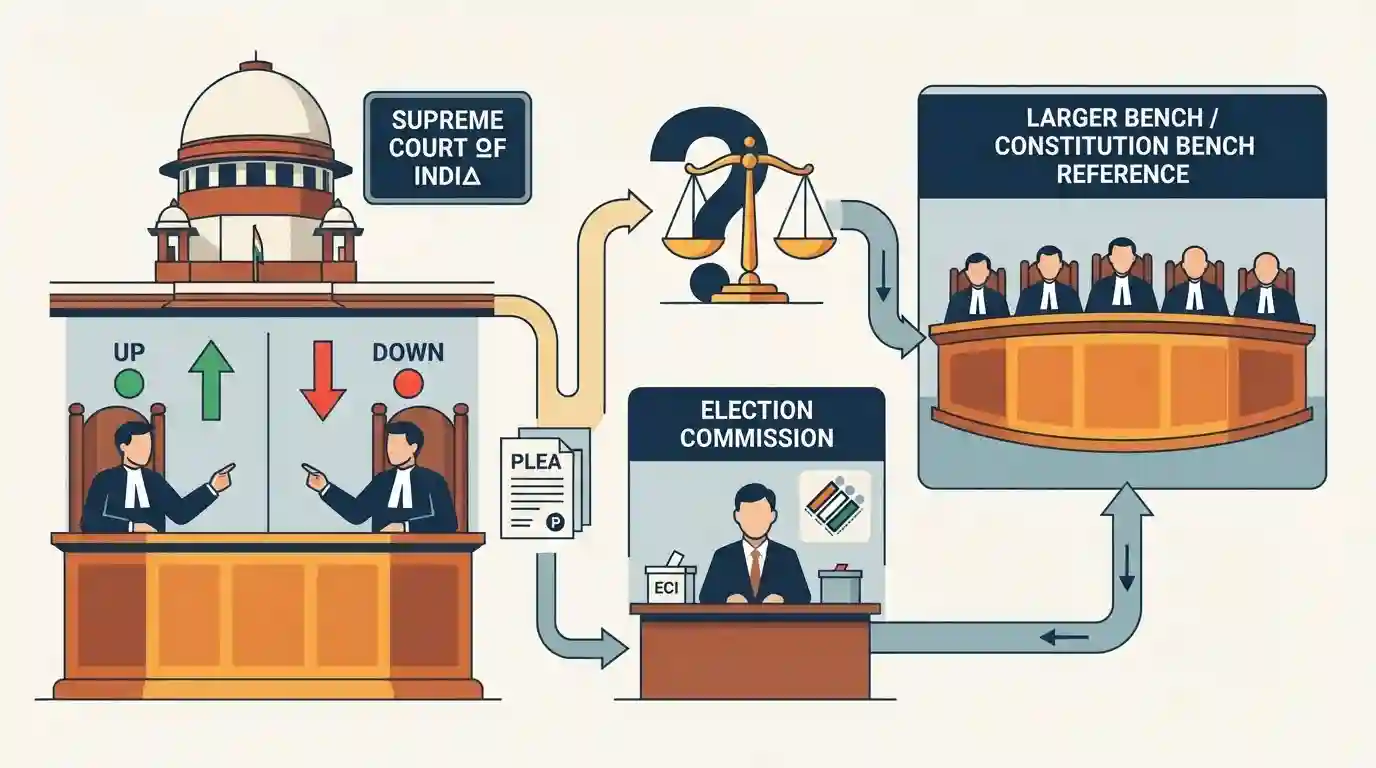
The Supreme Court of India is dealing with a plea concerning split verdicts and whether matters involving significant questions of law, such as the appointment of Election Commissioners, require automatic reference to a larger or constitution bench when judges differ.
ముఖ్య అంశాలు
- The Supreme Court is examining a petition regarding the legality and implications of split verdicts given by benches.
- The underlying context involves challenges to the appointment of Election Commissioners and the structure of high constitutional offices.
- Split verdicts create legal uncertainty, necessitating reference to larger benches or constitutional benches for authoritative rulings.
ముఖ్యమైన పదాలు
Article 324

Article 324 of the Constitution of India provides for the superintendence, direction, and control of elections to be vested in an Election Commission, establishing it as an independent constitutional body.
UPSC context
GS Paper II (Indian Polity and Constitution) - Important constitutional articles, statutory bodies, and features of the electoral process.
Election Commission of India
An independent constitutional body responsible for administering election processes in India under Article 324, ensuring free and fair elections to Parliament, State Legislatures, and offices of President and Vice-President.
UPSC context
GS Paper II (Governance and Polity) - Structure, functioning, and powers of constitutional authorities.
Supreme Court of India
The highest judicial forum of India, comprising the Chief Justice of India and other judges, exercising original, appellate, and advisory jurisdiction under the Constitution.
UPSC context
GS Paper II (Indian Polity) - Structure, organization, and functioning of the judiciary, judicial review, and constitutional interpretation.
అనుసంధానమైన స్థిర భావనలు
What are the constitutional provisions governing Constitution Benches and split verdicts in India?
- Article 145(3): Mandates that cases involving a substantial question of law as to the interpretation of the Constitution require a minimum of five judges.
- Master of Roster: The Chief Justice of India assigns cases and constitutes larger benches to resolve divergent opinions between two-judge benches.
- Split Verdict Procedure: If a two-judge bench splits, the matter is referred to a third judge (in High Courts) or a larger bench (in the Supreme Court).
అంతర-అంశ నమూనాలు
Split Verdicts + Constitutional Benches + Separation of Powers
Split verdicts in constitutional offices directly test the separation of powers and judicial review boundaries under Article 145(3) of the Constitution.

Split verdicts and Article 145(3) constitution bench requirements are prime candidates for a statement-based prelims question.
అనుసంధాన PYQలు · 2
అనుసంధాన PYQలు · 2
- 2017PrelimsGS1
Consider the following statements: 1. The Election Commission of India is a five-member body. 2. Union Ministry of Home Affairs decides the election schedule for the conduct of both general elections and bye-elections. 3. Election Commission resolves the disputes relating to splits/mergers of recognised political parties. Which of the statements given above is/are correct?
- 2025MainsGS2
"Constitutional morality is the fulcrum which acts as an essential check upon the high functionaries and citizens alike...." In view of the above observation of the Supreme Court, explain the concept of constitutional morality and its application to ensure balance between judicial independence and judicial accountability in India.
