Supreme Court Split Verdict on Election Commissioner Selection Law
Source:Indian Express ↗
Why It Matters
It directly impacts the independence of the Election Commission of India, a cornerstone of Indian democracy, and highlights procedural mechanisms of judicial review and split verdicts in constitutional benches.
Summary
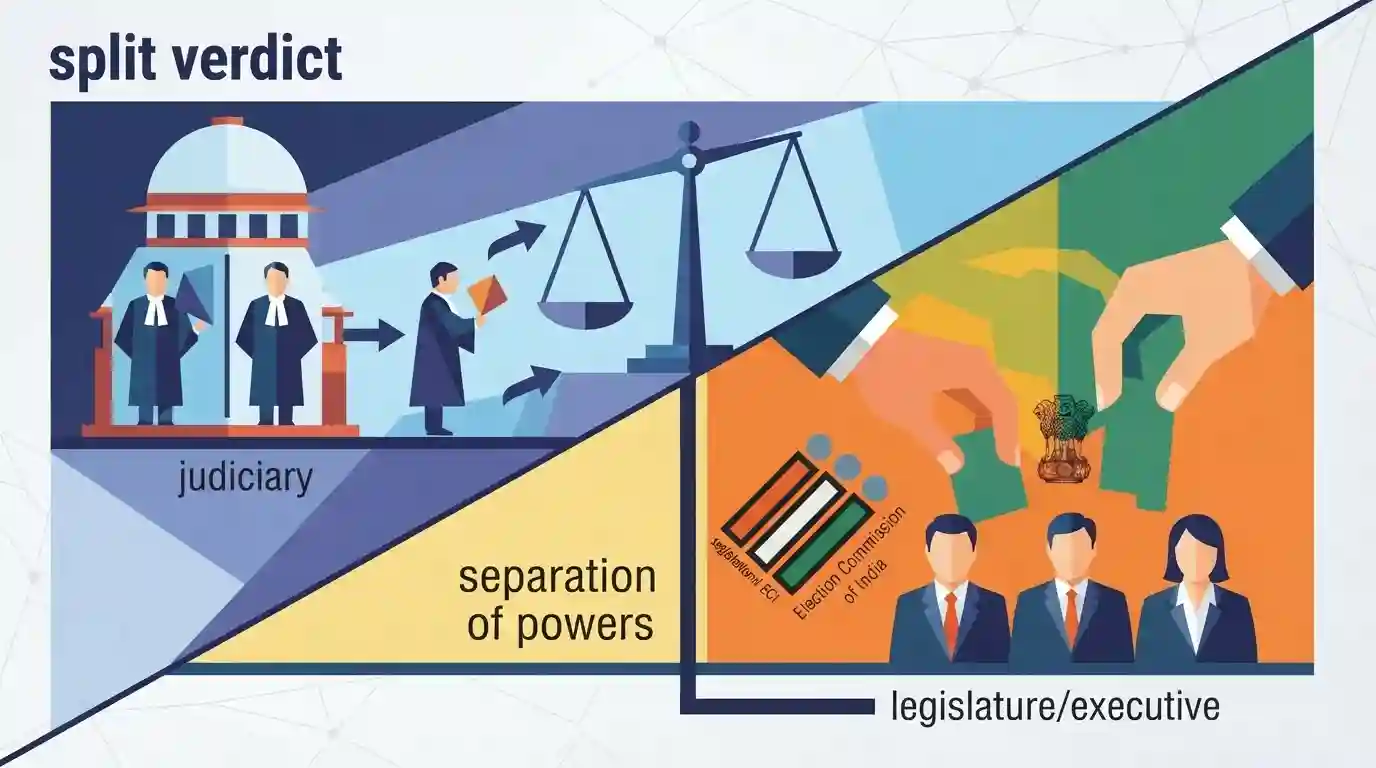
The Supreme Court delivered a split verdict on petitions challenging the constitutional validity of the law governing the selection and appointment of the Chief Election Commissioner and other Election Commissioners. The division underscores complex legal and constitutional questions concerning the independence of the Election Commission of India and the separation of powers between the judiciary and the legislature/executive.
Key Points
- The Supreme Court delivered a split verdict regarding the challenge to the law governing the selection of Election Commissioners (ECs).
- The case involves scrutiny of the statutory mechanism enacted by Parliament vis-à-vis earlier judicial directions (such as the Anoop Baranwal judgment) on insulating the Election Commission's independence.
- Split verdicts by benches necessitate reference to a larger bench for an authoritative pronouncement on key constitutional and governance issues.
- Highlights the ongoing institutional tussle over executive influence versus judicial safeguards in appointments to constitutional bodies.
Important Terms
Chief Election Commissioner and other Election Commissioners (Appointment, Conditions of Service and Term of Office) Act

The 2023 statute regulating the appointment, conditions of service, and term of office of the CEC and ECs, replacing the CJI with a Cabinet Minister in the selection committee.
UPSC context
GS Paper II (Polity & Governance - Statutory, Regulatory and Quasi-judicial Bodies); tests understanding of executive appointments and legislative changes to constitutional bodies.
Article 324 of the Constitution
Constitutional provision under Part XV vesting the superintendence, direction, and control of all elections to Parliament, State Legislatures, President, and Vice-President in the Election Commission.
UPSC context
GS Paper II (Indian Constitution - Significant Provisions); tests foundational provisions safeguarding free, fair, and independent elections in India.
Constitution Bench
A special bench of the Supreme Court consisting of five or more judges set up to decide cases involving substantial questions of law as to the interpretation of the Constitution.
UPSC context
GS Paper II (Judiciary - Structure, Organization and Functioning); tests knowledge of apex court jurisdiction and constitutional interpretation.
Election Commission of India
An autonomous constitutional authority responsible for administering election processes in India under Article 324, ensuring free and fair elections.
UPSC context
GS Paper II (Constitutional Bodies); tests the role, independence, powers, and functioning of key institutions of Indian democracy.
Static Concepts Connected
What are the constitutional provisions and appointment mechanism for the Election Commission of India under Article 324?
- Article 324: Constitutional Basis: Article 324 provides for the superintendence, direction, and control of elections to be vested in an Election Commission consisting of the Chief Election Commissioner and such number of other Election Commissioners as the President may fix from time to time.
- Appointment Power: Appointment Process: The President appoints the CEC and ECs. The Constitution originally left the specific legislative framework for appointments to Parliament, leading to the 2023 Act.
- Tenure & Security: Tenure & Removal: CEC and ECs hold office for a term of 6 years or until they attain the age of 65 years, whichever is earlier. CEC can be removed from office only in the manner and on the grounds as a judge of the Supreme Court.
Cross-Topic Patterns
EC Appointments vs NJAC: Executive vs Judiciary
The shift from judicial directions to legislative enactments in EC appointments mirrors the executive-legislature tussle seen in judicial appointments via the NJAC Act.

Expect a statement-based prelims question on Article 324 composition and the statutory shift replacing the CJI with a Cabinet Minister.
Linked PYQs · 3
Linked PYQs · 3
- 2022MainsGS2
Discuss the role of the Election Commission of India in the light of the evolution of the Model Code of Conduct.
- 2025MainsGS2
"Constitutional morality is the fulcrum which acts as an essential check upon the high functionaries and citizens alike...." In view of the above observation of the Supreme Court, explain the concept of constitutional morality and its application to ensure balance between judicial independence and judicial accountability in India.
- 2016MainsGS2
What was held in the Coelho case? In this context, can you say that judicial review is of key importance amongst the basic features of the Constitution?
