Supreme Court Invokes Article 142 in POCSO Case for Rehabilitation
Source:The Hindu ↗
Why It Matters
It provides a critical case study on the application of Article 142 to balance strict statutory frameworks (POCSO) with restorative justice. It also starkly highlights the grassroots implementation failures of child protection schemes, serving as excellent fodder for GS-2 answers on welfare policies, social justice, and judicial interventions.
Summary
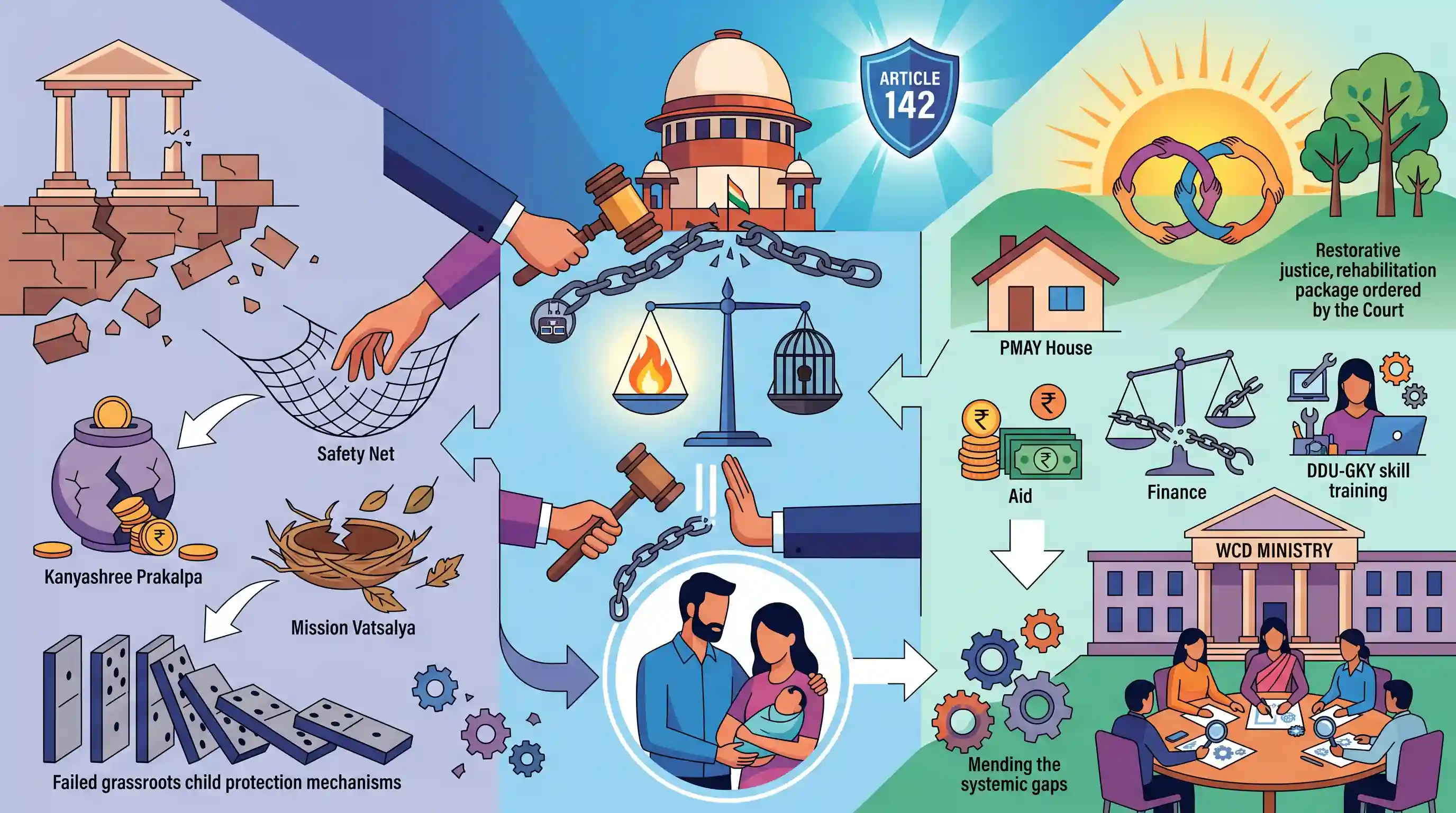
The Supreme Court invoked its extraordinary powers under Article 142 to spare a man convicted under the POCSO Act from a mandatory 10-year prison sentence. Highlighting the failure of the 'welfare state', the Court emphasized restorative justice and family rehabilitation over retribution to protect an adolescent mother and her child. It pinpointed systemic breakdowns in grassroots child protection mechanisms and state schemes like Kanyashree Prakalpa and Mission Vatsalya. Furthermore, the Court ordered a multi-faceted rehabilitation package—including housing under PMAY, financial aid, debt settlement, and skill training via DDU-GKY—and directed the Women and Child Development Ministry to form a committee to address these systemic gaps.
Key Points
- The Supreme Court invoked Article 142 (extraordinary jurisdiction) to bypass the mandatory minimum sentence under the POCSO Act, aiming to do 'complete justice' by preserving a family unit, though stipulating it cannot be treated as a precedent.
- The judgment prioritized restorative justice and rehabilitation over retribution, arguing that jailing the convict would only deepen the victim\'s trauma and cause destitution for the adolescent mother and child.
- The Court sharply criticized the 'systemic failures' of the welfare state, pointing out the ineffectiveness of Village-level Child Protection Committees, child welfare police, and schemes like Kanyashree Prakalpa and Mission Vatsalya in preventing child abuse and early marriage.
- Comprehensive rehabilitation directions were issued, mandating the state to provide housing (PMAY), settle debts, create fixed deposits, and ensure education and skill training (DDU-GKY), alongside directing the WCD Ministry to form an expert committee for systemic improvements.
Important Terms
Article 142 of the Constitution

Article 142 empowers the Supreme Court to pass any decree or order necessary for doing "complete justice" in any matter pending before it, even by transcending statutory limitations.
UPSC context
GS Paper II: Judiciary. Tests knowledge of extraordinary powers and the doctrine of 'complete justice' versus statutory laws.
POCSO Act (Protection of Children from Sexual Offences)
A comprehensive 2012 law protecting children from sexual abuse, exploitation, and pornography. It treats all sexual activity with minors as statutory rape, making consent legally irrelevant.
UPSC context
GS Paper II: Mechanisms, laws, and institutions for vulnerable sections. Focuses on child rights and legislative rigidity.
Mission Vatsalya
A centrally sponsored umbrella scheme by the WCD Ministry for child protection and welfare, emphasizing family-based non-institutional care and strengthening statutory bodies like Child Welfare Committees.
UPSC context
GS Paper II: Welfare schemes for vulnerable sections. Tests implementation and convergence of child protection mechanisms.
Kanyashree Prakalpa
West Bengal's flagship conditional cash transfer scheme providing annual scholarships and one-time grants to adolescent girls to prevent child marriage and encourage higher education.
UPSC context
GS Paper II: Government policies and interventions. Example of state-level social welfare and gender empowerment models.
Deen Dayal Upadhyaya Grameen Kaushalya Yojana (DDU-GKY)
A placement-linked skill training program for rural youth aged 15-35, functioning under the National Rural Livelihood Mission (NRLM) to diversify income of poor families.
UPSC context
GS Paper III: Employment and Skill Development. Focuses on rural livelihood and demographic dividend.
Village-level Child Protection Committees
The lowest-tier bodies under Mission Vatsalya responsible for identifying children in difficult circumstances (orphans, street children) at the grassroots level to facilitate state support.
UPSC context
GS Paper II: Issues related to children. Highlights the gap between policy design and local-level implementation.
Pradhan Mantri Awas Yojana (PMAY)
A flagship central scheme aiming to provide affordable "pucca" (permanent) houses with basic amenities to all eligible urban and rural households by 2024.
UPSC context
GS Paper III: Inclusive Growth and infrastructure. Tests knowledge of housing as a social safety net.
Prelims Trap
The POCSO Act allows judicial discretion to reduce mandatory minimum sentences in cases of family rehabilitation.
The POCSO Act prescribes strict mandatory minimums with NO discretion for trial courts. Only the Supreme Court bypassed this using its extraordinary constitutional power under Article 142.
Static Concepts Connected
What is the scope of the Supreme Court's power under Article 142?
- Complete Justice: Empowers the Supreme Court to pass any decree or order necessary for doing "complete justice" in any pending cause or matter.
- Statutory Override: It can override existing statutory laws in exceptional circumstances, but it cannot be used to violate Fundamental Rights.
- Enforceability: Orders passed under it are enforceable throughout the territory of India in such manner as prescribed by Parliament or the President.
What are the core components of Mission Vatsalya?
- Umbrella Scheme: It is a Centrally Sponsored Scheme under the WCD Ministry focused on child protection services and securing a healthy childhood.
- Non-institutional Care: Prioritizes family-based non-institutional care, including sponsorship, foster care, and adoption, over institutionalization.
- Statutory Strengthening: Provides funds to strengthen statutory bodies like Child Welfare Committees (CWCs) and Juvenile Justice Boards (JJBs) at the district level.
Cross-Topic Patterns
Article 142 vs. Separation of Powers
The use of Article 142 to bypass statutory criminal sentencing bridges constitutional equity with criminal law, reviving Mains debates on judicial activism versus separation of powers.
Multi-scheme convergence in rehabilitation
The SC’s directive merging PMAY (housing), DDU-GKY (skilling), and Mission Vatsalya (child welfare) highlights a judicial push for cross-ministry convergence to achieve substantive social justice.

Expect a Mains question assessing the friction between rigid mandatory sentencing laws (like POCSO) and the SC's use of Article 142.
Linked PYQs · 4
Linked PYQs · 4
- 2019MainsGS2
Performance of welfare schemes that are implemented for vulnerable sections is not so effective due to absence of their awareness and active involvement at all stages of policy process. Discuss.
- 2025MainsGS2
The National Commission for Protection of Child Rights has to address the challenges faced by children in the digital era. Examine the existing policies and suggest measures the Commission can initiate to tackle the issue.
- 2023MainsGS2
Explain the constitutional perspectives of Gender Justice with the help of relevant Constitutional Provisions and case laws.
- 2021MainsGS2
“Besides being a moral imperative of a Welfare State, primary health structure is a necessary precondition for sustainable development.” Analyze.
