Preventive Detention Jurisprudence and Ladakh Sixth Schedule Demands
Source:The Hindu ↗
Why It Matters
The case touches upon the frequent use of preventive detention laws like the NSA to curb agitations, sparking debate on individual liberties versus state security. It also highlights the ongoing political demands of Ladakh for constitutional safeguards under the Sixth Schedule and full statehood, topics highly relevant for GS2 Mains (Centre-State relations, UT administration) and Prelims (Schedules of the Constitution).
Summary
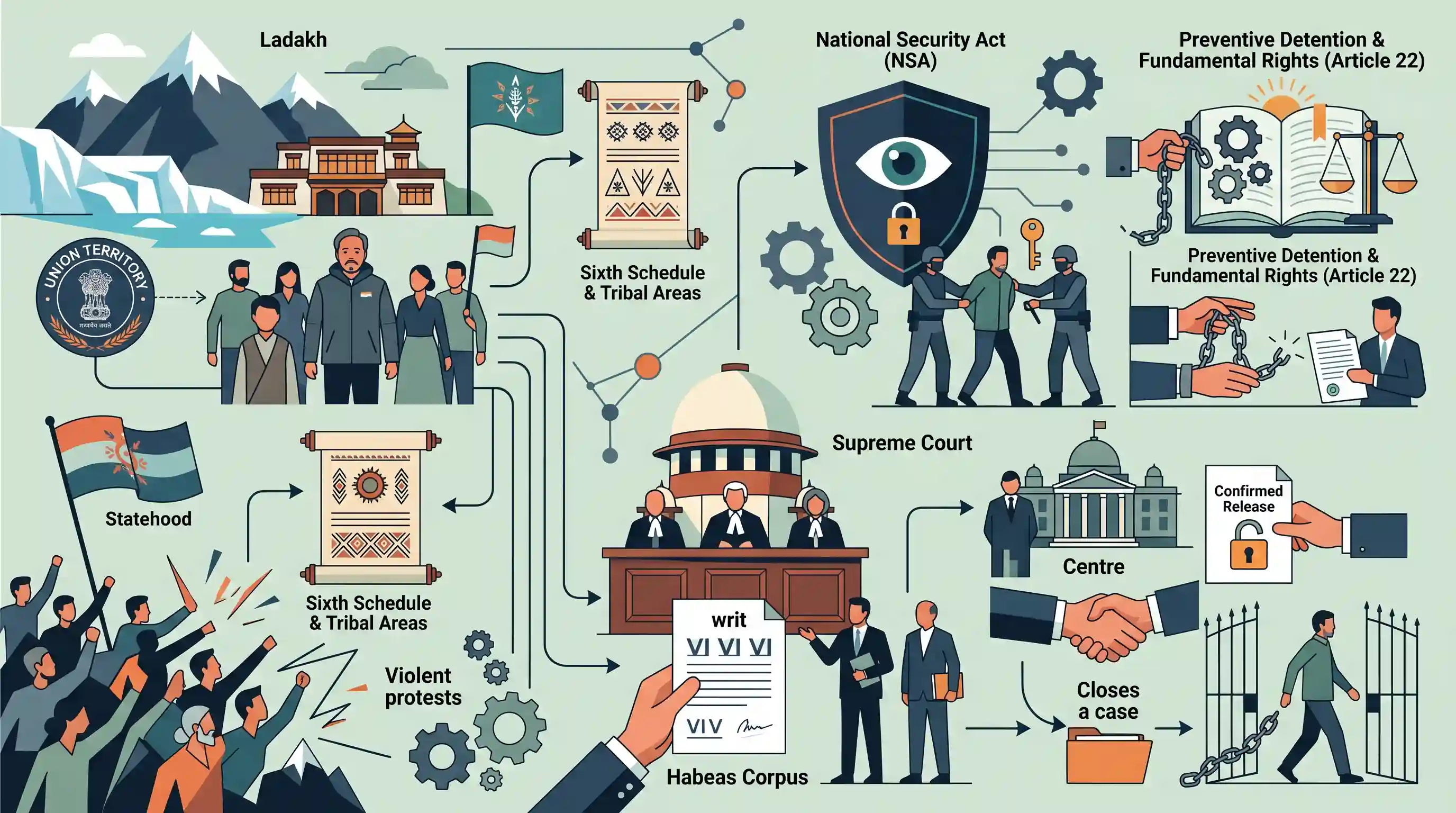
The Supreme Court has disposed of a habeas corpus petition challenging the detention of climate activist Sonam Wangchuk under the National Security Act (NSA), following his release from Jodhpur Central Jail on March 14. Wangchuk had been detained in September last year amidst violent protests in Ladakh over demands for full statehood and constitutional protection under the Sixth Schedule. With the Centre confirming his release, the bench deemed the case closed.
Key Points
- The Supreme Court disposed of a habeas corpus plea filed by Sonam Wangchuk's wife, which challenged his detention under the National Security Act (NSA).
- The Centre informed the Court that Wangchuk was released from Jodhpur Central Jail on March 14, rendering the plea infructuous.
- Wangchuk's detention in September last year followed violent protests in Ladakh demanding statehood and inclusion under the Sixth Schedule of the Constitution.
Important Terms
National Security Act (NSA), 1980

A 1980 law empowering the government to detain individuals without trial for up to 12 months to prevent actions prejudicial to national security or public order.
UPSC context
GS Paper II: Governance and Polity. Vital for questions on executive powers and internal security vs. civil liberties.
Sixth Schedule
Constitutional provisions (Articles 244(2) and 275(1)) for autonomous administration of tribal areas through councils; currently applicable in Assam, Meghalaya, Tripura, and Mizoram.
UPSC context
GS Paper II: Constitution and Governance. Critical for tribal administration and federalism-related topics.
Habeas Corpus
A prerogative writ ("to have the body") used by courts to determine the legality of a person's detention and order release if it is found unlawful.
UPSC context
GS Paper II: Fundamental Rights. Essential for understanding judicial remedies and Article 32.
Preventive Detention
The state practice of detaining individuals without trial based on the suspicion that they may commit future acts harmful to society or national security.
UPSC context
GS Paper II: Indian Constitution. Tests knowledge of exceptions to personal liberty and judicial safeguards.
Article 22
A constitutional provision offering protection against arrest and detention, laying down the procedural safeguards for both punitive and preventive detention cases.
UPSC context
GS Paper II: Fundamental Rights. Central to debates on personal liberty and the limits of state power.
Prelims Trap
Preventive detention under the National Security Act is constitutionally capped at 3 months, after which release is mandatory.
Article 22 allows detention beyond 3 months if an Advisory Board approves it. Under the statutory provisions of the NSA, a person can be detained for a maximum of 12 months.
Static Concepts Connected
What are the constitutional safeguards against preventive detention under Article 22?
- Advisory Board review: Detention cannot exceed three months unless an Advisory Board (comprising persons qualified as High Court judges) reports sufficient cause for extension.
- Grounds communication: The detaining authority must communicate the grounds of detention as soon as possible, except when disclosing facts is considered against public interest.
- Right to representation: The detenu must be afforded the earliest opportunity to make a representation against the detention order to the appropriate government.
What are the key administrative features of the Sixth Schedule?
- State applicability: Currently applies exclusively to tribal areas in four states: Assam, Meghalaya, Tripura, and Mizoram (AMTM), contrasting with the broader Fifth Schedule.
- Autonomous Councils: Empowers the creation of Autonomous District Councils (ADCs) equipped with legislative, judicial, and administrative autonomy over local land, forests, and resources.
- Governor's authority: The Governor holds the overarching power to organize, reorganize, alter boundaries, or dissolve these autonomous districts without requiring parliamentary legislation.
Cross-Topic Patterns
UT Administration vs Tribal Autonomy
Ladakh’s protests highlight the constitutional friction between centralized Union Territory administration (Article 239) and demands for decentralized tribal governance under the Sixth Schedule.
Habeas Corpus in National Security
While courts rarely review the executive's subjective satisfaction in NSA cases, Habeas Corpus acts as the crucial procedural check on Advisory Board timelines and fundamental rights compliance.

Expect a 2026 multi-statement question interlinking Article 22 preventive detention safeguards with Sixth Schedule state applicability.
Linked PYQs · 3
Linked PYQs · 3
- 2023PrelimsGS1
Consider the following statements: 1. According to the Constitution of India, the Central Government has a duty to protect States from internal disturbances. 2. The Constitution of India exempts the States from providing legal counsel to a person being held for preventive detention. 3. According to the Prevention of Terrorism Act, 2002, confession of the accused before the police cannot be used as evidence. How many of the above statements are correct?
- 2015PrelimsGS1
The provisions in Fifth Schedule and Sixth Schedule in the Constitution of India are made in order to
- 2025MainsGS2
Discuss the nature of Jammu and Kashmir Legislative Assembly after the Jammu and Kashmir Reorganization Act, 2019. Briefly describe the powers and functions of the Assembly of the Union Territory of Jammu and Kashmir.
