Supreme Court Criticizes FSSAI Over Food Warning Labels
Source:The Hindu ↗
Why It Matters
The issue underscores the critical role of statutory bodies like FSSAI in public health regulation and demonstrates how the judiciary uses Public Interest Litigation to compel executive and regulatory action when consumer health and fundamental rights are perceived to be compromised.
Summary
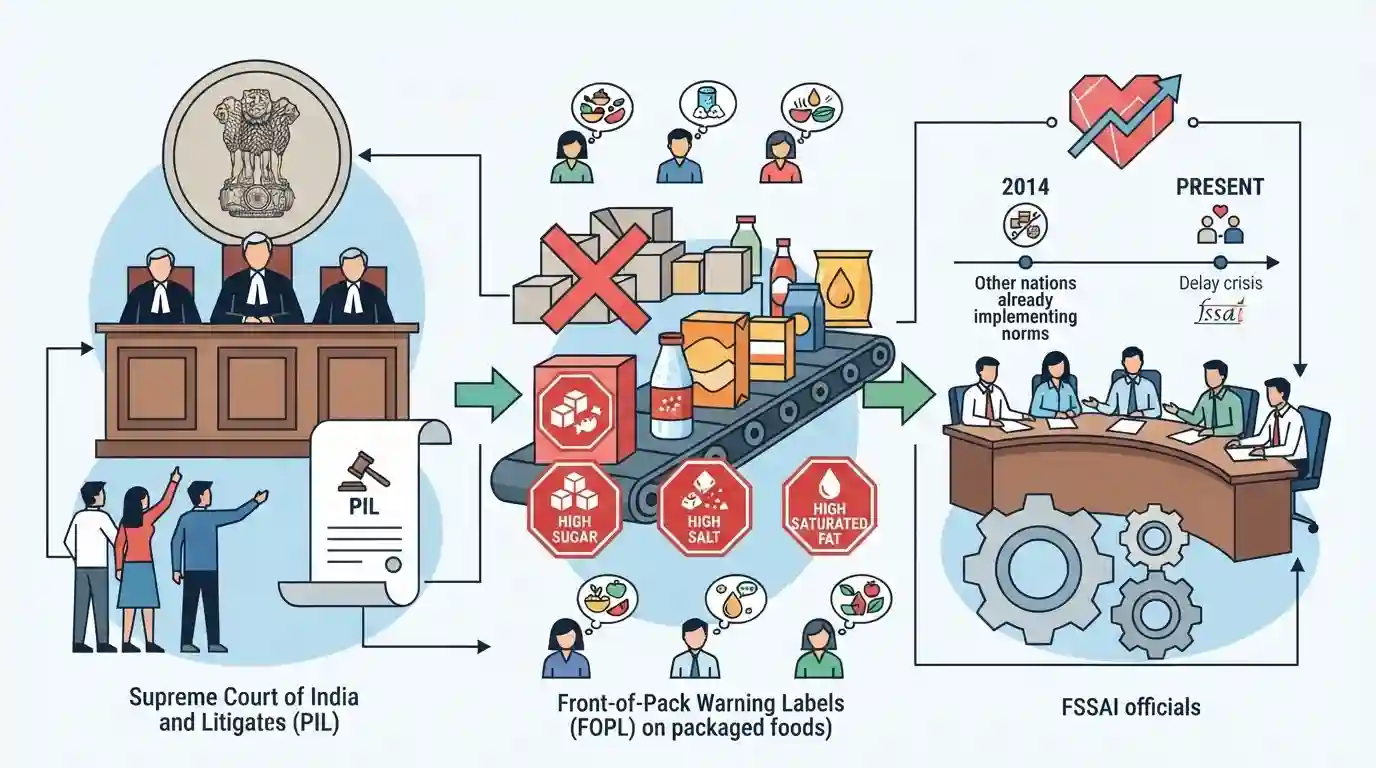
The Supreme Court of India reprimanded the Food Safety and Standards Authority of India (FSSAI) for its failure to implement front-of-pack warning labels (FOPL) on packaged foods. Hearing a PIL filed by the NGO 3S and Our Health Society, a Bench led by Justice J.B. Pardiwala questioned the statutory body's reluctance to mandate clear labels indicating high levels of sugar, salt, and saturated fat, noting that other nations have had similar norms since 2014. While FSSAI cited ongoing stakeholder consultations and the development of a star-rating system, the Court stressed that such regulatory delays are unacceptable given the rising burden of non-communicable diseases and the consumer's right to make informed health choices.
Key Points
- The Supreme Court strongly criticized the Food Safety and Standards Authority of India (FSSAI) for delaying the introduction of front-of-pack warning labels on packaged foods that indicate excess sugar, salt, and saturated fat.
- The court was hearing a Public Interest Litigation (PIL) by NGO 3S and Our Health Society, which argued that rising non-communicable diseases are linked to unhealthy packaged diets.
- FSSAI defended the delay by citing ongoing stakeholder consultations and the complexities of determining threshold values in coordination with the National Institute of Nutrition.
- The Court emphasized that many countries have implemented such norms since 2014, and FSSAI's continuous delays compromise the fundamental right to health and consumer awareness.
Important Terms
Food Safety and Standards Authority of India (FSSAI)

An autonomous statutory body established under the Ministry of Health and Family Welfare to regulate food manufacturing, storage, distribution, and import, ensuring safe and wholesome food for consumers.
UPSC context
GS2: Statutory Bodies & Health. Tests knowledge of the apex regulatory body's mandate, powers, and role in ensuring public health.
Food Safety and Standards Act, 2006
A comprehensive law that consolidated previous multi-departmental food regulations into a single framework. It established the FSSAI to set science-based standards and regulate India's entire food supply chain.
UPSC context
GS2: Governance. Crucial for understanding the transition from fragmented food laws to a unified regulatory framework governing food safety.
Indian Nutrition Rating (INR)
A proposed front-of-pack labelling system that assigns a rating from ½ star (unhealthiest) to 5 stars (healthiest) to pre-packaged foods based on their nutritional profile, including sugar and sodium content.
UPSC context
GS2: Issues related to Health. Relevant for questions on non-communicable disease prevention, public health interventions, and consumer rights.
National Institute of Nutrition (NIN)
A premier public health and translational research center under the Indian Council of Medical Research (ICMR). Located in Hyderabad, it conducts critical studies on food composition, malnutrition, and dietary guidelines.
UPSC context
GS2: Health; GS3: Science & Tech. Tests knowledge of key national research bodies guiding nutritional policies and dietary frameworks.
Prelims Trap
The FSSAI's proposed Indian Nutrition Rating (INR) system mandates explicit textual warning labels for foods high in salt, sugar, and fat.
The INR uses a 'Health Star Rating' (½ to 5 stars), not explicit warnings. The Supreme Court and health advocates are demanding explicit warning labels precisely because star ratings are inadequate.
Static Concepts Connected
What is the statutory basis and administrative structure of FSSAI?
- Statutory Origin: Established under the Food Safety and Standards Act, 2006, consolidating older laws like the Prevention of Food Adulteration Act, 1954.
- Nodal Ministry: Functions under the Ministry of Health and Family Welfare (MoHFW), NOT the Ministry of Consumer Affairs.
- Core Mandate: Regulates food manufacture, storage, distribution, sale, and import based on science-backed standards to ensure safe and wholesome food for human consumption.
How does this case illustrate Judicial Activism vs. Judicial Overreach?
- Judicial Activism: Intervening via PIL to protect Article 21 (Right to Health) by pushing a dormant regulatory body to address rising public health threats like NCDs.
- Boundary of Overreach: Dictating specific nutritional thresholds or exact label designs would cross into executive overreach, as such standards require expert input (e.g., from the National Institute of Nutrition).
Cross-Topic Patterns
MSME economics vs. Public Health regulations
Strict warning thresholds face pushback because traditional Indian foods are naturally high in salt/fat. This bridges GS-2 public health policies with GS-3 economic challenges for MSME food processors.
The Double Burden of Malnutrition & NCDs
India faces undernutrition alongside rising obesity and non-communicable diseases (NCDs). FOPL connects directly to GS-2 health targets aiming to curb lifestyle diseases driven by ultra-processed diets.

Expect a Prelims statement contrasting FSSAI's 'Health Star Rating' with 'Warning Labels', or a GS-2 Mains Q on judicial activism in health.
Linked PYQs · 5
Linked PYQs · 5
- 2018PrelimsGS1
Consider the following statements: 1. The Food Safety and Standards Act, 2006 replaced the Prevention of Food Adulteration Act, 1954. 2. The Food Safety and Standards Authority of India (FSSAI) is under the charge of Director General of Health Services in the Union Ministry of Health and Family Welfare. Which of the statements given above is/are correct?
- 2024MainsGS2
Explain the reasons for the growth of public interest litigation in India. As a result of it, has the Indian Supreme Court emerged as the world's most powerful judiciary ?
- 2020MainsGS2
Judicial Legislation is antithetical to the doctrine of separation of powers as envisaged in the Indian Constitution. In this context justify the filing of large number of public interest petitions praying for issuing guidelines to executive authorities.
- 2024MainsGS2
Poverty and malnutrition create a vicious cycle, adversely affecting human capital formation. What steps can be taken to break the cycle ?
- 2020MainsGS2
In order to enhance the prospects of social development, sound and adequate health care policies are needed particularly in the fields of geriatric and maternal health care. Discuss.
