Supreme Court takes cognisance of rising digital arrest cyber scams
Source:The Hindu ↗
Why It Matters
The staggering financial loss and use of AI-driven deepfakes illustrate the evolving nature of cyber threats. It emphasizes the need for GS-3 aspirants to understand the intersection of advanced technology, transnational organized crime, money laundering, and the institutional frameworks (like CBI and CERT-In) required to combat them.
Summary
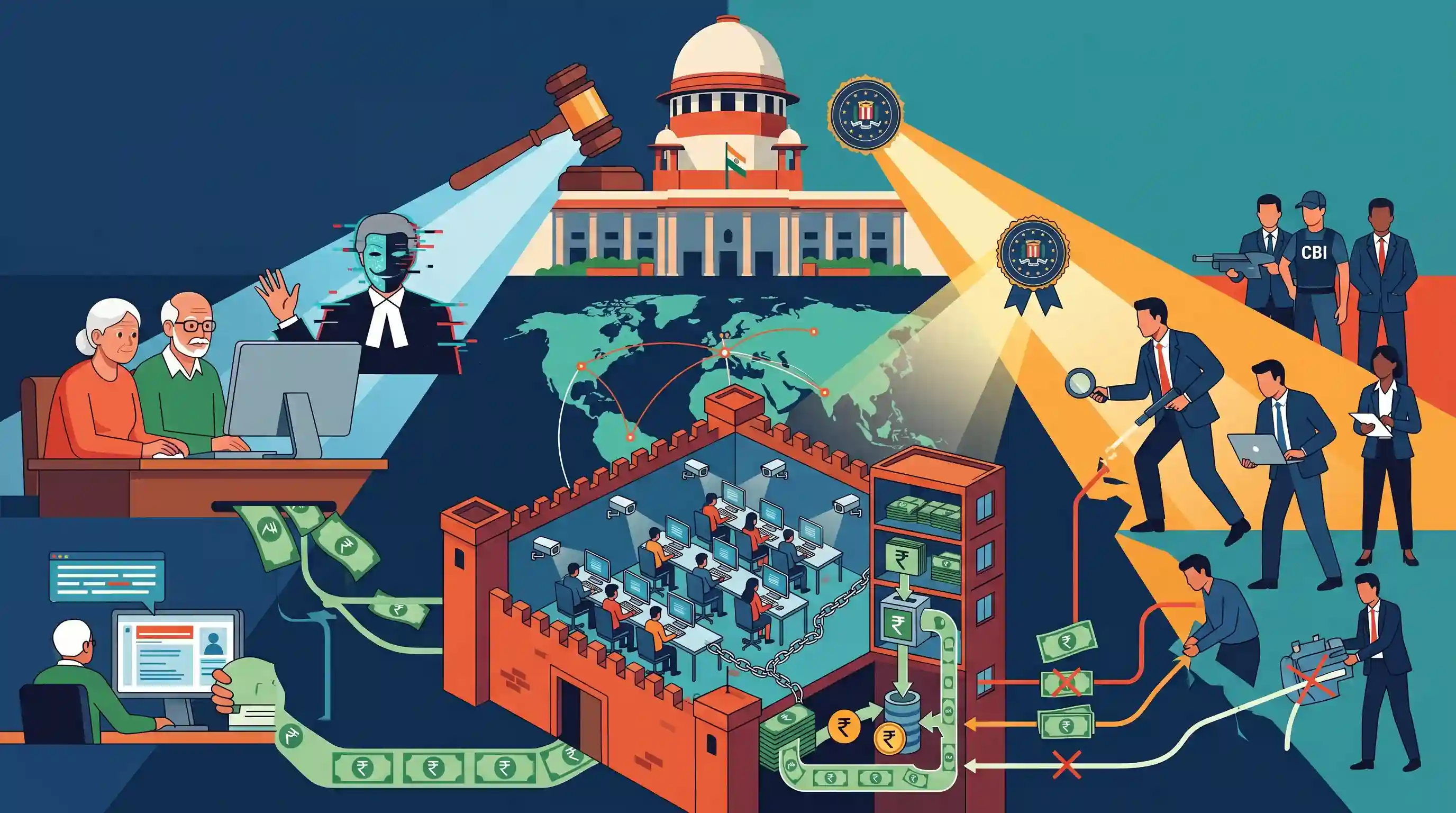
The Supreme Court has expressed profound concern over the escalating menace of 'digital arrest' scams, which have defrauded Indians—mostly senior citizens—of over ₹3,000 crore. Fraudsters utilize Artificial Intelligence to impersonate law enforcement officials and judges from morphed, realistic-looking courtrooms to extort money. According to the Union Government, these organized operations are often run by cross-border money-laundering gangs operating out of 'scam compounds', where individuals trafficked under the guise of foreign employment are forced to act as cyber-slaves. Recognizing the severe financial and human impact, the apex court has considered tasking the Central Bureau of Investigation (CBI) with investigating the widespread cybercrime network and promised stringent orders to empower investigating agencies.
Key Points
- The Supreme Court took suo motu cognisance of 'digital arrest' scams after a senior citizen couple in Ambala was defrauded of ₹1.05 crore using forged court orders.
- A confidential government report revealed that fraudsters have extorted over ₹3,000 crore from victims in India, predominantly targeting the elderly.
- Criminals use Artificial Intelligence to create convincing deepfakes of judges, police officers, and courtrooms to execute these sophisticated extortion attempts.
- Top government legal officers noted that these organized cybercrimes originate from cross-border 'scam compounds' run by money-laundering syndicates.
- The scams also involve a human trafficking element, as individuals lured by fake foreign jobs are coerced into working in these illicit scam compounds.
- The Supreme Court has emphasized the need for stringent measures and is considering tasking the CBI with a comprehensive probe to tackle the global menace.
Important Terms
Digital Arrest

A cybercrime technique where fraudsters impersonate law enforcement officials via video calls, psychologically trapping victims in 'virtual custody' to extort money through false criminal accusations.
UPSC context
GS Paper 3: Cyber Security; relevant for internal security challenges and emerging digital threats.
Indian Cyber Crime Coordination Centre (I4C)
The nodal agency under the Ministry of Home Affairs tasked with providing a coordinated framework for law enforcement to combat cybercrimes across India.
UPSC context
GS Paper 3: Internal Security; essential for institutional measures against organized crime.
Central Bureau of Investigation (CBI)
India's premier investigating agency, functioning under the Ministry of Personnel, recently granted pan-India jurisdiction by the Supreme Court to probe organized 'digital arrest' networks.
UPSC context
GS Paper 2: Statutory and Non-statutory bodies; tests knowledge of central agencies and jurisdictional reach.
CERT-In
The national agency for responding to computer security incidents (malware, hacking), operating under the Ministry of Electronics and Information Technology.
UPSC context
GS Paper 3: Cyber Security; fundamental for questions on India's technical cyber defense infrastructure.
Mule Account
A bank account used by criminals to receive and transfer illicitly obtained funds, helping to hide the identity of the primary fraudster.
UPSC context
GS Paper 3: Money Laundering; critical concept in financial crime and internal security.
Money Laundering
The process of concealing the origins of money obtained through illegal activities to make it appear legitimate, often involving placement, layering, and integration.
UPSC context
GS Paper 3: Internal Security; essential for understanding the financial backbone of transnational organized crime.
Prelims Trap
'Digital arrest' is a legal preventive detention provision under the IT Act for cyber-terror suspects.
'Digital arrest' has no legal basis in Indian law. It is merely a deceptive extortion tactic used by cybercriminals, not a statutory power of law enforcement agencies.
Static Concepts Connected
What is the mandate of the Indian Cyber Crime Coordination Centre (I4C)?
- MHA Nodal Body: Established under the Ministry of Home Affairs (MHA) to act as a nodal point for combating cybercrime in a coordinated and comprehensive manner.
- Key Initiatives: Operates the National Cyber Crime Reporting Portal, Helpline 1930, and joint cybercrime investigation teams to tackle inter-state and cross-border frauds.
What are the jurisdictional rules for the CBI regarding cybercrimes?
- State Consent: Derives power from the Delhi Special Police Establishment (DSPE) Act. Normally requires general or specific consent from state governments to investigate within their territorial jurisdiction.
- Constitutional Directives: The Supreme Court or High Courts can direct the CBI to investigate any crime anywhere in the country without the consent of the respective state government.
- INTERPOL Nodal Agency: CBI serves as the National Central Bureau for INTERPOL in India, making it the nodal agency for cross-border crime coordination.
Cross-Topic Patterns
Cyber-slavery and SE Asia's Golden Triangle
Fraud syndicates increasingly operate from conflict zones in SE Asia (Myanmar, Laos, Cambodia), blurring the lines between new-age cyber-extortion and traditional human trafficking.
AI Deepfakes intersecting with Money Laundering
Deepfakes have evolved beyond privacy and electoral disinformation threats; they are now primary vectors for organized financial crimes, necessitating action under the Prevention of Money Laundering Act (PMLA).

Expect a 2026 Prelims question linking I4C's mandate, the legality of 'digital arrests', and CBI's jurisdiction via Interpol.
Linked PYQs · 5
Linked PYQs · 5
- 2020MainsGS3
Discuss different types of cyber crimes and measures required to be taken to fight the menace.
- 2021MainsGS3
Keeping in view India's internal security, analyse the impact of cross-border cyber attacks. Also discuss defensive measures against these sophisticated attacks.
- 2023MainsGS3
Introduce the concept of Artificial Intelligence (AI). How does Al help clinical diagnosis? Do you perceive any threat to privacy of the individual in the use of Al in healthcare?
- 2021MainsGS3
Discuss how emerging technologies and globalisation contribute to money laundering. Elaborate measures to tackle the problem of money laundering both at national and international levels.
- 2021MainsGS2
The jurisdiction of the Central Bureau of Investigation (CBI) regarding lodging an FIR and conducting probe within a particular State is being questioned by various States. However, the power of the States to withhold consent to the CBI is not absolute. Explain with special reference to the federal character of India.
