Supreme Court Notice on Shiv Sena MPs Merger and Anti Defection Law
Source:Indian Express ↗
Why It Matters
This development is highly relevant for GS Paper 2 as it touches upon ongoing debates surrounding the Tenth Schedule, the phenomenon of political defections disguised as mergers, and the procedural authority of the Speaker's office. It also brings the concept of 'Constitutional Morality' into focus, asking whether elected representatives are bound by the mandate of the symbol/party they were elected under.
Summary
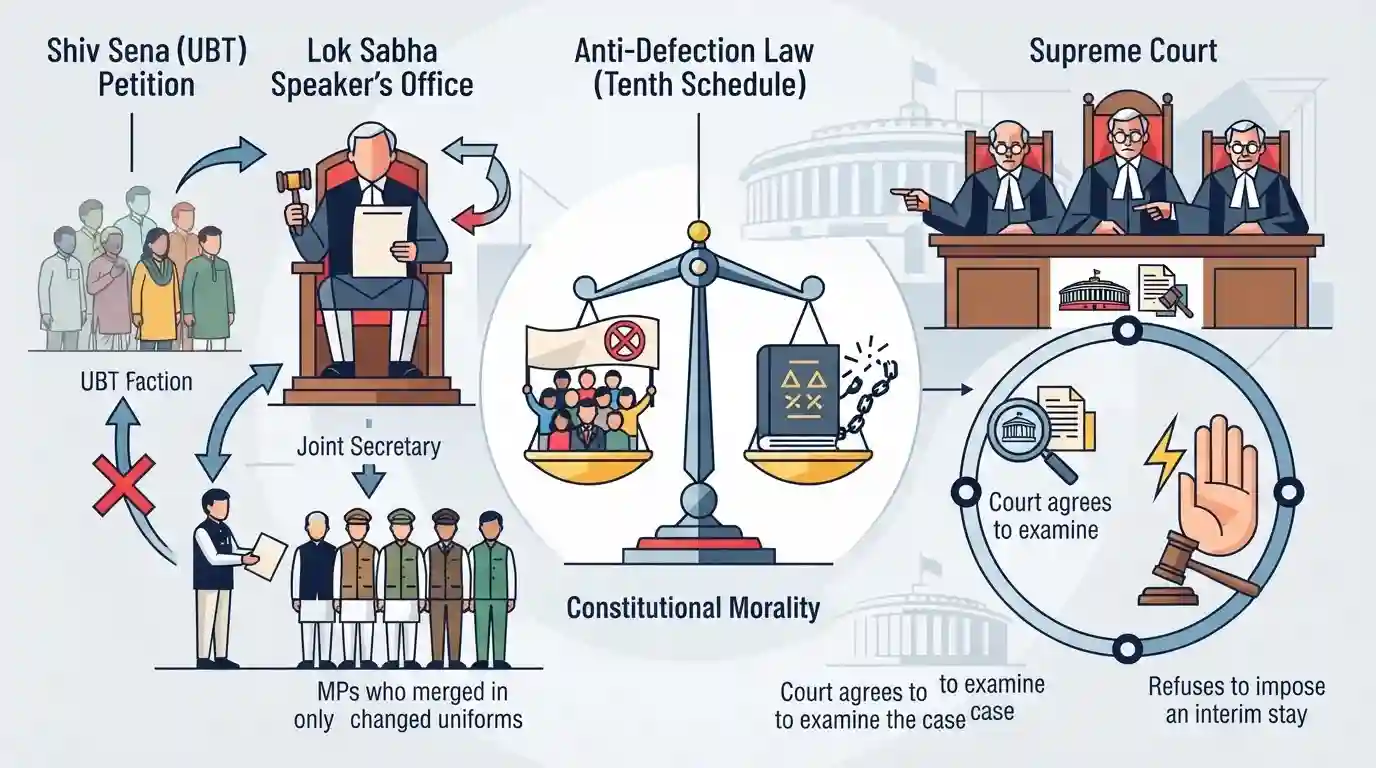
The Supreme Court has sought a response from the Lok Sabha Speaker's office concerning a petition filed by the Shiv Sena (UBT) faction. The petition challenges the official recognition of the merger of six of its MPs into the Eknath Shinde-led Shiv Sena. Petitioners argue that the merger is unconstitutional, bypasses the Anti-Defection Law (Tenth Schedule), and violates "constitutional morality" by betraying the electorate's mandate. Furthermore, the petition challenges the propriety of the merger order being issued by a Joint Secretary of the Lok Sabha Secretariat rather than the Speaker. While the Court agreed to examine the matter, it declined to impose an interim stay on the Speaker's recognition of the merger.
Key Points
- The Supreme Court has issued a notice seeking a response from the Lok Sabha Speaker regarding the merger of six Shiv Sena (UBT) MPs with the Eknath Shinde-led faction.
- The petition argues the merger is unconstitutional and violates the Tenth Schedule (Anti-Defection Law), asserting the MPs betrayed the mandate of the electorate who voted for them under the UBT symbol.
- The petitioners highlighted that the order recognizing the merger was signed by a Joint Secretary of the Lok Sabha Secretariat rather than the Speaker himself, questioning its validity.
- The Supreme Court bench, led by CJI Sanjiv Khanna, refused to grant an interim stay on the Speaker's decision while agreeing to examine the constitutional issues raised.
- The case centers on principles of 'constitutional morality' and the balance between representative democracy and party mandates.
Important Terms
Tenth Schedule

Added by the 52nd Amendment in 1985, this constitutional schedule contains provisions for disqualifying members of Parliament and state legislatures on the grounds of defection.
UPSC context
GS Paper II (Polity); tests understanding of legislative stability, defection exceptions (mergers), and the Speaker's adjudicatory powers.
Anti-Defection Law
A legal framework designed to prevent political defections by penalizing legislators who switch parties after being elected, aiming to maintain government stability and uphold electoral mandates.
UPSC context
GS Paper II (Polity); evaluates the law's performance, challenges, role in parliamentary democracy, and judicial reviews.
Supreme Court of India
The highest judicial court and final court of appeal under the Indian Constitution, possessing original, appellate, and advisory jurisdictions with the power of judicial review.
UPSC context
GS Paper II (Judiciary); tests constitutional interpretation, judicial review of legislative/executive actions, and the separation of powers.
Lok Sabha
The lower house of India’s bicameral Parliament, representing the public through directly elected members who draft laws and hold the executive government accountable.
UPSC context
GS Paper II (Parliament); tests the structure, powers, legislative processes, and executive accountability of the lower house.
Election Commission of India
An autonomous constitutional authority responsible for administering Union and State election processes in India, ensuring free, fair, and credible elections.
UPSC context
GS Paper II (Constitutional Bodies); tests the powers, role, and challenges of overseeing elections and political party recognition.
Prelims Trap
A faction of two-thirds of a legislature party can merge with another party without any merger of the original political party.
Paragraph 4 requires a dual-test: the original political party must merge, AND at least two-thirds of the legislature party members must agree to it. One cannot happen legally without the other.
Static Concepts Connected
What is the dual-test for merger exemption under the Tenth Schedule?
- Original Party Merger: The original political party must merge with another political party.
- Legislative Consensus: At least two-thirds of the legislature party members in the House must agree to the merger.
- Constitutional Protection: Disqualification is waived only when both conditions are cumulatively satisfied.
How did Kihoto Hollohan (1992) define judicial review of the Speaker's decisions?
- Quasi-Judicial Tribunal: The Speaker acts as a tribunal, making final decisions subject to judicial review.
- Limited Intervention: Review is restricted to mala fides, perversity, constitutional violations, or jurisdictional errors.
- No Premature Stay: Courts cannot intervene at interlocutory stages before the Speaker passes a final order.
Cross-Topic Patterns
Separation of powers vs Judicial review
How the Speaker's tribunal status under the Tenth Schedule overrides standard Article 122 immunity, enabling judicial review of internal legislative actions.
Representative democracy vs Party whips
The tension between an MP's constitutional duty to the electorate's mandate versus the strict anti-defection penalties enforcing rigid political party discipline.

Dual-test of Paragraph 4 (Tenth Schedule) combined with the Speaker's administrative delegation limits will likely feature in Prelims 2026.
Linked PYQs · 5
Linked PYQs · 5
- 2021MainsGS2
‘Constitutional Morality’ is rooted in the Constitution itself and is founded on its essential facets. Explain the doctrine of ‘Constitutional Morality’ with the help of relevant judicial decisions.
- 2025MainsGS2
"Constitutional morality is the fulcrum which acts as an essential check upon the high functionaries and citizens alike...." In view of the above observation of the Supreme Court, explain the concept of constitutional morality and its application to ensure balance between judicial independence and judicial accountability in India.
- 2020MainsGS2
Once a Speaker, Always a Speaker' ! Do you think this practice should be adopted to impart objectivity to the office of the Speaker of Lok Sabha ? What could be its implications for the robust functioning of parliamentary business in India?
- 2025PrelimsGS1
Consider the following statements : I. If any question arises as to whether a Member of the House of the People has become subject to disqualification under the 10th Schedule, the President's decision in accordance with the opinion of the Council of Union Ministers shall be final. II. There is no mention of the word 'political party' in the Constitution of India. Which of the statements given above is/are correct?
- 2025PrelimsGS1
Consider the following statements : I. On the dissolution of the House of the People, the Speaker shall not vacate his/her office until immediately before the first meeting of the House of the People after the dissolution. II. According to the provisions of the Constitution of India, a Member of the House of the People on being elected as Speaker shall resign from his/her political party immediately. III. The Speaker of the House of the People may be removed from his/her office by a resolution of the House of the People passed by a majority of all the then Members of the House, provided that no resolution shall be moved unless at least fourteen days' notice has been given of the intention to move the resolution. Which of the statements given above are correct?
