Legal distinction between human trafficking and voluntary sex work
Source:Indian Express ↗
Why It Matters
The Supreme Court's intervention provides critical constitutional clarity regarding the rights of vulnerable groups by distinguishing between voluntary sex work and human trafficking. It emphasizes the role of Article 142 in addressing legislative vacuums and directly relates to the Right against Exploitation (Article 23), setting a precedent for systemic reforms in law enforcement and amending the Immoral Trafficking Prevention Act.
Summary
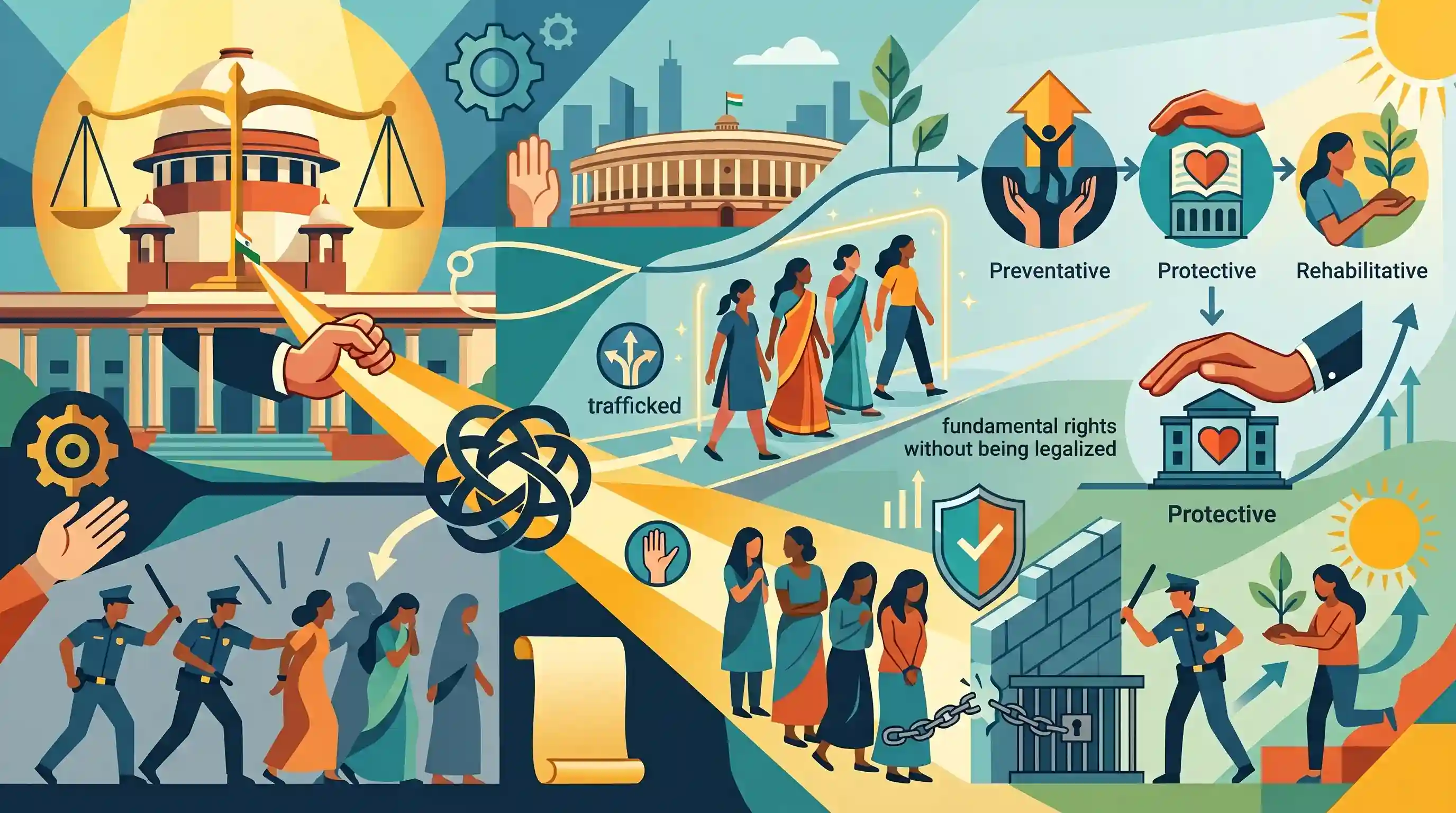
The Supreme Court of India has directed the government to frame a comprehensive law distinguishing between 'voluntary' sex workers and trafficked individuals, explicitly exempting trafficked victims from criminal charges. Using its extraordinary powers under Article 142, the Court proposed a 'Victim Protection Plan' encompassing preventive, protective, and rehabilitative measures for victims of trafficking for commercial sexual exploitation (CSE). The ruling highlighted that the fundamental rights of sex workers can exist independent of a legalized 'right to sex work.' It also criticized the Immoral Trafficking Prevention Act (ITPA) for conflating trafficking and prostitution, which leads to the marginalization of voluntary sex workers and subjects victims to police abuse.
Key Points
- The Supreme Court invoked its extraordinary powers under Article 142 to formulate a 'Victim Protection Plan' for individuals trafficked for commercial sexual exploitation (CSE).
- The Court directed the government to enact a new, comprehensive law that clearly distinguishes between 'voluntary' sex workers and trafficked victims.
- The judgment held that trafficked sex workers must be exempted from criminal charges to prevent their secondary victimization.
- The Court criticized the existing Immoral Trafficking Prevention Act (ITPA) for conflating prostitution with human trafficking, a flaw that disproportionately harms voluntary sex workers.
- Magistrates are mandated to conduct a threshold inquiry to identify voluntary sex workers, ensuring they are not involuntarily confined to long-term safe custody.
- The ruling underscored that the 'rights of sex workers can exist without there being a right to sex work,' demanding protective measures against police abuse and affirming the fundamental dignity of sex workers.
Important Terms
Immoral Traffic (Prevention) Act (ITPA), 1956

India's primary law aimed at curbing human trafficking for sexual exploitation; it criminalizes brothel-keeping and pimping while distinguishing between commercial exploitation and voluntary sex work.
UPSC context
GS Paper II (Social Justice/Vulnerable Sections); essential for understanding legal protections for women and children.
Article 142 of the Constitution
Constitutional provision granting the Supreme Court extraordinary power to pass any decree or order necessary to ensure "complete justice" where existing laws may be silent or inadequate.
UPSC context
GS Paper II (Judiciary/Polity); key for topics on judicial activism and separation of powers.
Victim Protection Plan
A Supreme Court-proposed framework (2026) focusing on the rescue, identification, and rehabilitation of trafficked persons, ensuring they are not prosecuted as criminals for prostitution-related activities.
UPSC context
GS Paper II (Social Justice/Judiciary); illustrates the court's intervention in policy-making for marginalized groups.
Commercial Sexual Exploitation (CSE)
The use of individuals for sexual acts in exchange for payment, involving coercion, force, or trafficking; it is considered a severe violation of human rights.
UPSC context
GS Paper I (Society) and II (Social Justice); critical for essays and questions on human trafficking.
Article 21 of the Constitution
A fundamental right guaranteeing life and personal liberty; interpreted by the judiciary to include the right to live with human dignity and access to rehabilitation.
UPSC context
GS Paper II (Fundamental Rights); the bedrock for legal arguments regarding the dignity of vulnerable sections.
Prelims Trap
Prostitution and voluntary sex work are explicitly criminalised under the Immoral Traffic (Prevention) Act.
Prostitution per se is not a crime in India. The ITPA only penalizes commercialized, organized aspects like running brothels, pimping, and soliciting in public places.
Static Concepts Connected
What is the scope of the Supreme Court's power under Article 142?
- Complete Justice: Empowers the Supreme Court to pass any decree or make any order necessary for doing "complete justice" in any pending cause or matter.
- Legislative Vacuum: Extensively used to lay down guidelines (like the Vishaka guidelines) when there is an absence of executive or legislative action on critical issues.
- Limitations: It is an equitable power that supplements the law, but it cannot be used to supplant substantive statutory law or violate fundamental rights.
What are the constitutional protections against human trafficking in India?
- Article 23: Prohibits "traffic in human beings", begar, and forced labor. This is an absolute right enforceable against both the State and private citizens.
- Article 35: Empowers Parliament (not state legislatures) to make laws punishing acts prohibited under Article 23, leading to the enactment of ITPA, 1956.
Cross-Topic Patterns
Decriminalization of marginalized identities
Mirrors the Navtej Johar (Section 377) and NALSA rulings, emphasizing that fundamental dignity under Article 21 cannot be denied due to societal moral panic or lack of legal recognition.
Judicial legislation via Article 142
The formulation of a 'Victim Protection Plan' mirrors the Vishaka Guidelines, where the SC proactively fills legislative voids regarding women's safety until Parliament enacts a formal law.

A 2026 Prelims question will likely contrast ITPA provisions with Article 23, specifically testing if voluntary sex work is explicitly illegal.
Linked PYQs · 4
Linked PYQs · 4
- 2023MainsGS2
Explain the constitutional perspectives of Gender Justice with the help of relevant Constitutional Provisions and case laws.
- 2024MainsGS1
Despite comprehensive policies for equity and social justice, underprivileged sections are not yet getting the full benefits of affirmative action envisaged by the Constitution. Comment.
- 2017PrelimsGS1
Which of the following are envisaged by the Right against Exploitation in the Constitution of India? 1. Prohibition of traffic in human beings and forced labour 2. Abolition of untouchability 3. Protection of the interests of minorities 4. Prohibition of employment of children in factories and mines Select the correct answer using the code given below:
- 2023MainsGS2
“Constitutionally guaranteed judicial independence is a prerequisite of democracy.” Comment.
