Supreme Court Sets Deadline for State Bar Council Elections
Source:The Hindu ↗
Why It Matters
Demonstrates the Supreme Court's role in enforcing democratic accountability within statutory professional bodies (Bar Councils) and underscores the tension between necessary regulatory exercises (weeding out fake degrees) and statutory electoral mandates.
Summary
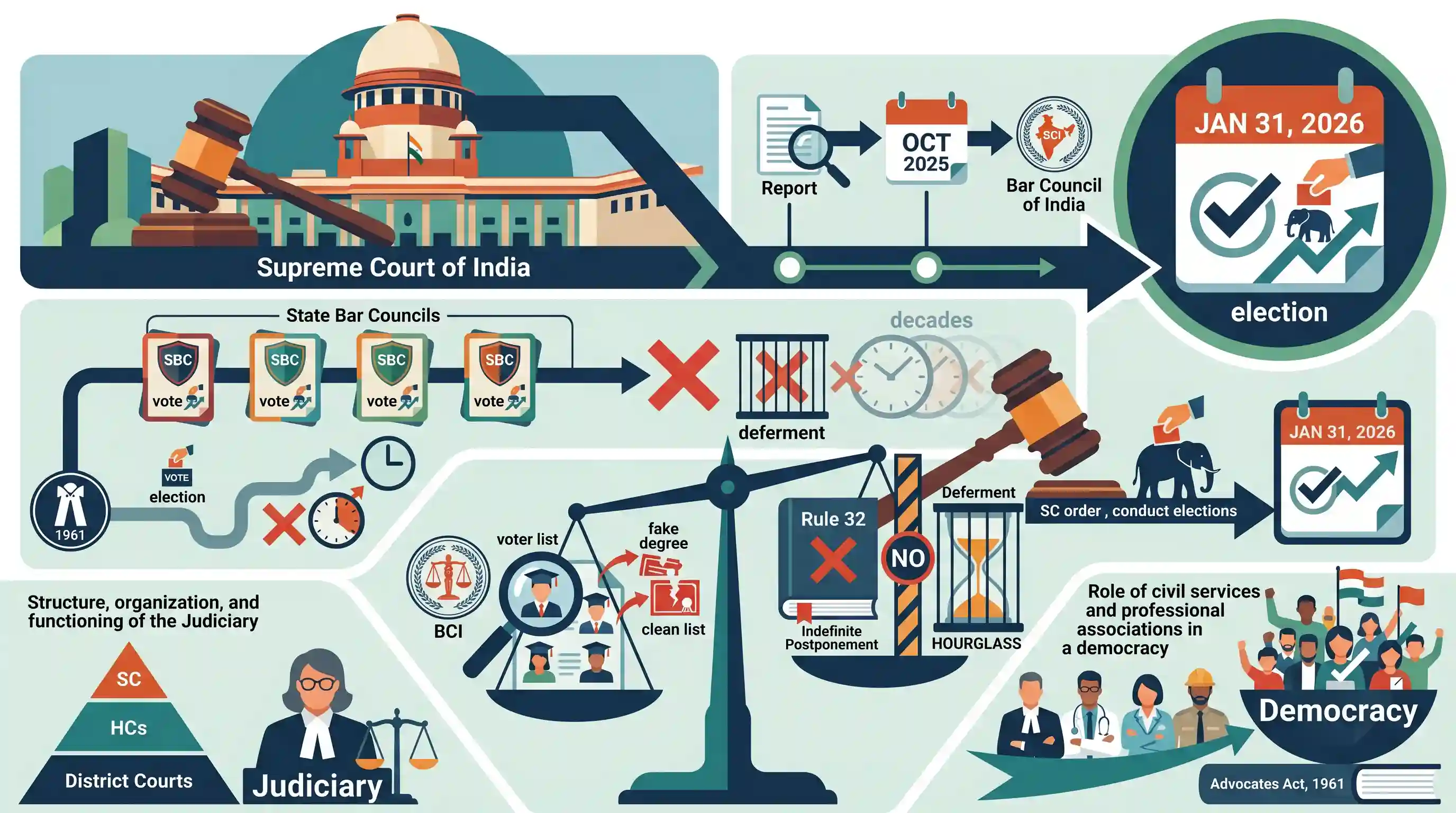
The Supreme Court has set a strict deadline of January 31, 2026, for conducting pending State Bar Council elections across India, addressing delays that have persisted for decades in some states. The Court directed the Bar Council of India (BCI) to report non-compliant councils by October 2025. While the Court acknowledged the necessity of the BCI's ongoing degree verification drive to eliminate individuals with fake legal qualifications, it explicitly ruled that this administrative exercise cannot justify indefinite election deferments. The judicial intervention arises from petitions challenging the BCI's invocation of Rule 32 of its 2015 Verification Rules to extend tenures beyond the statutory limits prescribed by the Advocates Act, 1961.
Key Points
- The Supreme Court mandated that elections for all State Bar Councils must be completed by January 31, 2026, to address decades-long delays.
- The Bar Council of India (BCI) is required to submit a status report by October 31, 2025, identifying State Bar Councils unwilling or unable to conduct elections.
- The Court clarified that the ongoing verification drive to weed out fake law degrees and individuals with criminal backgrounds cannot be used as a pretext to indefinitely delay elections.
- Petitions are challenging Rule 32 of the 2015 BCI Verification Rules, which allegedly allows the BCI to extend members' tenures beyond the limits set by the Advocates Act, 1961.
- Failure to meet the election deadline may result in the Supreme Court appointing a retired High Court judge as a commissioner to oversee the electoral process.
Important Terms
Bar Council of India (BCI)

A statutory body established under the Advocates Act, 1961, that regulates the legal profession and education in India, setting standards for professional conduct and accrediting law universities.
UPSC context
GS Paper II: Statutory, regulatory and various quasi-judicial bodies. Tests understanding of professional regulation and judicial administration.
State Bar Councils
Statutory entities established at the state level under the Advocates Act, 1961, responsible for enrolling advocates, maintaining state-wise rolls, and exercising initial disciplinary control over legal practitioners.
UPSC context
GS Paper II: Structure, organization, and functioning of the Judiciary and related regulatory bodies.
Advocates Act, 1961
The primary legislation governing the legal profession in India, which unified various classes of practitioners into a single class of 'Advocates' and created a self-regulating framework through Bar Councils.
UPSC context
GS Paper II: Important aspects of governance, transparency, and accountability; also relevant to legal and judicial reforms.
BCI Certificate and Place of Practice (Verification) Rules, 2015
A regulatory framework enacted by the BCI to verify advocates' degrees and practice status, aimed at weeding out fake or non-practicing individuals from electoral rolls and active legal practice.
UPSC context
GS Paper II: Government policies and interventions for development in various sectors and issues arising out of their implementation.
Rule 32 (Verification Rules)
A specific provision in the 2015 Verification Rules that empowers the BCI to extend the statutory tenure of State Bar Councils to complete degree verification and electoral roll preparation.
UPSC context
GS Paper II: Regulatory bodies and the balance between administrative discretion and statutory timelines.
Prelims Trap
The Bar Council of India is a constitutional body headed by the Attorney General of India.
BCI is a statutory body under the Advocates Act, 1961. The Attorney General and Solicitor General are ex-officio members, but the Chairman is elected.
Static Concepts Connected
What is the statutory mandate and composition of the Bar Council of India (BCI)?
- Statutory Origin: Established under the Advocates Act, 1961 to regulate legal practice and legal education across India.
- Composition: Includes elected representatives from various State Bar Councils, alongside the Attorney General and Solicitor General as ex-officio members.
- Core Functions: Prescribes standards for professional conduct, legal education, and recognizes university degrees qualifying students for advocate enrolment.
Can subordinate rules override the provisions of their parent statute?
- Ultra Vires doctrine: Subordinate or delegated legislation (like BCI rules) cannot extend powers or tenures beyond the statutory limits prescribed by the parent Act.
- Judicial Review: Courts can strike down or restrict administrative rules if they act contrary to primary legislative intent, such as bypassing mandated election timelines.
Cross-Topic Patterns
Regulatory overlap in higher education
BCI's mandate to set legal education standards often intersects with UGC's broader higher education policies, a theme highly relevant to the proposed Higher Education Commission of India (HECI).
Judicial enforcement of statutory elections
The SC routinely uses its jurisdiction to enforce democratic functioning within statutory bodies and local governments when administrative exercises are used as pretexts to bypass mandatory statutory tenures.

Expect a 2026 prelims statement comparing BCI's statutory structure (AG as ex-officio) with other regulators like the Medical Commission.
Linked PYQs · 2
Linked PYQs · 2
- 2022PrelimsGS1
With reference to India, consider the following statements: 1. Government law officers and legal firms are recognised as advocates, but corporate lawyers and patent attorneys are excluded from recognition as advocates. 2. Bar Councils have the power to lay down the rules relating to legal education and recognition of law colleges. Which of the statements given above is/are correct?
- 2024MainsGS2
What are the aims and objects of recently passed and enforced, The Public Examination (Prevention of Unfair Means) Act, 2024? Whether University/State Education Board examinations, too, are covered under the Act ?
