Supreme Court Sets Aside NCLAT Order on Amazon Future Deal
Source:The Hindu ↗
Why It Matters
This case highlights the functioning and regulatory reach of the Competition Commission of India (CCI) in scrutinizing corporate deals and ensuring market fairness. It also underscores the appellate mechanism involving the NCLAT and the Supreme Court, which is vital for understanding the resolution of high-profile corporate disputes and the regulatory environment for multinational corporations operating in India.
Summary
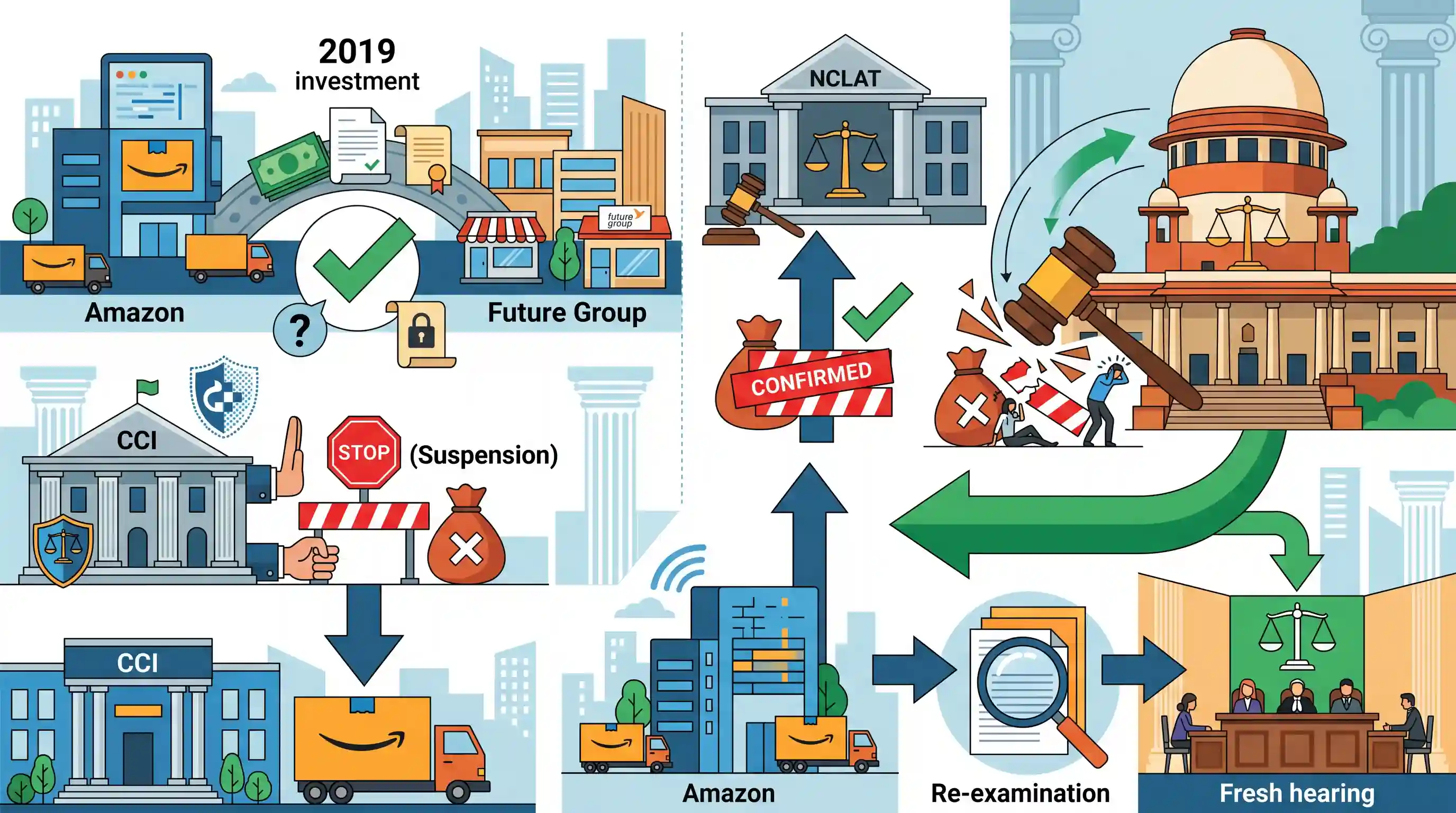
The Supreme Court has set aside a National Company Law Appellate Tribunal (NCLAT) order that upheld the Competition Commission of India’s (CCI) decision to suspend Amazon's 2019 investment deal with Future Group. The CCI had previously suspended its approval and imposed a penalty on Amazon, alleging that the e-commerce giant withheld information regarding its intent to secure a strategic stake in Future Retail. The Supreme Court has now quashed the CCI's original penalty order and directed the antitrust regulator to re-examine Amazon's notification and provide the company a fresh hearing.
Key Points
- The Supreme Court set aside the NCLAT's June 2022 order that had rejected Amazon's appeal against an anti-trust suspension of its investment deal with Future Group.
- The apex court also set aside the December 2021 CCI order that suspended its 2019 approval for the deal and penalized Amazon ₹202 crore for alleged non-disclosure of material facts.
- The CCI originally asserted that Amazon had failed to notify the regulatory body of its primary objective—to acquire a strategic stake in Future Retail Limited (FRL) through its investment in Future Coupons Private Limited (FCPL).
- The Supreme Court has now remanded the matter to the CCI for a fresh hearing, directing it to re-examine Amazon's notification and give the company an opportunity to present its case.
Important Terms
Competition Commission of India (CCI)

A statutory, quasi-judicial body under the Ministry of Corporate Affairs responsible for enforcing the Competition Act, 2002, preventing anti-competitive practices, and regulating mergers to ensure market fairness.
UPSC context
GS Paper II (Statutory Bodies) and GS Paper III (Indian Economy). Tests knowledge of regulatory frameworks and market regulation.
National Company Law Appellate Tribunal (NCLAT)
A statutory tribunal established under the Companies Act, 2013, to hear appeals against orders from the NCLT and the Competition Commission of India (CCI).
UPSC context
GS Paper II (Quasi-judicial Bodies). Tests understanding of the appellate mechanism for corporate and competition disputes.
Competition Act, 2002
The primary legislation in India that regulates anti-competitive agreements, abuse of dominant market positions, and combinations (mergers and acquisitions) to ensure a competitive economic environment.
UPSC context
GS Paper III (Economy). Essential for questions on economic liberalization, consumer protection, and the transition from the MRTP Act.
Combinations
The legal term under the Competition Act for mergers, acquisitions, or amalgamations that exceed certain financial thresholds, requiring mandatory notification and approval from the CCI.
UPSC context
GS Paper III (Economy). Tests technical understanding of M&A regulations and their impact on market competition.
Principles of Natural Justice
Fundamental legal principles, such as the right to a fair hearing (audi alteram partem), that ensure unbiased decision-making by judicial or quasi-judicial authorities.
UPSC context
GS Paper II (Polity/Judiciary). Tests understanding of administrative law and the grounds for judicial review of tribunal orders.
Supreme Court
India's highest judicial body, which oversees the legality of tribunal orders through appellate jurisdiction, ensuring that statutory bodies do not exceed their legal powers.
UPSC context
GS Paper II (Judiciary). Tests the role of the apex court in judicial review and maintaining regulatory legitimacy.
Prelims Trap
Appeals against Competition Commission of India (CCI) orders lie with a specialized Competition Appellate Tribunal (COMPAT).
The Competition Appellate Tribunal (COMPAT) was abolished in 2017. Under the Finance Act 2017, the National Company Law Appellate Tribunal (NCLAT) handles all CCI appeals.
Static Concepts Connected
What is the appellate jurisdiction of the NCLAT?
- NCLT Appeals: Hears appeals against the orders of the National Company Law Tribunal (NCLT) under the Companies Act, 2013.
- IBC Appeals: Acts as the Appellate Tribunal for orders passed by the NCLT under the Insolvency and Bankruptcy Code, 2016 (IBC).
- CCI Appeals: Hears and disposes of appeals against any direction issued, decision made, or penalty order passed by the Competition Commission of India (CCI).
What is 'Gun Jumping' in the context of competition law?
- Definition: The illegal practice of consummating a merger or acquisition without notifying the antitrust regulator (CCI), or integrating operations before the mandatory waiting period expires.
- Penalty mechanism: Under Section 43A of the Competition Act, the CCI can impose financial penalties up to 1% of the total turnover or assets of the combination.
Cross-Topic Patterns
FDI E-Commerce Rules vs Antitrust
Foreign entities often use complex indirect holding structures to bypass India's strict FDI prohibitions on inventory-based e-commerce, triggering aggressive CCI scrutiny over hidden strategic intents.
IBC and Competition Act overlaps
Distressed assets like Future Group highlight the regulatory intersection between the Insolvency and Bankruptcy Code (for corporate resolution) and the Competition Act (for M&A antitrust approvals).

Expect a 2026 multi-statement question on NCLAT’s varied jurisdiction (IBC, Companies Act, CCI) paired with the concept of 'gun jumping'.
Linked PYQs · 1
Linked PYQs · 1
- 2023MainsGS2
Discuss the role of the Competition Commission of India in containing the abuse of dominant position by the Multi-National Corporations in India. Refer to the recent decisions.
