Supreme Court Scrutiny of State DGP Appointment Rules
Source:The Hindu ↗
આ શા માટે મહત્વનું છે
This ruling impacts federal balance, police autonomy, executive accountability, and judicial oversight regarding administrative appointments, directly addressing long-pending governance and police reforms in India.
સારાંશ
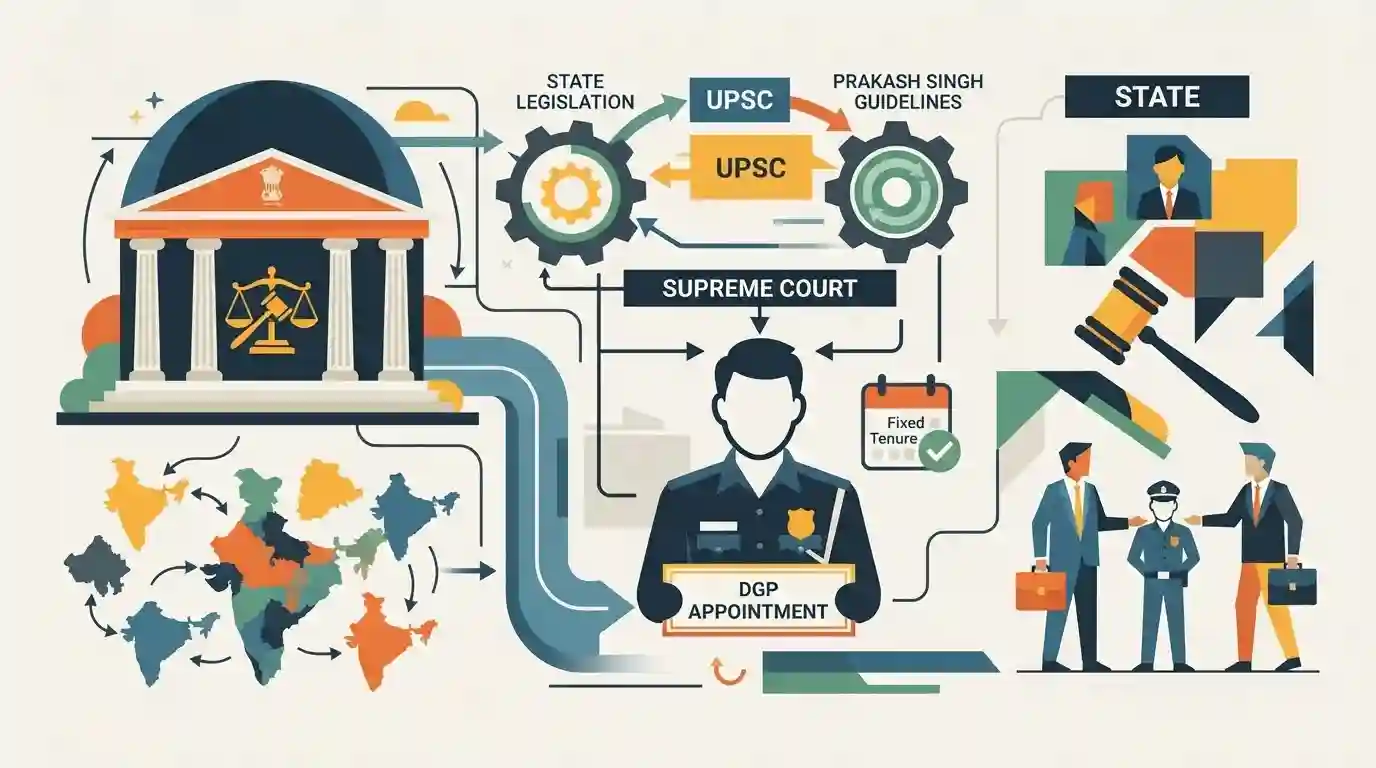
The Supreme Court has broadened its scrutiny on State Director-General of Police (DGP) appointment rules nationwide to verify compliance with the landmark 2006 Prakash Singh judgment. Triggered by a petition involving Jharkhand, the apex court is examining state-level legislations that bypass UPSC panel consultations and fixed tenures, reinforcing judicial oversight on police reforms and executive independence.
મુખ્ય મુદ્દા
- The Supreme Court has expanded its nationwide scrutiny of State DGP appointment rules to examine whether various states comply with its 2006 Prakash Singh judgment.
- The court questioned laws enacted by several states that dilute the mandate requiring Union Public Service Commission (UPSC) panel consultation and minimum tenure provisions for DGPs.
- The case arose after Jharkhand questioned the Centre and UPSC regarding the process of DGP appointments, highlighting potential executive overreach and political interference in police administration.
- The development highlights the ongoing friction between judicial directions on police reforms and legislative/executive actions at the state level.
મહત્વપૂર્ણ શબ્દો
Prakash Singh v. Union of India (2006)

A landmark 2006 Supreme Court ruling that mandated sweeping police reforms across India, including a fixed two-year tenure for DGPs and transparent appointment panels via the UPSC.
UPSC context
GS Paper II (Polity & Governance — Judicial Activism, Police Reforms, and Federalism). Crucial for questions on executive accountability and administrative reforms.
UPSC
The constitutional body mandated to conduct civil services examinations and consult with states on DGP empanelment under the Prakash Singh judgment guidelines.
UPSC context
GS Paper II (Constitutional Bodies, Polity). Tests understanding of institutional roles, federal coordination, and merit-based recruitment.
પ્રિલિમ્સ ટ્રેપ
The UPSC directly selects and appoints the State Director-General of Police based on merit and seniority.
Aspirants often assume UPSC has absolute power to select the DGP. In reality, UPSC only recommends a panel of three senior officers, and the state government makes the final appointment from that panel.
સંલગ્ન સ્થિર ખ્યાલો
What were the key structural directives issued by the Supreme Court in the landmark Prakash Singh v. Union of India (2006) judgment?
- UPSC Panel: State DGP selection must follow a panel of three senior officers recommended by the UPSC.
- Fixed Tenure: The appointed DGP must have a guaranteed minimum tenure of at least two years.
- Establishment Board: States must establish a Police Establishment Board to handle transfers, postings, and promotions.
- Security Commission: A State Security Commission must be set up to ensure the state government does not exercise unwarranted influence over the police.
આંતર-વિષય પેટર્ન
Police Reforms & Investigative Agency Appointments
Judicial enforcement of Prakash Singh directions mirrors Supreme Court interventions in CBI and ED director appointments, testing executive discretion vs institutional independence.
Cooperative Federalism vs State Legislative Autonomy
State-level dilution of UPSC panel mandates for DGP selections directly engages federal friction and the limits of executive power under Article 162.

Prakash Singh guidelines + UPSC panel role in DGP appointments is prime material for a multi-statement polity prelims question.
સંલગ્ન PYQ · 1
સંલગ્ન PYQ · 1
- 2020MainsGS2
Judicial Legislation is antithetical to the doctrine of separation of powers as envisaged in the Indian Constitution. In this context justify the filing of large number of public interest petitions praying for issuing guidelines to executive authorities.
