Supreme Court Seeks Response on Homebuyers Funds Siphoning
Source:The Hindu ↗
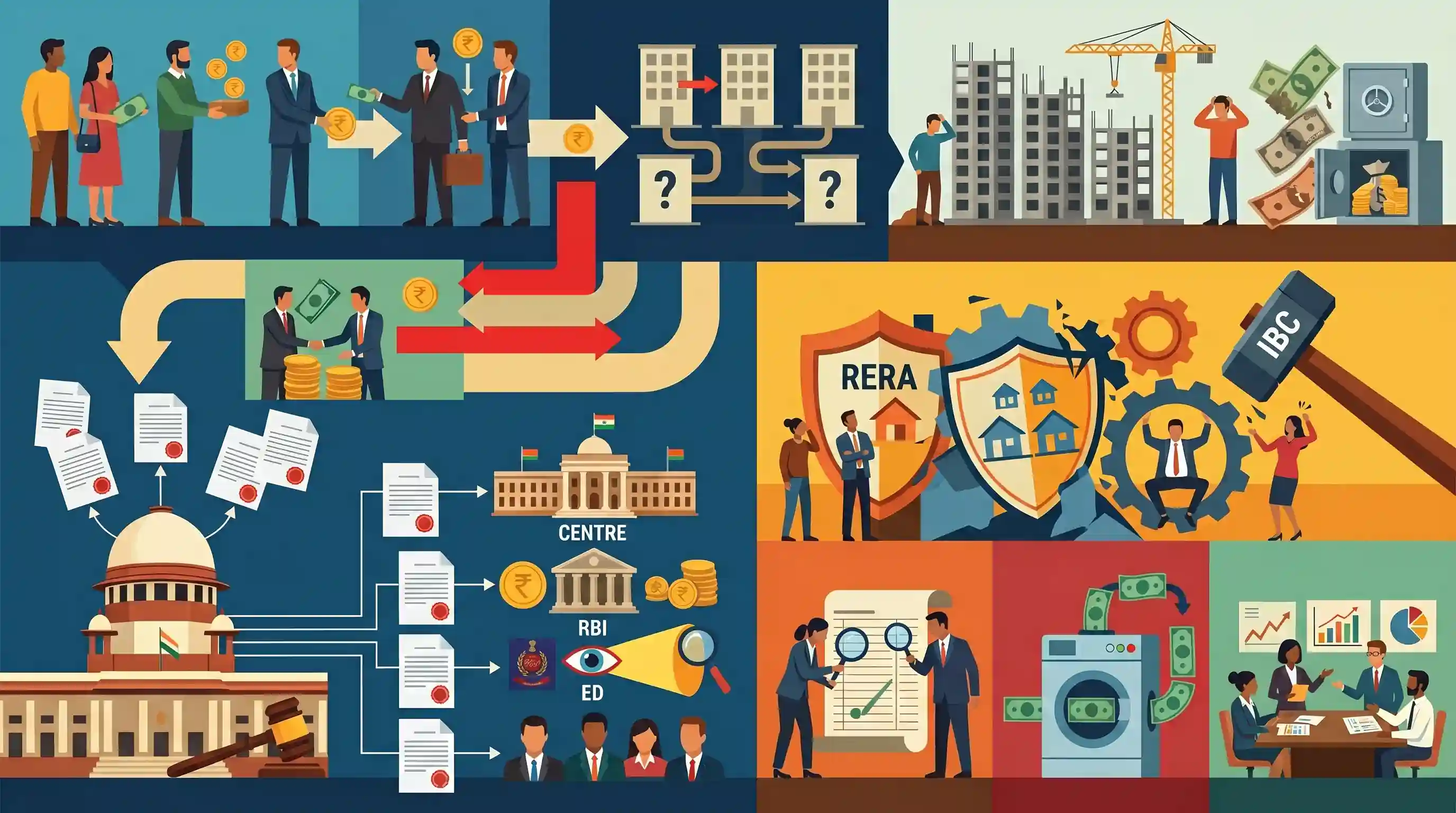
Why It Matters
This issue highlights critical vulnerabilities at the intersection of real estate regulation (RERA) and corporate insolvency (IBC). It underscores the economic consequences of white-collar crimes, such as the generation of banking NPAs and money laundering, making it highly relevant for UPSC questions on economic regulation, banking sector health, and enforcement of anti-money laundering laws.
Summary
The Supreme Court has issued notices to the Centre, ED, RBI, and major real estate developers over a PIL concerning the alleged siphoning of homebuyers' funds in the Noida and Yamuna Expressway regions. The plea claims that developers diverted thousands of crores collected from buyers and banks into shell companies, causing massive Non-Performing Assets (NPAs) and stalled projects. The petitioner highlighted that the interplay between the Insolvency and Bankruptcy Code (IBC) and RERA often leaves homebuyers helpless, as insolvency proceedings effectively nullify RERA's protective measures. The PIL calls for a forensic audit by the RBI, potential money-laundering probes by the ED under PMLA, and an expert committee to recommend structural amendments to RERA policies.
Key Points
- The Supreme Court sought responses from the Centre, ED, RBI, and real estate developers regarding a PIL on the alleged siphoning of thousands of crores of homebuyers' funds.
- The PIL alleges developers collected massive funds from homebuyers and banks but diverted them to shell companies, leaving projects stalled and homebuyers stranded.
- The petitioner argued that corporate insolvency proceedings under the IBC leave homebuyers disadvantaged and make RERA provisions ineffective for securing refunds or possession.
- The plea seeks an expert committee to examine RERA policies and suggest amendments to prevent fund diversion.
- The petition also calls for the RBI to conduct forensic audits of banks that financed these projects, given the resulting massive Non-Performing Assets (NPAs), and for the ED to take action under PMLA.
Important Terms
Real Estate (Regulation and Development) Act (RERA)

A landmark 2016 law regulating the real estate sector to ensure transparency, accountability, and homebuyer protection through mandatory project registration and state-level regulatory authorities.
UPSC context
GS Paper 2 (Governance) and GS Paper 3 (Economy); tests regulatory reforms and consumer rights in the housing sector.
Insolvency and Bankruptcy Code (IBC)
A 2016 legal framework providing time-bound insolvency resolution for distressed companies. It empowers creditors to recover dues and classifies homebuyers as financial creditors in resolution processes.
UPSC context
GS Paper 3 (Indian Economy); critical for understanding stressed asset resolution and its interplay with sector-specific laws like RERA.
Prevention of Money Laundering Act (PMLA)
A 2002 Act enacted to prevent money laundering and authorize the confiscation of assets derived from criminal activities, primarily enforced by the Enforcement Directorate.
UPSC context
GS Paper 3 (Security/Economy); vital for topics on economic offences, organized crime, and the mandate of investigative agencies.
Directorate of Enforcement (ED)
A premier financial investigation agency under the Ministry of Finance responsible for enforcing the PMLA and FEMA to combat money laundering and economic crimes.
UPSC context
GS Paper 2 (Statutory Bodies); tests the powers, functions, and judicial scrutiny of central investigative agencies.
Non-Performing Assets (NPAs)
A loan or advance where interest or principal remains overdue for 90 days or more, indicating a default that impacts a bank's profitability and capital.
UPSC context
GS Paper 3 (Banking/Economy); fundamental for analyzing financial stability, the twin balance sheet problem, and credit growth.
Reserve Bank of India (RBI)
India's central bank and regulatory authority for the banking sector. It monitors financial stability, formulates monetary policy, and supervises NPA resolution and credit discipline.
UPSC context
GS Paper 3 (Indian Economy); central to understanding the role of the monetary authority in crisis management and banking regulation.
Prelims Trap
Homebuyers are categorized as operational creditors under IBC, and RERA regulations supersede insolvency proceedings.
False. The 2018 IBC amendment made homebuyers 'financial creditors'. Additionally, IBC Section 238 overrides RERA, meaning initiating insolvency pauses RERA remedies.
Static Concepts Connected
How does the IBC treat homebuyers in real estate insolvencies?
- Financial Creditors: Post-2018 IBC amendment, homebuyers are recognized as financial creditors, allowing them representation and voting rights in the Committee of Creditors (CoC).
- Filing Threshold: To prevent frivolous suits, at least 100 allottees or 10% of total homebuyers in a project must jointly file for insolvency at NCLT.
- Overriding Effect: Under Section 238, the IBC overrides other statutes. Once corporate insolvency (CIRP) begins, a moratorium halts ongoing RERA proceedings.
What are the core financial safeguards provided under RERA?
- 70% Escrow Rule: Developers must deposit 70% of project funds collected from buyers into a dedicated bank account, strictly used for construction and land costs.
- Proportional Withdrawal: Funds can only be withdrawn in proportion to the project's completion stage, which must be certified by a CA, engineer, and architect.
- Advance Payment Limit: Promoters cannot accept more than 10% of the property cost as an advance payment without first entering into a registered agreement for sale.
Cross-Topic Patterns
RERA vs IBC Regulatory Overlap
The structural friction between consumer-protection (RERA) and creditor-resolution (IBC) laws is a prime example of statutory overlap leading to judicial intervention and governance bottlenecks in GS2.
NPAs and Shell Company Money Laundering
Diversion of retail buyer funds via shell entities links GS3 banking sector stress (NPAs) directly to internal security, triggering ED probes under the Prevention of Money Laundering Act (PMLA).

Expect a GS3 Mains question in 2026 evaluating the structural conflict between RERA's consumer safeguards and IBC's creditor resolution.
Linked PYQs · 2
Linked PYQs · 2
- 2021MainsGS3
Discuss how emerging technologies and globalisation contribute to money laundering. Elaborate measures to tackle the problem of money laundering both at national and international levels.
- 2013MainsGS3
Money laundering poses a serious security threat to a country's economic sovereignty. What is its significance for India and what steps are required to be taken to control this menace?
