Supreme Court seeks response on tribal children deaths in MP
Source:livelaw ↗
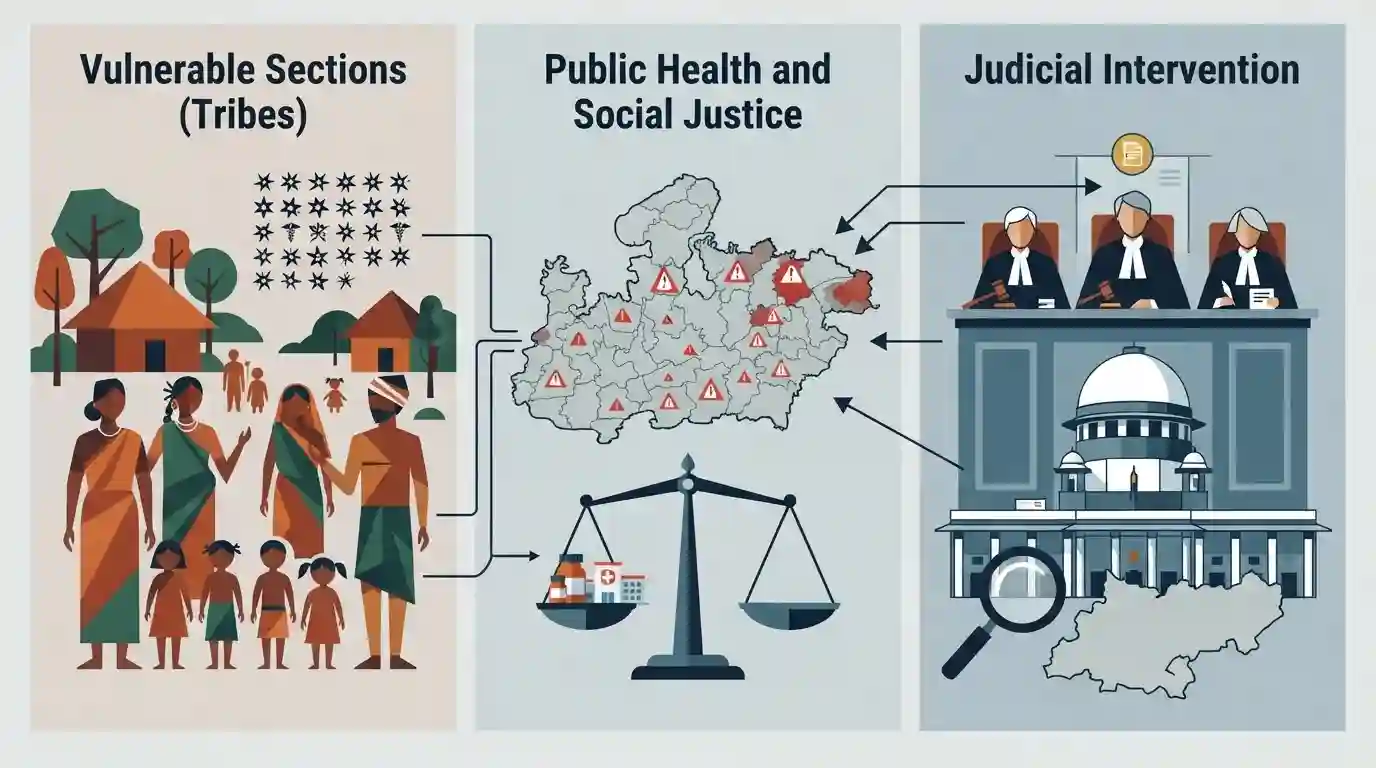
Why It Matters
It addresses critical socio-legal questions regarding public health infrastructure, child mortality, and the welfare of Particularly Vulnerable Tribal Groups (PVTGs) in Madhya Pradesh, making it relevant for GS Paper 2 (Governance/Social Justice) and MPPSC Prelims (Madhya Pradesh tribal issues and welfare).
Summary
The Supreme Court has sought responses on a PIL/plea requesting that certain regions in a Madhya Pradesh district be declared epidemic-prone following the tragic deaths of 35 tribal children, bringing attention to public health and tribal welfare challenges in the state.
Key Points
- The Supreme Court sought a response on a plea seeking to declare parts of an MP district epidemic-prone following the reported deaths of 35 tribal children.
- The case highlights public health concerns, healthcare access issues, and child mortality among marginalized tribal communities in Madhya Pradesh.
- Issues related to health infrastructure, malnutrition, and epidemic control in remote tribal pockets of the state were brought into legal focus.
Important Terms
Epidemic Diseases Act, 1897

A central colonial-era public health legislation empowering governments to take special measures and regulations to contain dangerous epidemic outbreaks.
UPSC context
Relevant for MPPSC GS Paper II (Public Health, Governance and Statutory Powers). Tests understanding of disease management legislation.
Particularly Vulnerable Tribal Groups (PVTGs)
Particularly Vulnerable Tribal Groups (PVTGs) are marginalized tribal communities identified by pre-agricultural technology, stagnant population, and low literacy. Madhya Pradesh has three recognized PVTGs: Baiga, Bharia, and Sahariya.
UPSC context
Essential for MPPSC GS Paper I (Tribal Culture and Welfare in Madhya Pradesh) and Paper II (Vulnerable Sections).
Supreme Court
Apex judicial institution of India empowered under Article 32 to issue writs and entertain PILs for the enforcement of fundamental rights and public interest.
UPSC context
Core to MPPSC GS Paper II (Indian Constitution and Judicial System, Judicial Activism and PIL).
Prelims Trap
All Scheduled Tribes in Madhya Pradesh are officially classified as Particularly Vulnerable Tribal Groups (PVTGs).
Aspirants often confuse PVTGs with general Scheduled Tribes. MP has specifically three recognized PVTGs, not more.
Static Concepts Connected
Which are the officially recognized Particularly Vulnerable Tribal Groups (PVTGs) in Madhya Pradesh?
- Baiga Tribe: Baiga tribe residing mainly in Dindori, Mandla, and Shahdol districts.
- Bharia Tribe: Bharia tribe primarily found in the Patalkot valley of Chhindwara district.
- Sahariya Tribe: Sahariya tribe inhabiting northern districts like Sheopur, Morena, and Gwalior.
Cross-Topic Patterns
PVTG Nutrition + Fifth Schedule Governance
PVTG nutrition schemes like Ahar Anudan Yojana connect directly to constitutional mandates under Fifth and Sixth Schedules for tribal protection.
Judicial PILs + DPSP Public Health Mandate
Judicial intervention via PILs in public health matters intersects with Directive Principles of State Policy (Article 47).

MPPSC Prelims often tests exact names of PVTGs in MP (Baiga, Bharia, Sahariya) alongside welfare schemes like Ahar Anudan Yojana.
Linked PYQs · 2
Linked PYQs · 2
- 2025MPPSC_PRELIMSGS1
Which one of the following is not one of the Particularly Vulnerable Tribal Group (PVTG) of Madhya Pradesh?
- 2025MPPSC_PRELIMSGS1
Since the date 23.12.2017, 'Ahar Anudan Yojana' is a yojana to get rid of malnutrition of which tribal community?
