Supreme Court Seeks Centre Response on Jantar Mantar Protest Site Plea
Source:Indian Express ↗
Why It Matters
This case highlights the ongoing friction between state executive actions restricting public spaces for administrative/security reasons and citizens' fundamental rights to peaceful assembly and democratic dissent under Article 19 of the Constitution.
Summary
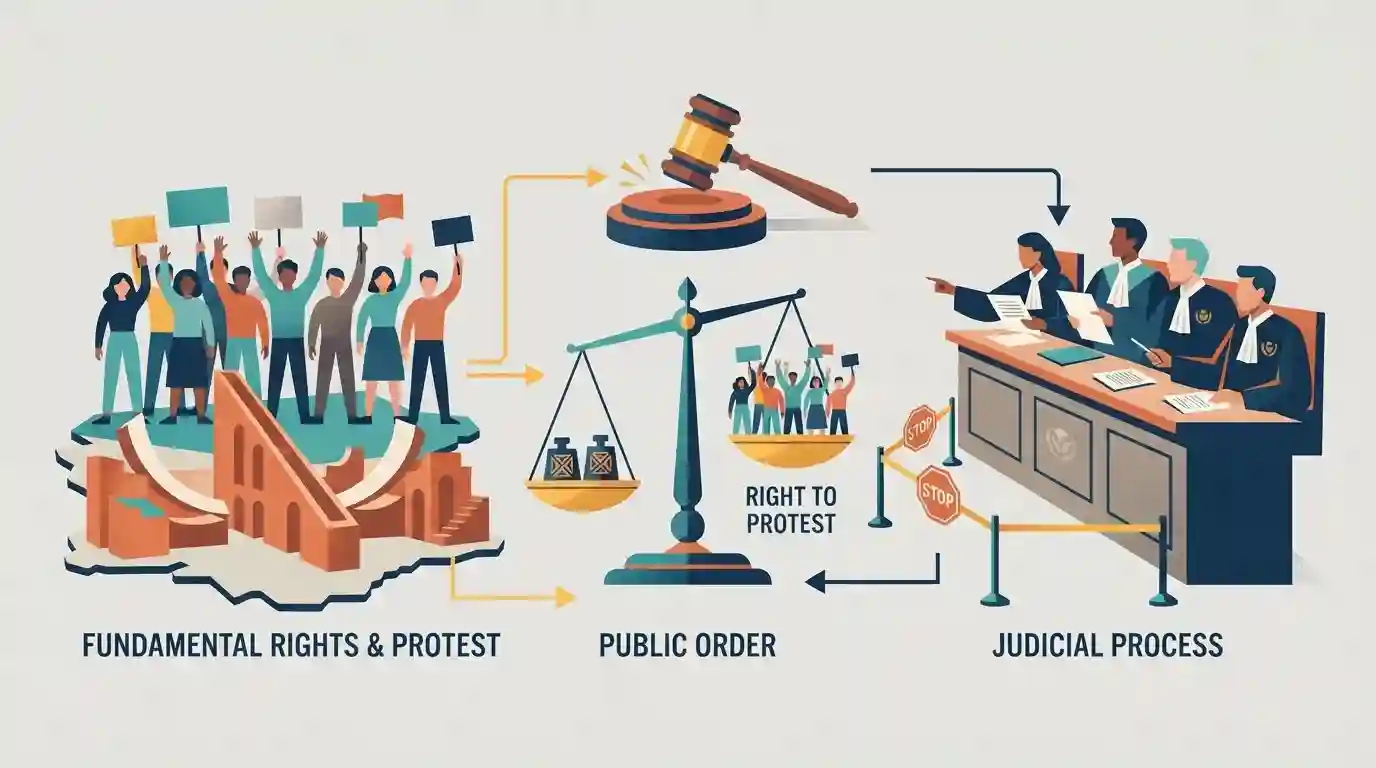
The Supreme Court has sought responses from the Centre and Delhi Police regarding a plea challenging the stripping of Jantar Mantar's status as a designated protest site in New Delhi, bringing focus back to the delicate balance between the fundamental right to protest and public order.
Key Points
- The Supreme Court sought responses from the Centre and Delhi Police on a plea challenging the removal of Jantar Mantar as a designated protest site in New Delhi.
- The petition raises crucial constitutional questions regarding the right to peaceful assembly, freedom of speech and expression, and the balancing of public order with democratic dissent.
- Jantar Mantar has historically served as a prominent space for public demonstrations and protests in the national capital.
Important Terms
Article 19 of the Constitution

Part III of the Constitution guarantees citizens freedom of speech and expression (Article 19(1)(a)) and peaceful assembly (Article 19(1)(b)), subject to reasonable restrictions in the interest of public order.
UPSC context
GS Paper II (Polity and Governance) - Fundamental Rights, judicial review, balancing constitutional freedoms with state police powers and public order.
Supreme Court
The apex constitutional court empowered under Article 132-142 to interpret the Constitution, protect fundamental rights, and adjudicate executive actions affecting citizens' democratic rights.
UPSC context
GS Paper II (Polity and Governance) - Structure, organization, and functioning of the Judiciary and judicial review of administrative actions.
Delhi Police
The law enforcement agency operating under the Union Ministry of Home Affairs responsible for maintaining law, order, and security in the National Capital Territory of Delhi.
UPSC context
GS Paper II/III - Police reforms, maintenance of public order, urban governance, and Union territory administration in India.
Static Concepts Connected
What are the constitutional grounds and limitations for freedom of speech and peaceful assembly in India?
- Constitutional Basis: Article 19(1)(a) guarantees freedom of speech, and 19(1)(b) guarantees the right to assemble peacefully and without arms.
- Speech Restrictions: Article 19(2) allows reasonable restrictions on speech in the interests of sovereignty, integrity, security, public order, decency, or morality.
- Assembly Restrictions: Article 19(3) permits reasonable restrictions on assembly specifically in the interests of public order or India's sovereignty and integrity.
- Judicial Test: Restrictions must pass the proportionality test; complete bans on traditional protest sites like Jantar Mantar face judicial scrutiny.
Cross-Topic Patterns
Article 19 vs. Public Order & Urban Regulation
Right to protest under Article 19 interacts with municipal regulations, urban planning, and police powers under BNSS 2023, testing administrative efficiency against democratic freedoms.

Expect a statement-based question pairing Article 19(1)(b) absolute vs. reasonable restriction grounds with BNSS 2023 executive powers.
Linked PYQs · 2
Linked PYQs · 2
- 2014MainsGS2
What do you understand by the concept "freedom of speech and expression"? Does it cover hate speech also ? Why do the films in India stand on a slightly different plane from other forms of expression ? Discuss.
- 2022MainsGS2
“Right of movement and residence throughout the territory of India are freely available to the Indian citizens, but these rights are not absolute.” Comment.
