यात्रा मार्गों पर क्यूआर कोड के निर्देश पर न्यायिक समीक्षा
स्रोत:द हिंदू ↗
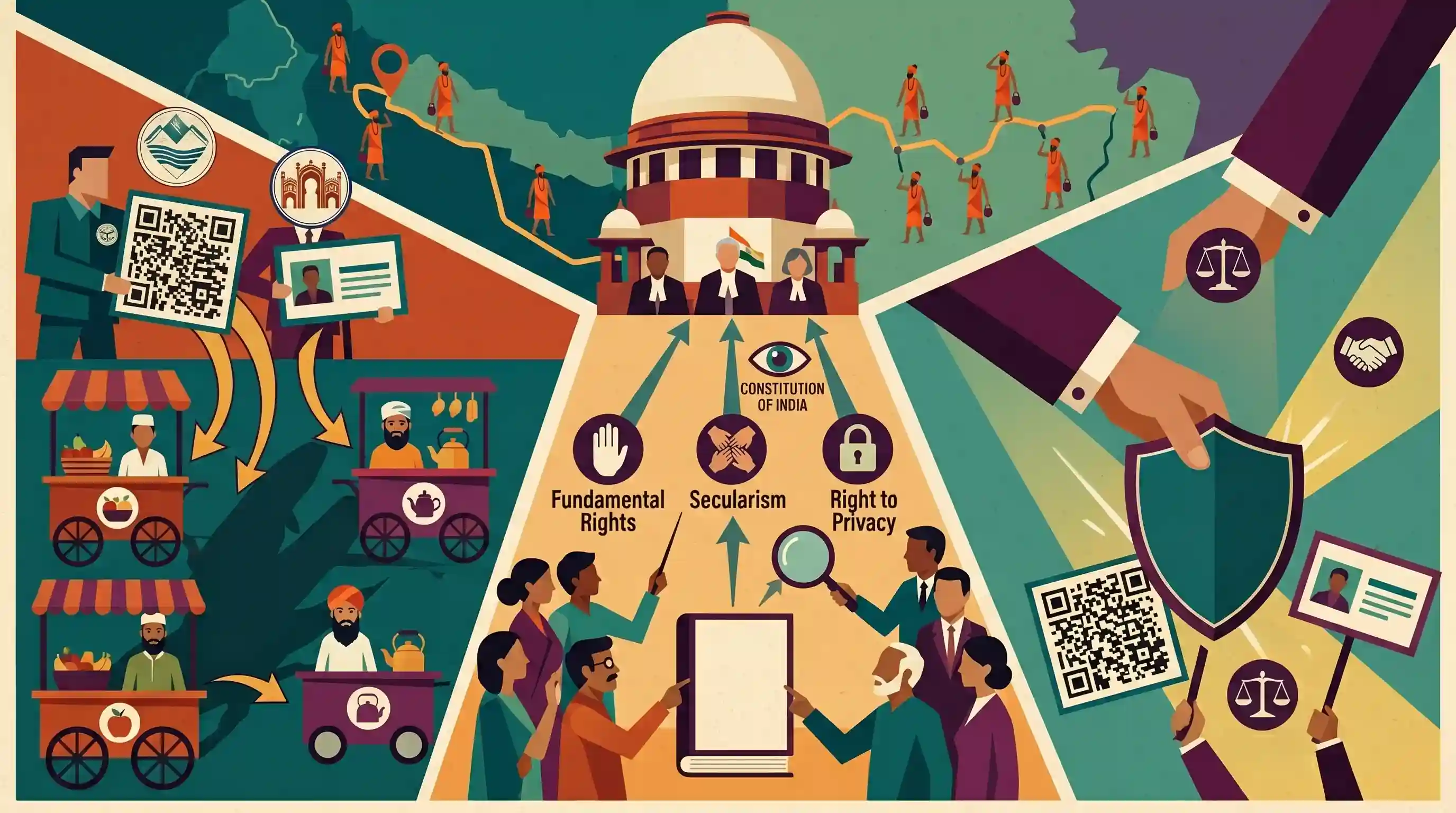
क्यों मायने रखता है
The issue highlights the intersection of executive directives, fundamental rights (specifically Articles 14, 15, 19, and 21), and the principle of secularism. It is highly relevant for GS Paper 2 questions on constitutional morality, the scope of the right to privacy (post-Puttaswamy), and the judiciary's role in checking colorable legislation or state actions that subtly discriminate against minorities.
सारांश
The Supreme Court of India has issued notices to the Uttar Pradesh and Uttarakhand governments regarding a controversial directive that mandates food vendors along the Kanwar Yatra route to display QR codes revealing their owners' identities. Petitioners, including civil rights groups and politicians, have challenged the order, arguing it promotes discriminatory profiling and economic boycotts against minority vendors under the guise of food safety and licensing compliance. The plea claims the move violates fundamental rights to equality, non-discrimination, privacy, and livelihood. The Supreme Court had previously stayed a similar name-display directive in July 2024, citing concerns over its impact on secularism and potential to incite communal tensions.
मुख्य बिंदु
- The Supreme Court sought responses from the UP and Uttarakhand governments on pleas challenging directives that require eateries along the Kanwar Yatra route to display QR codes revealing owner identities.
- याचिकाकर्ताओं का तर्क है कि यह निर्देश शक्ति का एक छद्म प्रयोग (colorable exercise of power) है जो अल्पसंख्यक स्वामित्व वाले प्रतिष्ठानों की भेदभावपूर्ण प्रोफाइलिंग और उनके आर्थिक बहिष्कार को सुगम बनाता है।
- The plea contends that the mandate violates constitutional guarantees including Article 14 (equality), Article 15 (non-discrimination), Article 19(1)(g) (right to trade), and Article 21 (right to privacy and dignity).
- A similar mandate enforcing the display of owners' names was previously stayed by the Supreme Court in July 2024 due to its potential to infringe on the secular character of the Preamble and spark communal discord.
महत्वपूर्ण शब्द
Food Safety and Standards Act, 2006

खाद्य सुरक्षा से संबंधित कानूनों को समेकित करने वाला 2006 का एक अधिनियम। इसने खाद्य पदार्थों के लिए विज्ञान-आधारित मानक निर्धारित करने और उनके निर्माण, भंडारण, वितरण और बिक्री को विनियमित करने के लिए FSSAI की स्थापना की।
UPSC context
GS पेपर II: सरकारी नीतियां और हस्तक्षेप। खाद्य-संबंधी निर्देशों में नियामक ढांचे और राज्य की शक्ति की सीमाओं को समझने के लिए महत्वपूर्ण।
Association for Protection of Civil Rights (APCR)
A non-governmental organization that advocates for the legal and civil rights of marginalized sections. It is a key petitioner in the Kanwar Yatra identity-disclosure case.
UPSC context
GS पेपर II: NGOs और दबाव समूहों की भूमिका। न्यायिक सक्रियता और नागरिक अधिकार मुकदमों से संबंधित मामलों के लिए प्रासंगिक।
Secularism
A core constitutional principle and part of the 'Basic Structure,' requiring the state to maintain neutrality towards all religions and refrain from discriminating against citizens on religious grounds.
UPSC context
GS पेपर I और II: भारतीय समाज और राजव्यवस्था। भारत के विशिष्ट धर्मनिरपेक्ष मॉडल और सांप्रदायिक प्रोफाइलिंग को रोकने में इसकी भूमिका की समझ का परीक्षण करता है।
निजता का अधिकार
अनुच्छेद 21 के तहत जीवन और व्यक्तिगत स्वतंत्रता के अधिकार का एक अभिन्न हिस्सा, जैसा कि के.एस. पुट्टास्वामी बनाम भारत संघ (2017) के निर्णय में स्थापित किया गया है।
UPSC context
GS Paper II: Fundamental Rights. Tests knowledge of judicial interpretations of Article 21 and protection against state intrusion into personal identity.
Right to Livelihood
Derived from Article 21, it holds that any state action depriving a person of their means of living must follow a fair and reasonable legal procedure.
UPSC context
GS पेपर II: मौलिक अधिकार। छोटे विक्रेताओं और अल्पसंख्यक व्यवसायों पर सरकारी शासनादेशों के सामाजिक-आर्थिक प्रभावों पर चर्चा के लिए महत्वपूर्ण।
Constitutional Morality
The principle that constitutional values and democratic norms should guide government actions, preventing arbitrary exercise of power or decisions driven solely by popular sentiment.
UPSC context
GS Paper IV (Ethics) & GS Paper II (Polity). Tests the ability to balance majoritarian demands with constitutional protections for minorities.
न्यायिक समीक्षा
The power of the judiciary to examine the constitutionality of legislative acts and executive orders, ensuring they do not violate the Fundamental Rights or the Basic Structure.
UPSC context
GS Paper II: Indian Constitution. Critical for analyzing the Supreme Court’s role in staying directives that lack statutory backing or constitutional validity.
प्रारंभिक ट्रैप
"The Food Safety and Standards Act mandates eateries to display the names of owners to ensure traceability."
FSSAI सार्वजनिक स्वास्थ्य के लिए भोजन के प्रकार (शाकाहारी/मांसाहारी) और स्वच्छता रेटिंग (hygiene ratings) प्रदर्शित करना अनिवार्य करता है। यह मालिक की व्यक्तिगत पहचान या धर्म प्रदर्शित करना अनिवार्य नहीं करता है।
संबंधित अवधारणाएँ
What are the key facets of the Right to Privacy under the Puttaswamy judgment?
- Informational privacy: Individuals have the fundamental right to control the dissemination of their personal data, identity, and commercial information in the public domain.
- Decisional privacy: Protects individual autonomy over deeply personal choices, such as food habits, faith, bodily autonomy, and associations.
- आनुपातिकता परीक्षण: Any state restriction on privacy must satisfy three tests: legality (a valid law), a legitimate state aim, and proportional means to achieve it.
What is the Doctrine of Colourable Legislation/Exercise of Power?
- Core principle: सिद्धांत "जो प्रत्यक्ष रूप से नहीं किया जा सकता, उसे अप्रत्यक्ष रूप से भी नहीं किया जा सकता।" इसका उपयोग यह जाँचने के लिए किया जाता है कि क्या किसी विधायी या कार्यकारी निकाय ने अपनी संवैधानिक सीमाओं का उल्लंघन किया है।
- Motive irrelevance: This doctrine tests actual competence and jurisdiction, not just the good or bad intentions (bona fides/mala fides) of the authority making the rule.
- Colourable executive power: In this case, it refers to using legitimate statutory frameworks (like food safety laws) as a facade to achieve unauthorized ends (like religious profiling of vendors).
अंतर-विषय पैटर्न
डिजिटल पहचान और स्टेट प्रोफाइलिंग
The misuse of QR codes for tracing identity mirrors broader concerns over state surveillance and data protection, linking digital tech regulation directly with Article 21 fundamental rights.
संवैधानिक नैतिकता बनाम आर्थिक बहिष्कार
SC का हस्तक्षेप सबरीमाला और नवतेज जोहर के न्यायिक उदाहरणों को प्रतिबिंबित करता है, जो बहुसंख्यकवादी राजकीय निर्देशों से अल्पसंख्यकों की आजीविका की रक्षा के लिए 'संवैधानिक नैतिकता' (Constitutional Morality) को एक सक्रिय ढाल के रूप में उपयोग करता है।

Mains GS2 2026: Analyze how 'informational privacy' protects vulnerable groups from majoritarian directives and economic profiling.
संबद्ध PYQ · 3
संबद्ध PYQ · 3
- 2017MainsGS2
Examine the scope of Fundamental Rights in the light of the latest judgement of the Supreme Court on Right to Privacy.
- 2024MainsGS2
Discuss India as a secular state and compare with the secular principles of the US constitution.
- 2024MainsGS2
Right to privacy is intrinsic to life and personal liberty and is inherently protected under Article 21 of the constitution. Explain. In this reference discuss the law relating to D.N.A. testing of child in the womb to establish its paternity.
