Judicial Scrutiny of QR Code Directives on Yatra Routes
Source:The Hindu ↗
Why It Matters
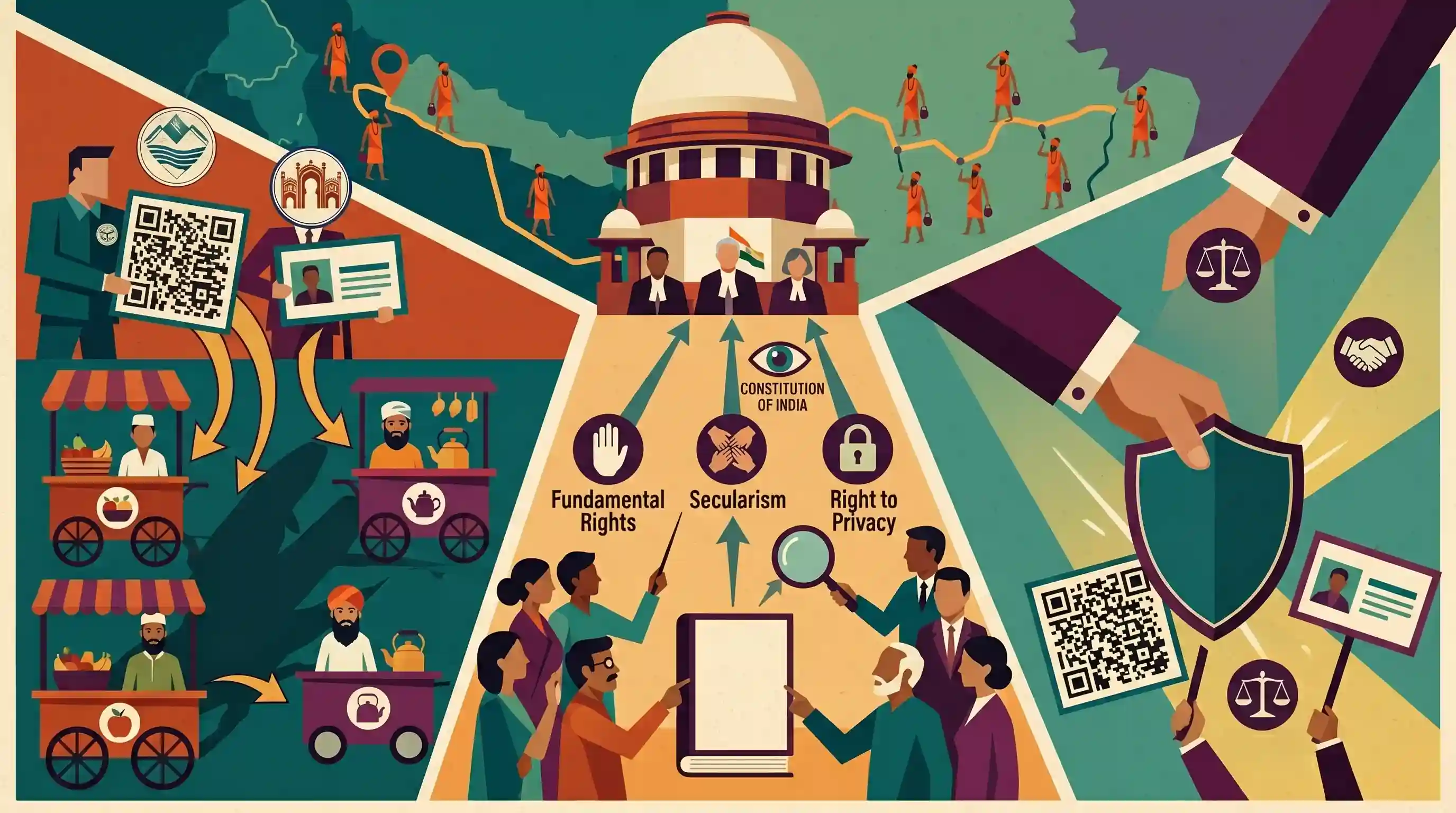
The issue highlights the intersection of executive directives, fundamental rights (specifically Articles 14, 15, 19, and 21), and the principle of secularism. It is highly relevant for GS Paper 2 questions on constitutional morality, the scope of the right to privacy (post-Puttaswamy), and the judiciary's role in checking colorable legislation or state actions that subtly discriminate against minorities.
Summary
The Supreme Court of India has issued notices to the Uttar Pradesh and Uttarakhand governments regarding a controversial directive that mandates food vendors along the Kanwar Yatra route to display QR codes revealing their owners' identities. Petitioners, including civil rights groups and politicians, have challenged the order, arguing it promotes discriminatory profiling and economic boycotts against minority vendors under the guise of food safety and licensing compliance. The plea claims the move violates fundamental rights to equality, non-discrimination, privacy, and livelihood. The Supreme Court had previously stayed a similar name-display directive in July 2024, citing concerns over its impact on secularism and potential to incite communal tensions.
Key Points
- The Supreme Court sought responses from the UP and Uttarakhand governments on pleas challenging directives that require eateries along the Kanwar Yatra route to display QR codes revealing owner identities.
- Petitioners argue the directive is a colorable exercise of power that facilitates discriminatory profiling and economic boycotts of minority-owned establishments.
- The plea contends that the mandate violates constitutional guarantees including Article 14 (equality), Article 15 (non-discrimination), Article 19(1)(g) (right to trade), and Article 21 (right to privacy and dignity).
- A similar mandate enforcing the display of owners' names was previously stayed by the Supreme Court in July 2024 due to its potential to infringe on the secular character of the Preamble and spark communal discord.
Important Terms
Food Safety and Standards Act, 2006

A 2006 Act consolidating laws related to food safety. It established FSSAI to set science-based standards for food and regulate its manufacture, storage, distribution, and sale.
UPSC context
GS Paper II: Government Policies and Interventions. Important for understanding the regulatory framework and the limits of state power in food-related directives.
Association for Protection of Civil Rights (APCR)
A non-governmental organization that advocates for the legal and civil rights of marginalized sections. It is a key petitioner in the Kanwar Yatra identity-disclosure case.
UPSC context
GS Paper II: Role of NGOs and Pressure Groups. Relevant for cases involving judicial activism and civil rights litigation.
Secularism
A core constitutional principle and part of the 'Basic Structure,' requiring the state to maintain neutrality towards all religions and refrain from discriminating against citizens on religious grounds.
UPSC context
GS Paper I & II: Indian Society and Polity. Tests understanding of India's unique secular model and its role in preventing communal profiling.
Right to Privacy
An intrinsic part of the Right to Life and Personal Liberty under Article 21, as established in the K.S. Puttaswamy v. Union of India (2017) judgment.
UPSC context
GS Paper II: Fundamental Rights. Tests knowledge of judicial interpretations of Article 21 and protection against state intrusion into personal identity.
Right to Livelihood
Derived from Article 21, it holds that any state action depriving a person of their means of living must follow a fair and reasonable legal procedure.
UPSC context
GS Paper II: Fundamental Rights. Important for discussing the socio-economic impacts of government mandates on small-scale vendors and minority businesses.
Constitutional Morality
The principle that constitutional values and democratic norms should guide government actions, preventing arbitrary exercise of power or decisions driven solely by popular sentiment.
UPSC context
GS Paper IV (Ethics) & GS Paper II (Polity). Tests the ability to balance majoritarian demands with constitutional protections for minorities.
Judicial Review
The power of the judiciary to examine the constitutionality of legislative acts and executive orders, ensuring they do not violate the Fundamental Rights or the Basic Structure.
UPSC context
GS Paper II: Indian Constitution. Critical for analyzing the Supreme Court’s role in staying directives that lack statutory backing or constitutional validity.
Prelims Trap
"The Food Safety and Standards Act mandates eateries to display the names of owners to ensure traceability."
FSSAI mandates the display of food types (veg/non-veg) and hygiene ratings for public health. It does not mandate the display of the owner's personal identity or religion.
Static Concepts Connected
What are the key facets of the Right to Privacy under the Puttaswamy judgment?
- Informational privacy: Individuals have the fundamental right to control the dissemination of their personal data, identity, and commercial information in the public domain.
- Decisional privacy: Protects individual autonomy over deeply personal choices, such as food habits, faith, bodily autonomy, and associations.
- Proportionality test: Any state restriction on privacy must satisfy three tests: legality (a valid law), a legitimate state aim, and proportional means to achieve it.
What is the Doctrine of Colourable Legislation/Exercise of Power?
- Core principle: The maxim "what cannot be done directly, cannot be done indirectly." It is used to check if a legislative or executive body has transgressed its constitutional bounds.
- Motive irrelevance: This doctrine tests actual competence and jurisdiction, not just the good or bad intentions (bona fides/mala fides) of the authority making the rule.
- Colourable executive power: In this case, it refers to using legitimate statutory frameworks (like food safety laws) as a facade to achieve unauthorized ends (like religious profiling of vendors).
Cross-Topic Patterns
Digital Identity & State Profiling
The misuse of QR codes for tracing identity mirrors broader concerns over state surveillance and data protection, linking digital tech regulation directly with Article 21 fundamental rights.
Constitutional Morality vs Economic Boycotts
The SC's intervention mirrors the Sabarimala and Navtej Johar precedents, utilizing Constitutional Morality as an active shield to protect minority livelihoods from majoritarian state directives.

Mains GS2 2026: Analyze how 'informational privacy' protects vulnerable groups from majoritarian directives and economic profiling.
Linked PYQs · 3
Linked PYQs · 3
- 2017MainsGS2
Examine the scope of Fundamental Rights in the light of the latest judgement of the Supreme Court on Right to Privacy.
- 2024MainsGS2
Discuss India as a secular state and compare with the secular principles of the US constitution.
- 2024MainsGS2
Right to privacy is intrinsic to life and personal liberty and is inherently protected under Article 21 of the constitution. Explain. In this reference discuss the law relating to D.N.A. testing of child in the womb to establish its paternity.
