Anti-conversion laws face Supreme Court scrutiny over religious rights
Source:The Hindu ↗
Why It Matters
The debate over anti-conversion laws deals with core constitutional issues, specifically balancing the fundamental right to freedom of religion (Article 25) and the right to privacy (Article 21) against the State's duty to protect citizens from fraudulent or forced conversions. This is crucial for GS2 Governance and Polity.
Summary
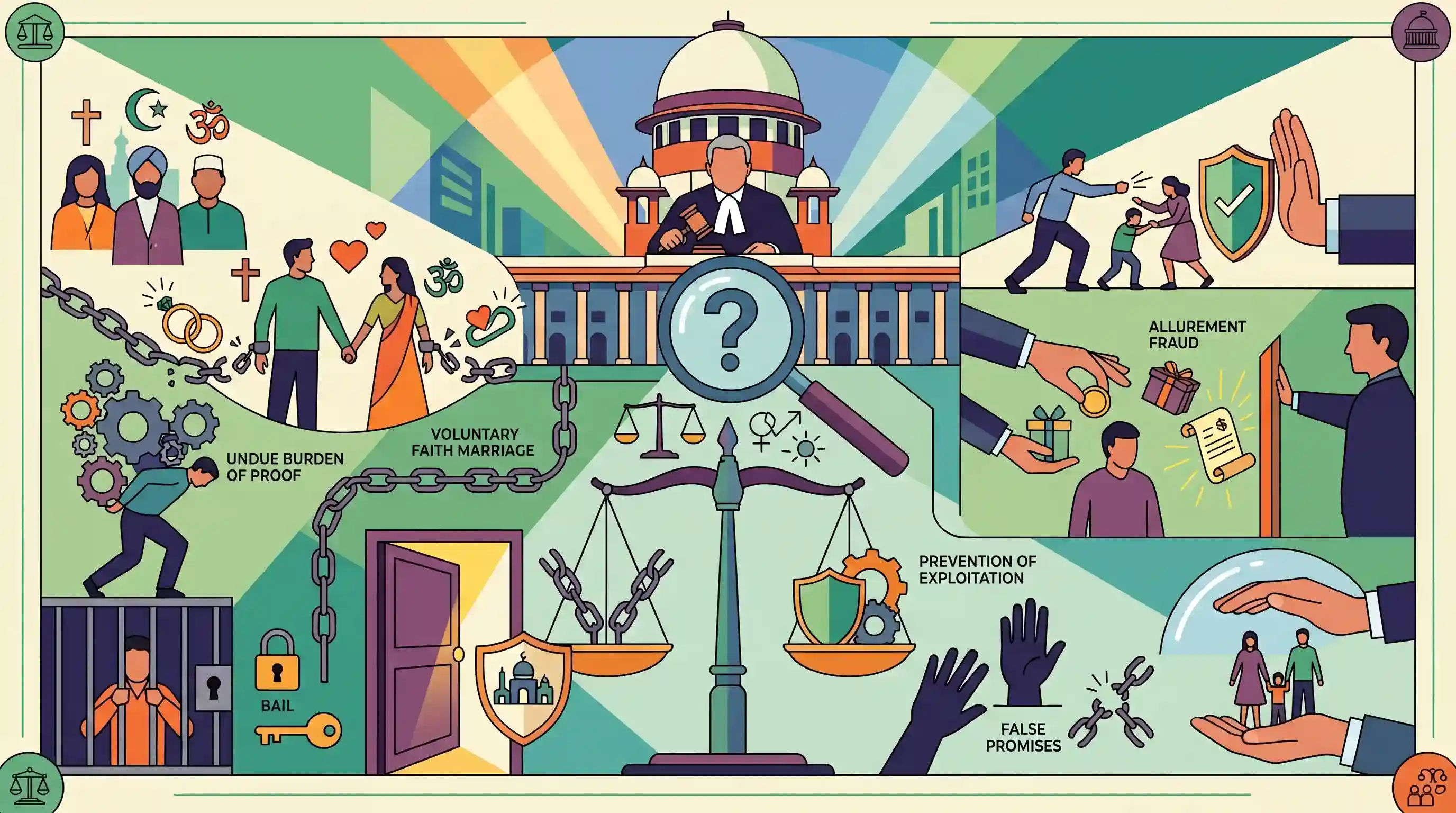
The Supreme Court is currently examining the constitutionality of State-level anti-conversion laws (Freedom of Religion Acts) enacted by 10 States. During hearings, the Chief Justice of India questioned the criteria for determining if a conversion is 'deceitful.' Petitioners from civil rights groups argue these laws infringe on Article 25 by criminalizing voluntary conversions and inter-faith marriages, placing an undue burden of proof on converts, and imposing harsh bail conditions. Conversely, proponents argue the laws are necessary to prevent conversions achieved through fraud, force, or allurement, highlighting the delicate balance between preventing exploitation and safeguarding the fundamental right to freedom of religion and privacy.
Key Points
- The Supreme Court of India has questioned the legal benchmark for determining what constitutes a 'deceitful' religious conversion.
- A batch of petitions is challenging the constitutional validity of anti-conversion laws (Freedom of Religion Acts) currently in force across 10 States.
- Petitioners argue that these State laws infringe upon the fundamental right to freedom of conscience and free profession, practice, and propagation of religion guaranteed under Article 25.
- Critics claim the laws impose stringent bail conditions similar to the UAPA, place the burden of proof on the convert, and criminalize inter-faith marriages.
- Advocates of the laws, however, maintain that Article 25 protects voluntary propagation but does not extend a fundamental right to convert others through force, allurement, or deceit.
Important Terms
Freedom of Religion Acts

State-level legislations (commonly called anti-conversion laws) that regulate religious change by prohibiting "force, fraud, or allurement" and often requiring administrative notice.
UPSC context
GS Paper II (Polity); tests the balance between state regulation and individual religious freedom under Indian secularism.
Article 25 of the Constitution
A fundamental right guaranteeing freedom of conscience and the right to profess, practice, and propagate religion, subject to public order, health, and morality.
UPSC context
GS Paper II (Fundamental Rights); central to debates on the "right to convert" and judicial precedents like Stainislaus (1977).
Unlawful Activities (Prevention) Act (UAPA)
India's primary anti-terror law providing for the prevention of "unlawful activities" and "terrorist acts," notable for its stringent bail conditions and investigative powers.
UPSC context
GS Paper III (Internal Security); often compared with other stringent legislations regarding the "reverse burden of proof."
Law Commission of India
A non-statutory executive body established by the Government of India to recommend legal reforms and the modernization of the Indian legal system.
UPSC context
GS Paper II (Governance); important for its role in drafting institutional reports on criminal and constitutional law reforms.
Citizens for Justice and Peace (CJP)
A Mumbai-based civil rights NGO that serves as a lead petitioner in legal challenges against laws deemed to infringe on constitutional liberties and secularism.
UPSC context
GS Paper II (Social Justice); illustrates the role of civil society and PIL in safeguarding fundamental rights.
Supreme Court of India
The highest judicial authority in India and the ultimate interpreter of the Constitution, empowered to strike down laws that violate fundamental rights.
UPSC context
GS Paper II (Judiciary); tests knowledge of judicial review and the Court's adjudication of state-federal constitutional conflicts.
Prelims Trap
Article 25 explicitly guarantees the fundamental right to convert others to one's own religion.
The SC ruled in the Rev. Stanislaus case (1977) that 'propagate' means transmitting tenets, not a right to convert. Forced conversion infringes on the target's freedom of conscience.
Static Concepts Connected
What are the constitutional grounds for restricting freedom of religion under Article 25?
- Public Order, Morality, Health: The primary grounds under Article 25(1) allowing the State to restrict religious freedom. States heavily utilize "Public Order" to justify enacting anti-conversion laws.
- Other Fundamental Rights: Article 25 is uniquely subject to other provisions of Part III, meaning religious practices cannot violate Article 21 (Right to Life/Dignity) or Article 14 (Equality).
- Secular Activity Regulation: The State is empowered to regulate or restrict economic, financial, political, or other secular activities associated with religious practices under Article 25(2)(a).
Under which legislative domain do States derive the power to enact anti-conversion laws?
- State List (Entry 1): States enact Freedom of Religion Acts primarily under 'Public Order' (Entry 1 of List II in the Seventh Schedule).
- Absence of Central Law: India currently has no national anti-conversion law. The regulation of religious conversions is handled individually by states to prevent localized public disturbances.
Cross-Topic Patterns
Article 21 overriding religious restrictions
The SC views the right to marry a person of one's choice (Hadiya case) as intrinsic to personal liberty (Art 21), heavily conflicting with state laws annulling inter-faith marriages.
Reversal of burden of proof in criminal law
Like UAPA, PMLA, and NDPS, state anti-conversion laws shift the burden of proof to the accused, raising severe fair-trial and due-process concerns under Article 21.

Expect a Prelims statement contrasting 'propagate' (Art 25) vs 'convert' alongside State vs Union legislative powers on public order.
Linked PYQs · 3
Linked PYQs · 3
- 2024MainsGS2
Discuss India as a secular state and compare with the secular principles of the US constitution.
- 2017MainsGS2
Examine the scope of Fundamental Rights in the light of the latest judgement of the Supreme Court on Right to Privacy.
- 2024PrelimsGS1
Under which of the following Articles of the Constitution of India, has the Supreme Court of India placed the Right to Privacy ?
