Supreme Court Notice on Gulf CBSE Assessment Scheme
Source:The Hindu ↗
Why It Matters
This issue highlights the vulnerability of the Indian diaspora during regional geopolitical crises and illustrates the intersection between administrative policy, the Right to Education, and the role of the judiciary in examining policies that retrospectively affect students' careers and admissions.
Summary
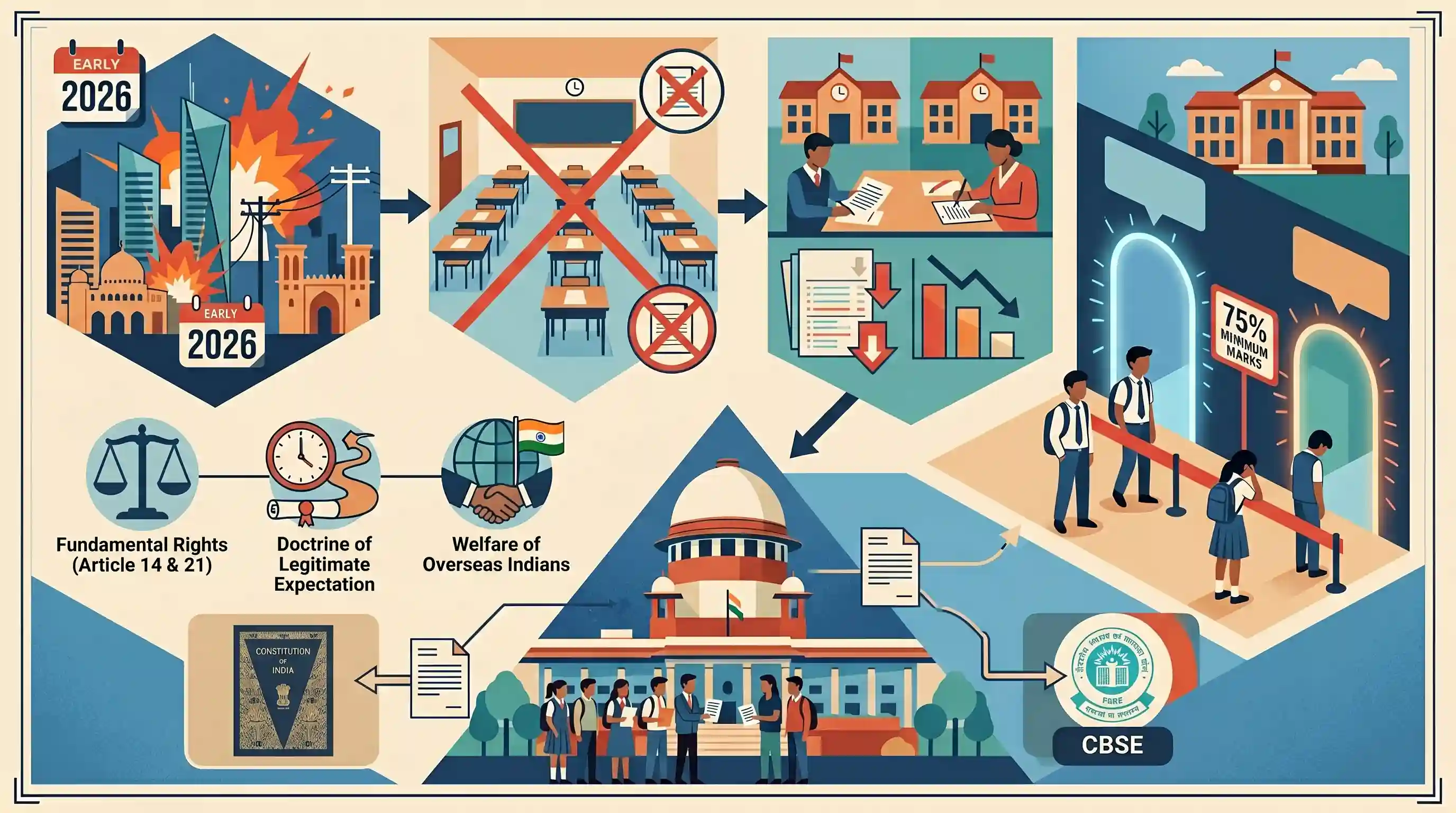
The Supreme Court has issued notices to the Union Government and CBSE regarding a petition filed by Class XII students in Gulf countries. Due to the West Asia conflict in early 2026, standard board examinations were cancelled in these regions, forcing CBSE to apply an assessment scheme based purely on school-level internal evaluations. The students contend that this has severely deflated their academic performance, disqualified them from major technical admissions under the DASA and CIWG diaspora entry schemes (which require 75% marks), and violated their fundamental rights and legitimate expectations.
Key Points
- The Supreme Court of India has sought a response from the Centre and CBSE on a plea by Class XII students in the Gulf region challenging the March 27, 2026 CBSE assessment scheme.
- The board exams in the Gulf nations (UAE, Saudi Arabia, Qatar, Kuwait, Bahrain, Oman) had been cancelled earlier in 2026 owing to the erupting geopolitical conflict in West Asia.
- The contested assessment scheme evaluated the students' final marks based solely on school-level internal examinations (quarterly, half-yearly, and pre-boards) for the cancelled papers, which the petitioners claim artificially and drastically deflated their grades.
- The lowered marks have compromised the students' eligibility for premier Indian engineering institutions (NITs, IIITs, and CFTIs) under the DASA and CIWG schemes, both of which require a minimum 75% aggregate in Class XII.
- The petitioners argue that the retrospective application of this internal-only assessment scheme is arbitrary, discriminatory, and violates Articles 14 (Equality), 21 (Right to Education/Life), and the administrative principle of the Doctrine of Legitimate Expectation.
- Relief requested by the students includes a one-time grant of compensatory moderation marks, special physical/improvement exams with a 'better of the two' grading safety net, and a temporary lowering of the DASA/CIWG eligibility threshold from 75% to 60%.
Important Terms
Direct Admission of Students Abroad (DASA) scheme

A Ministry of Education initiative facilitating undergraduate and postgraduate engineering and technical admissions in premier Indian institutions for NRIs, PIOs, OCIs, and foreign nationals.
UPSC context
GS Paper II: Policies for education, welfare of the Indian diaspora, and international student mobility.
Children of Indian Workers in Gulf Countries (CIWG) scheme
A specialized sub-category under the DASA scheme reserving 1/3rd of supernumerary seats with resident-equivalent fee concessions for children of Indian expatriates working in Gulf nations.
UPSC context
GS Paper II: Welfare of the Indian diaspora and welfare schemes for vulnerable/specific segments.
Centrally Funded Technical Institutions (CFTIs)
Elite, autonomous public higher education institutions in India (such as IITs, NITs, and IIITs) that receive direct funding from the Union Ministry of Education.
UPSC context
GS Paper II: Issues relating to development and management of education and human resources.
National Institutes of Technology (NITs)
A network of premier, autonomous public technical universities in India designated as Institutes of National Importance, offering specialized undergraduate and postgraduate engineering programs.
UPSC context
GS Paper II: Education policies, statutory bodies, and development of human capital.
Indian Institutes of Information Technology (IIITs)
A group of autonomous, engineering-focused technical research universities in India dedicated to information technology, established under both fully government-funded and public-private partnership models.
UPSC context
GS Paper III: Science and Technology infrastructure, IT sector development, and digital skill building.
Central Board of Secondary Education (CBSE)
A national-level board of education in India for public and private schools, controlled and managed by the Government of India, responsible for standard school-level curriculum and examinations.
UPSC context
GS Paper II: Statutory, regulatory and various quasi-judicial bodies, and governance of the education sector.
Prelims Trap
The CIWG and DASA schemes are independent welfare programs run by the Ministry of External Affairs for NRI students.
CIWG is a sub-category under the DASA scheme, both administered by the Ministry of Education (not MEA), using JEE Main ranks for admissions.
Static Concepts Connected
What is the Doctrine of Legitimate Expectation in Indian law?
- Constitutional base: Rooted in Article 14 (non-arbitrariness) and natural justice, protecting citizens against sudden, unjustified reversals of state policy.
- Key precedent: Established in State of Kerala v. K.G. Madhavan Pillai (1988), asserting past regular practices create a reasonable expectation of fair treatment.
- Not absolute: It does not guarantee a final right; public interest or statutory necessity can override it if the state's action is rational and justified.
How do DASA and CIWG educational schemes operate?
- Nodal authority: Managed by the Ministry of Education for admissions of NRIs, OCIs, and foreign nationals into NITs, IIITs, and CFTIs.
- CIWG sub-quota: Reserves 1/3rd of DASA seats for children of Indian workers in the Gulf, providing heavily subsidized tuition fees equal to domestic students.
- Academic threshold: Requires JEE Main ranks and a strict minimum of 75% aggregate marks (or 7.5 CGPA) in the Class XII qualifying board exams.
Cross-Topic Patterns
West Asia instability & Diaspora vulnerability
Geopolitical conflict in the Gulf triggers domestic administrative friction, requiring Indian courts to mediate educational equity for children of transient overseas laborers.
Remittance dynamics & State reciprocity
While high-skill Western migration dominates remittance values, the 9-million-strong GCC labor force remains highly dependent on domestic welfare schemes like CIWG for socio-economic mobility.

Legitimate Expectation under Article 14 and DASA/CIWG eligibility norms are highly likely to feature in a GS-2 Polity question.
Linked PYQs · 2
Linked PYQs · 2
- 2020MainsGS2
Indian diaspora has a decisive role to play in the politics and economy of America and European Countries'. Comment with examples.
- 2023MainsGS2
Indian diaspora has scaled new heights in the West. Describe its economic and political benefits for India.
