Supreme Court Notice on Climate Induced Heat Wave Deaths
Source:The Hindu ↗
Why It Matters
This issue represents a crucial convergence of constitutional law and environmental disaster management. It illustrates how the Indian judiciary is increasingly treating the adverse impacts of climate change, such as fatal heat waves, as a fundamental rights issue that requires proactive disaster mitigation and accountable governance.
Summary
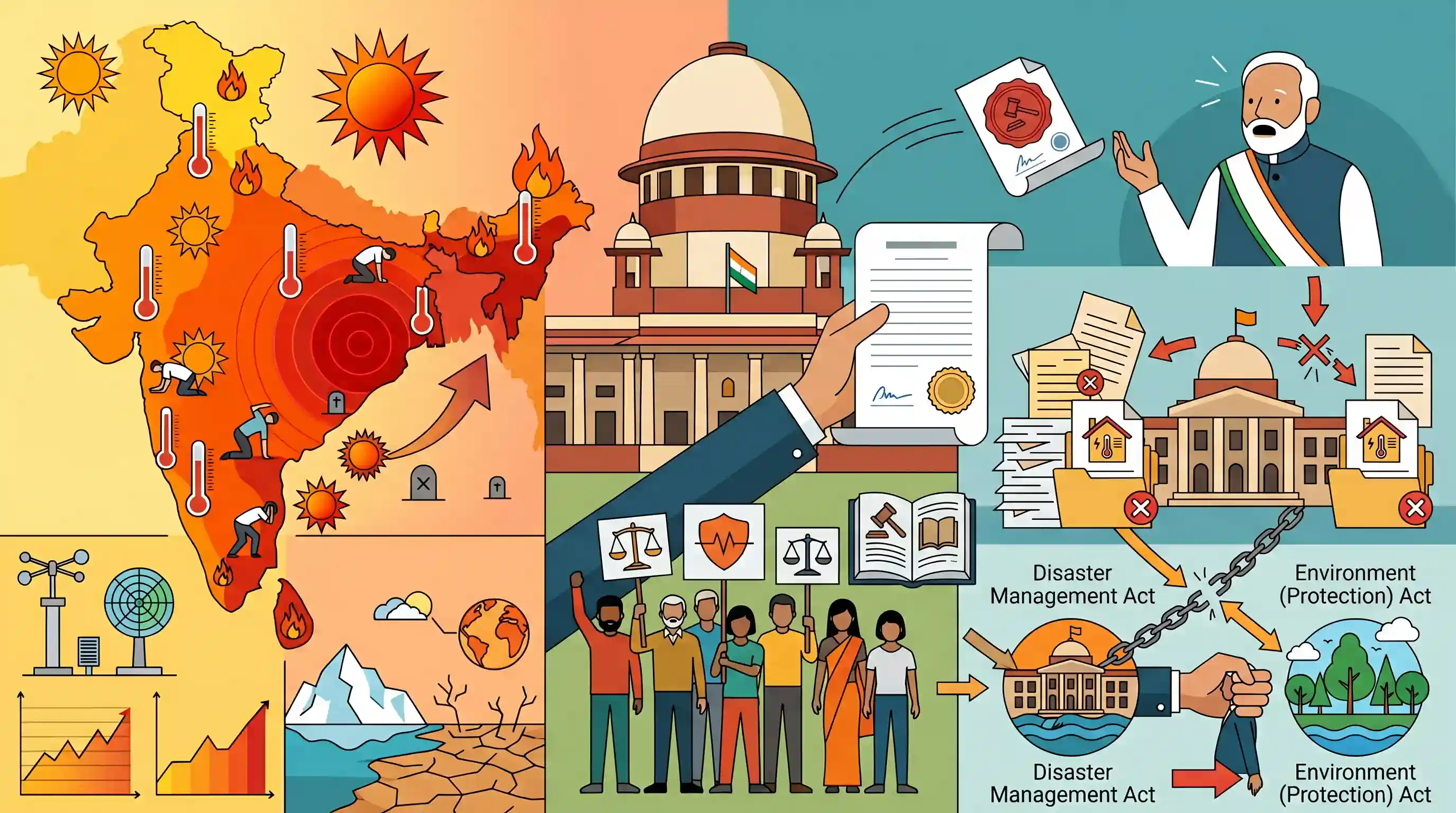
The Supreme Court has issued a notice to the Union government regarding a public interest litigation on mounting heat wave deaths across India. Citing the SC's previous landmark ruling in the M.K. Ranjitsinh case, the petitioner argued that the failure to protect citizens from climate-induced extreme heat violates fundamental rights under Articles 14 and 21. The petition underscored a widespread failure by state governments to implement the National Disaster Management Authority's (NDMA) 2019 guidelines on Heat Action Plans. Relying on IMD data showing the spatial expansion of heat waves and IPCC reports on escalating climate risks, the plea calls for urgent government accountability under the Disaster Management Act and Environment (Protection) Act.
Key Points
- The Supreme Court is reviewing the government's response to rising heat wave deaths, framing climate change impacts as a potential violation of the fundamental right to life (Article 21).
- A petition highlighted the failure of state governments to properly implement the NDMA's 2019 National Guidelines on Heat Action Plans.
- The IMD reports that severe heat waves have geographically expanded beyond Northwest and Central India to include the East Coast, Peninsular, and Southern regions.
- The 2023 IPCC Synthesis Report warns that human-induced climate change will significantly increase extreme heat events, resulting in higher mortality and threatening food and water security.
Important Terms
M.K. Ranjitsinh case

A 2024 Supreme Court ruling establishing the 'right to be free from adverse effects of climate change' as a fundamental right under Articles 14 and 21.
UPSC context
GS Papers 2 & 3: Crucial for Environmental Jurisprudence and the expansion of Fundamental Rights regarding climate accountability.
National Guidelines for Preparation of Action Plan – Prevention and Management of Heat Wave, 2019
NDMA framework helping states and districts develop Heat Action Plans (HAPs) for early warning, medical preparedness, and public awareness to reduce heat-related mortality.
UPSC context
GS Paper 3: Essential for Disaster Management; tests knowledge of institutional responses to escalating extreme weather events.
Disaster Management Act, 2005
Central legislation providing the legal framework for disaster preparedness and mitigation; it established the NDMA and shifted India's approach from relief-centric to proactive management.
UPSC context
GS Papers 2 & 3: Core act for Governance and Disaster Management; fundamental for understanding executive powers during emergencies.
National Disaster Management Authority (NDMA)
The apex statutory body for disaster management in India, chaired by the Prime Minister, mandated to lay down policies and coordinate national disaster responses.
UPSC context
GS Paper 3: Institutional framework for Disaster Management; key for understanding policy formulation and inter-agency coordination.
Article 21
A fundamental right guaranteeing the 'protection of life and personal liberty,' judicially expanded to include the right to a clean environment and protection from climate risks.
UPSC context
GS Paper 2: Frequently tested under Indian Polity; focuses on judicial activism and the evolving scope of constitutional rights.
Environment (Protection) Act, 1986
An 'umbrella' legislation enacted after the Bhopal Gas Tragedy that empowers the Central Government to coordinate environmental protection and set pollution standards.
UPSC context
GS Paper 3: Primary environmental law; tests understanding of the state's regulatory authority in ecological conservation.
India Meteorological Department (IMD)
India’s nodal agency for meteorological observations and forecasting; it defines and issues color-coded alerts for Heat Waves based on specific regional temperature thresholds.
UPSC context
GS Papers 1 & 3: Relevant for Geography (climatic phenomena) and Disaster Management (early warning systems).
Intergovernmental Panel on Climate Change (IPCC)
A UN-backed body that provides scientific assessments on climate change impacts and risks; its reports form the basis for international climate policy and negotiations.
UPSC context
GS Paper 3: International organizations; provides the scientific consensus used to frame answers on global warming's impact on India.
Prelims Trap
"Heat waves are formally notified as a national disaster under the Disaster Management Act, 2005."
Despite severe impacts and NDMA guidelines, heat waves are currently NOT formally notified as a national disaster under the DM Act, 2005.
Static Concepts Connected
What are the IMD's criteria for declaring a heat wave?
- Plains threshold: The maximum temperature of a station must reach at least 40°C.
- Hilly regions: The maximum temperature of a station must reach at least 30°C.
- Temperature departure: The departure from normal temperature must be between 4.5°C to 6.4°C (Severe heat wave if > 6.4°C).
How does the Indian Constitution address environmental protection?
- Article 21: Judicial interpretation (e.g., M.K. Ranjitsinh case) includes the right to a clean environment and protection from adverse climate change effects under Right to Life.
- DPSP (Article 48A): Directs the State to endeavor to protect and improve the environment and to safeguard the forests and wildlife of the country.
- Article 51A(g): Makes it a duty of every citizen to protect and improve the natural environment, including forests, lakes, rivers, and wildlife.
Cross-Topic Patterns
Climate Jurisprudence & Executive Accountability
SC's use of Articles 14 and 21 to force implementation of NDMA guidelines highlights the growing intersection of fundamental rights, judicial activism, and disaster management.
Spatial shift & Urban Heat Islands
The expansion of heat waves to Peninsular India connects to unplanned urbanization, urban heat islands, and altering local microclimates that worsen the region's overall climate vulnerability.

Expect a 2026 Prelims statement mixing IMD heat wave criteria with its non-notified status under the Disaster Management Act.
Linked PYQs · 3
Linked PYQs · 3
- 2022MainsGS2
“The most significant achievement of modern law in India is the constitutionalization of environmental problems by the Supreme Court.” Discuss this statement with the help of relevant case laws.
- 2014MainsGS3
Drought has been recognized as a disaster in view of its spatial expanse, temporal duration, slow onset and lasting effects on vulnerable sections. With a focus on the September 2010 guidelines from the National Disaster Management Authority (NDMA), discuss the mechanisms for preparedness to deal with likely El Niño and La Niña fallouts in India.
- 2022MainsGS3
Discuss global warming and mention its effects on the global climate. Explain the control measures to bring down the level of greenhouse gases which cause global warming, in the light of the Kyoto Protocol, 1997.
