Supreme Court Questions Government on IPS Deputation in CAPFs
Source:The Hindu ↗
কেন এটি গুরুত্বপূর্ণ
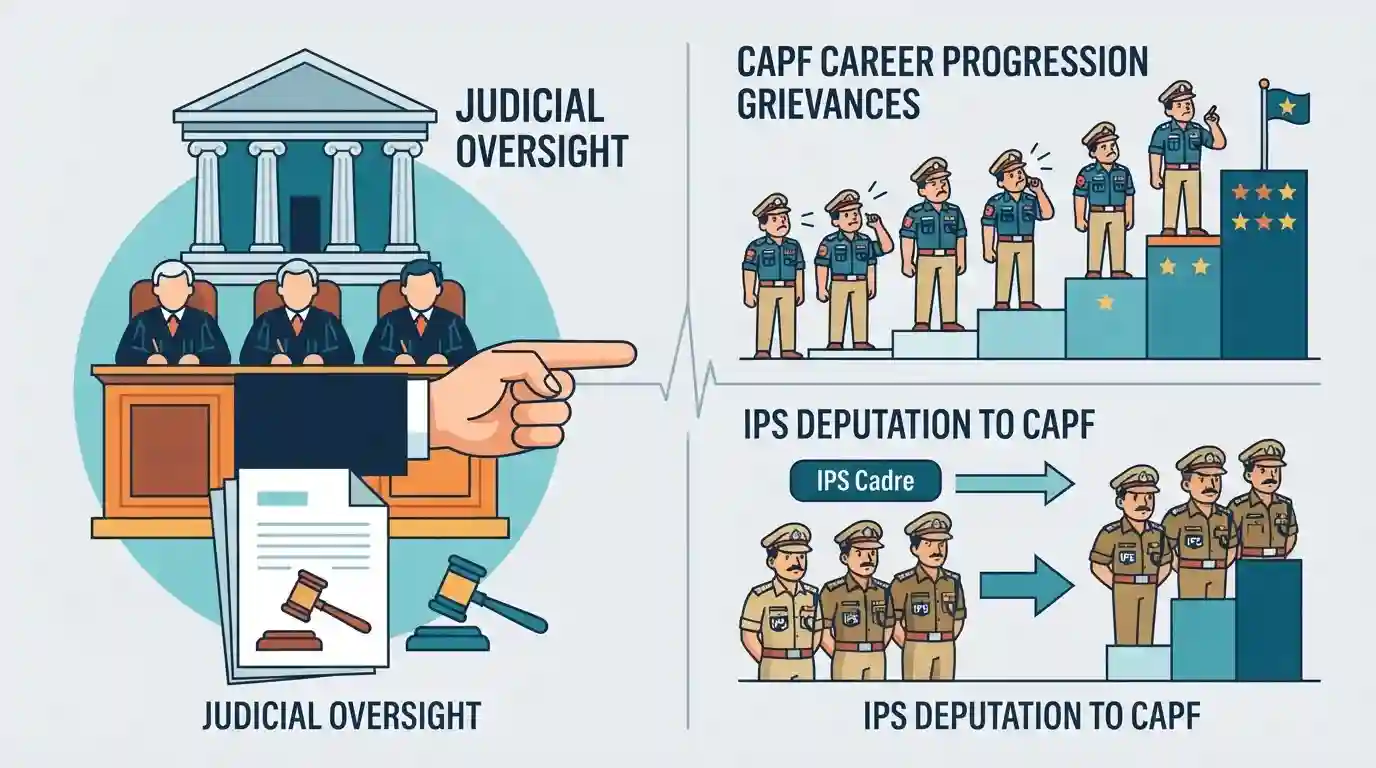
This development addresses long-standing grievances regarding career stagnation among direct-entry officers in Central Armed Police Forces (CAPFs) and highlights judicial scrutiny over executive cadre management policies involving All India Services like the IPS.
সারসংক্ষেপ
The Supreme Court sought an explanation from the central government over the deputation of IPS officers to leadership positions in Central Armed Police Forces (CAPFs), a contentious issue involving career progression grievances of direct-entry CAPF officers versus all-India service deputation practices.
মূল বিষয়
- The Supreme Court has sought an explanation from the central government regarding the continued deputation of Indian Police Service (IPS) officers to senior leadership positions within Central Armed Police Forces (CAPFs).
- CAPF cadre officers have long raised concerns that deputing IPS officers to top posts hinders their own career progression and promotional avenues.
- The issue highlights systemic tensions in public service cadre management, balancing specialized force leadership with all-India service deputation practices.
গুরুত্বপূর্ণ শব্দ
Supreme Court of India

The apex judicial court of India under the Constitution, responsible for constitutional interpretation, judicial review, and adjudicating disputes between various authorities and citizens.
UPSC context
Crucial for GS Paper II (Indian Constitution, Judiciary, Separation of Powers, and Judicial Review).
Central Armed Police Forces (CAPFs)
A group of central security forces in India—including CRPF, BSF, CISF, ITBP, and SSB—tasked with internal security, border guarding, and counter-insurgency operations.
UPSC context
Important for GS Paper III (Internal Security, Security Forces, and their Management).
Indian Police Service (IPS)
One of the All India Services under Article 312 of the Constitution, responsible for maintaining public peace, order, and policing at senior levels across states and the central government.
UPSC context
Relevant for GS Paper II (Civil Services, Cadre Management, All India Services).
Ministry of Home Affairs
The central government ministry charged with the maintenance of internal security, domestic policy, administration of all-India services, and control over central security forces.
UPSC context
Essential for GS Paper II and III (Government Ministries, Internal Security Governance, and Policy Implementation).
সংযুক্ত স্থির ধারণা
What is the administrative control and organizational mandate of Central Armed Police Forces (CAPFs) in India?
- Administrative Control: Under Ministry of Home Affairs, CAPFs comprise forces like CRPF, BSF, ITBP, CISF, and SSB tasked with internal security and border guarding.
- OGAS Status: Supreme Court granted Organised Group A Service (OGAS) status to CAPF officers in 2019, ensuring parity in non-functional financial upgrades.
- Direct Entry: Direct-entry officers enter via UPSC CAPF Assistant Commandant examination, facing career stagnation at higher supervisory levels due to deputation practices.
আন্তঃবিষয় প্যাটার্ন
Civil Services Reforms + Cadre Management Dynamics
The debate over IPS deputation in CAPFs mirrors wider discussions on administrative reform, lateral entry, and balancing generalist IAS/IPS officers with domain-specific central civil services.

Expect a multi-statement prelims question on CAPF officer classification (OGAS) and statutory vs executive rules for cadre deputation.
সংযুক্ত PYQ · 2
সংযুক্ত PYQ · 2
- 2020MainsGS2
Institutional quality is a crucial driver of economic performance". In this context suggest reforms in Civil Service for strengthening democracy.
- 2017MainsGS2
Initially Civil Services in India were designed to achieve the goals of neutrality and effectiveness, which seems to be lacking in the present context. Do you agree with the view that drastic reforms are required in Civil Services? Comment.
