Supreme Court Seeks Response On CBI Probe For Ponzi Scheme
Source:The Hindu ↗
Why It Matters
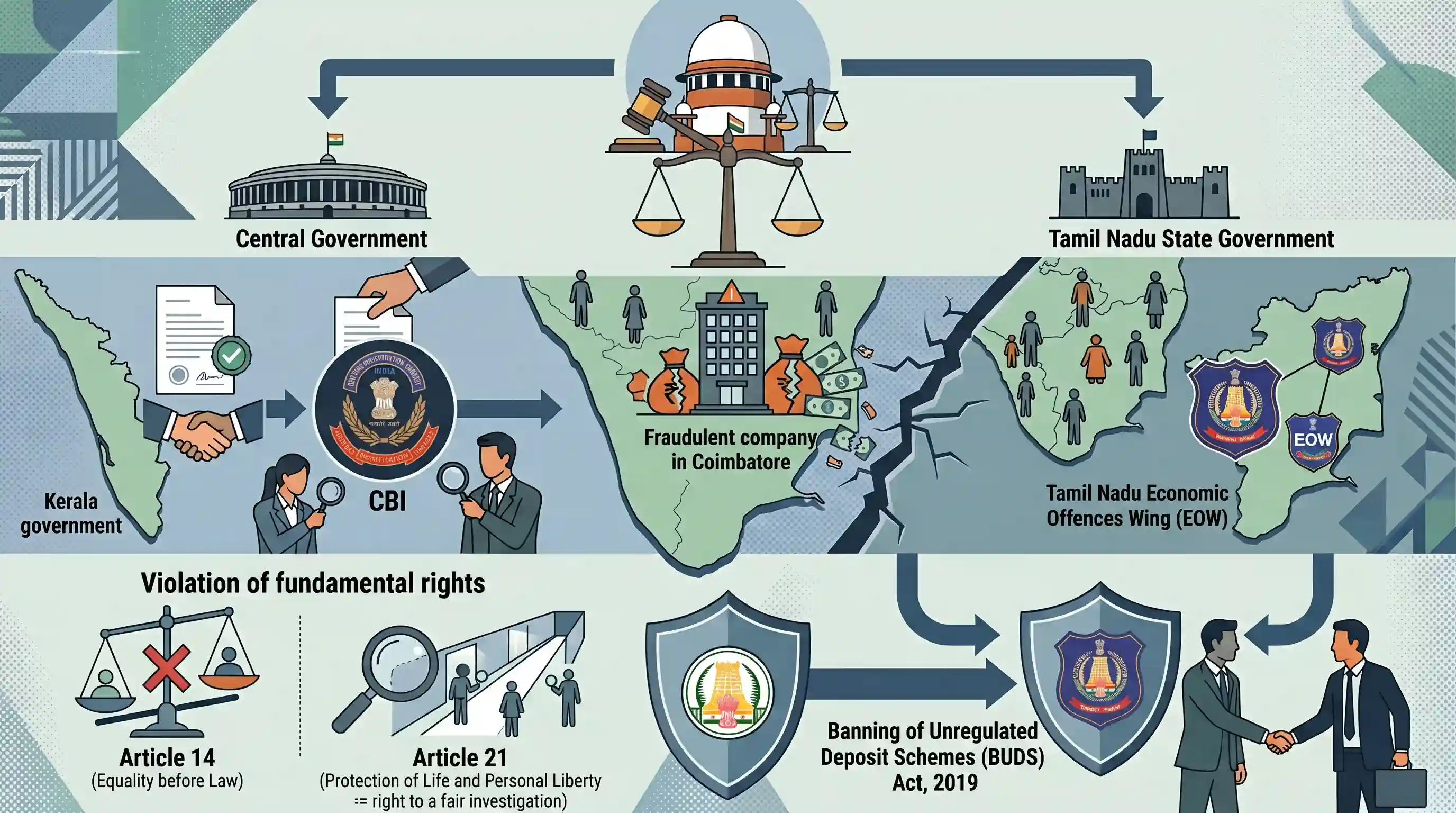
This case illustrates the practical challenges in India's federal structure regarding law enforcement jurisdictions. The requirement for state consent for a CBI probe under the DSPE Act often leads to fragmented investigations in multi-state crimes, which can impact the efficiency of justice delivery and investor protection frameworks.
Summary
The Supreme Court has sought responses from the Centre and Tamil Nadu government regarding a petition for a centralized CBI investigation into a ₹1,000-crore multi-state Ponzi scheme. The scam, orchestrated by a Coimbatore-based company, has affected around 73,000 investors. The case underscores federal complexities in investigating cross-border financial crimes; while Kerala granted consent to the CBI under Section 6 of the Delhi Special Police Establishment (DSPE) Act, Tamil Nadu's Economic Offences Wing is conducting a separate probe. Petitioners argue that this fragmented approach violates the fundamental rights to equality and a fair investigation (Articles 14 and 21), highlighting the necessity for cohesive action under the Banning of Unregulated Deposit Schemes Act, 2019.
Key Points
- The Supreme Court has sought responses from the Centre and the Tamil Nadu government regarding a plea for a centralized CBI probe into a massive multi-state Ponzi scheme.
- The scheme, run by Coimbatore-based Universal Trading Solutions, allegedly defrauded approximately 73,000 investors of nearly ₹1,000 crore.
- A fragmented probe is currently underway because Kerala granted consent for a CBI investigation under Section 6 of the DSPE Act, whereas Tamil Nadu's EOW is conducting its own separate investigation.
- Petitioners argue that piecemeal investigations across states violate the fundamental right to a fair probe under Articles 14 and 21, necessitating a uniform CBI investigation.
- The case invokes legal frameworks aimed at investor protection, including the Banning of Unregulated Deposit Schemes Act, 2019, and state-specific depositor protection acts.
Important Terms
Banning of Unregulated Deposit Schemes (BUDS) Act, 2019

A comprehensive 2019 law prohibiting unregulated deposit-taking to protect investors. It provides for property attachment and designates a 'Competent Authority' to repay victims of financial fraud.
UPSC context
GS-3 Economy/Internal Security; tests regulatory frameworks against financial fraud and consumer protection mechanisms.
Delhi Special Police Establishment (DSPE) Act, 1946
The law governing the Central Bureau of Investigation (CBI). Section 6 requires the agency to obtain state government consent before investigating crimes within a state's jurisdiction.
UPSC context
GS-2 Federalism/Statutory Bodies; tests jurisdictional boundaries between central agencies and state police powers.
Central Bureau of Investigation (CBI)
India's premier central investigative agency under the DSPE Act. It handles complex corruption, economic offences, and cases referred by the Supreme Court or High Courts.
UPSC context
GS-2 Statutory Bodies; tests the role, independence, and challenges of central investigative institutions.
Ponzi Scheme
A fraudulent investing scam where returns are paid to earlier investors using capital from newer investors rather than actual business profits, inevitably leading to collapse.
UPSC context
GS-3 Economy/Internal Security; tests understanding of white-collar crimes and their impact on financial stability.
Economic Offences Wing (EOW)
Specialized police units at the state or central level dedicated to investigating complex white-collar crimes, investment scams, and organized financial misconduct.
UPSC context
GS-3 Internal Security; tests knowledge of specialized law enforcement units and their role in tackling economic crimes.
Tamil Nadu Protection of Interests of Depositors (TNPID) Act, 1997
A specialized Tamil Nadu law enacted to protect depositors from fraudulent financial establishments by facilitating property attachment and establishing Special Courts for recovery.
UPSC context
GS-2 State Governance; tests state-level legislative responses to financial fraud and their federal implications.
Prelims Trap
"The CBI requires mandatory State consent to investigate any offence, even if the probe is directed by the Supreme Court."
The Supreme Court and High Courts can order CBI investigations without State consent. Consent under Section 6 of the DSPE Act is only required when the Centre or CBI initiates the probe.
Static Concepts Connected
How is the CBI's jurisdiction regulated within the territory of Indian States?
- Executive Body: CBI is not a statutory body; it derives its investigative powers from the Delhi Special Police Establishment (DSPE) Act, 1946.
- Section 6 Consent: Under Section 6, the CBI requires general or specific consent from the State government to operate within its jurisdiction, reflecting that 'Police' is a State subject.
- Judicial Exception: Constitutional courts (Supreme Court and High Courts) can mandate a CBI probe in any state without requiring the State government's consent.
What are the key mechanisms of the Banning of Unregulated Deposit Schemes (BUDS) Act, 2019?
- Absolute Ban: The Act explicitly bans all unregulated deposit-taking activities, replacing previous fragmented regulations with a single, comprehensive legal framework against Ponzi schemes.
- Priority of Claims: It ensures that depositors' repayment claims take precedence over all other debts, revenues, and taxes, empowering authorities to attach promoters' properties.
- Centralized Database: It mandates the creation of a centralized online database to share information on deposit-taking activities, bridging the gap between state and central enforcement agencies.
Cross-Topic Patterns
CBI Consent + Federal Friction
The withdrawal of 'general consent' by several states creates jurisdictional deadlocks, making GS2 federalism questions heavily reliant on DSPE Act provisions and Centre-State friction.
Article 21 + Fair Investigation
Expanding Article 21's scope to include the 'right to a fair investigation' creates a constitutional basis for the Supreme Court to bypass state-level policing constraints in complex, multi-state economic offences.

Expect a 2026 prelims multi-statement question combining CBI's non-statutory status, DSPE Act consent rules, and SC’s Article 21 powers.
Linked PYQs · 1
Linked PYQs · 1
- 2021MainsGS2
The jurisdiction of the Central Bureau of Investigation (CBI) regarding lodging an FIR and conducting probe within a particular State is being questioned by various States. However, the power of the States to withhold consent to the CBI is not absolute. Explain with special reference to the federal character of India.
