Supreme Court seeks response on PIL to curb malicious prosecutions
Source:Indian Express ↗
Why It Matters
Highlights the growing concern over judicial pendency caused by malicious prosecutions and fake cases. It underscores the importance of balancing fundamental rights with duties, making it relevant for GS2 topics on the judiciary, PILs, and statutory laws.
Summary
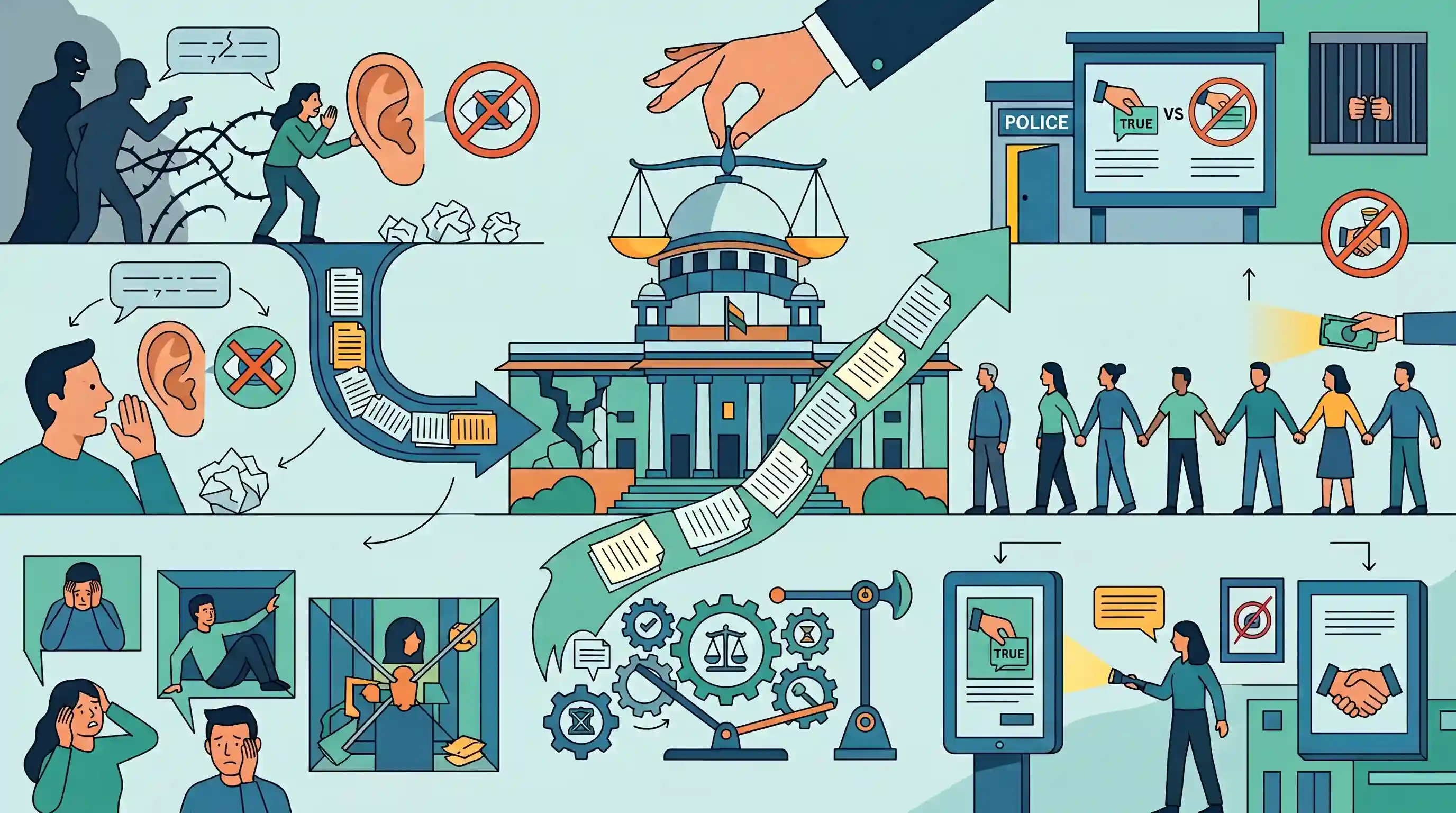
The Supreme Court is examining a Public Interest Litigation (PIL) that seeks intervention to prevent the lodging of false cases and malicious prosecutions. Chief Justice of India Surya Kant highlighted the need for checks and balances, noting that the abuse of the legal system and unchecked defamation must be countered with responsible citizenship. The PIL, filed by Advocate Ashwini Upadhyay, suggests raising public awareness about the punishments for false complaints under the Bharatiya Nyaya Sanhita 2023 by installing notice boards in police stations and other public areas. It also points out that the misuse of laws, such as the SC/ST Act in unrelated disputes, severely overburdens the judiciary and harms innocent individuals.
Key Points
- The Supreme Court issued a notice to the Centre and states on a PIL seeking to curb false cases and malicious prosecutions.
- Chief Justice Surya Kant emphasized the need for checks and balances against the misuse of the legal system, defamation, and abusive language.
- The PIL suggested installing notice boards in police stations and public spaces to inform citizens about punishments for false complaints under the Bharatiya Nyaya Sanhita 2023.
- The petition highlighted that courts are burdened by fake cases, including the misuse of the SC/ST Act in unrelated disputes.
Important Terms
Bharatiya Nyaya Sanhita, 2023 (BNS)

India's new criminal code replacing the Indian Penal Code. Sections 227-248 specifically address offenses related to false evidence, with penalties up to seven years for lying in judicial proceedings.
UPSC context
GS Paper 2 (Criminal Justice Reforms). Crucial for understanding the transition from colonial-era laws to modern statutory frameworks.
Public Interest Litigation (PIL)
A legal mechanism allowing individuals or organizations to file petitions for the protection of public interest, bypassing the traditional "locus standi" rule that requires the petitioner to be personally affected.
UPSC context
GS Paper 2 (Judiciary). Tests knowledge of judicial activism and the expansion of access to justice for marginalized sections.
SC/ST Act (1989)
A special legislation designed to prevent discrimination and crimes against Scheduled Castes and Scheduled Tribes. It includes stringent provisions like the denial of anticipatory bail to prevent harassment of vulnerable groups.
UPSC context
GS Paper 2 (Social Justice). Often discussed in terms of its efficacy versus reports of misuse in personal or civil disputes.
Malicious Prosecution
The wrongful initiation of criminal or civil proceedings against a person without reasonable cause and with improper motives (malice), often leading to a claim for damages by the victim.
UPSC context
GS Paper 4 (Ethics/Integrity). Relevant for understanding the misuse of state machinery and the need for accountability in justice.
Supreme Court of India
The highest judicial court and final interpreter of the Constitution in India. It possesses original, appellate, and advisory jurisdictions and acts as the guardian of fundamental rights.
UPSC context
GS Paper 2 (Judiciary). Central to study of separation of powers, judicial review, and significant constitutional interpretations.
Prelims Trap
The Bharatiya Nyaya Sanhita (BNS) 2023 introduced the penalization of false complaints and malicious prosecutions for the first time in India.
The BNS 2023 merely reorganizes and updates these penalties (e.g., Section 212). The Indian Penal Code (IPC) already contained provisions (like Sections 182 and 211) penalizing false charges.
Static Concepts Connected
What is the constitutional and procedural basis for PILs in India?
- Relaxed Locus Standi: The traditional rule is relaxed, allowing any public-spirited individual or entity to approach the court on behalf of marginalized or disadvantaged groups.
- Constitutional Authority: PILs are primarily entertained under Article 32 (Supreme Court) and Article 226 (High Courts) for the enforcement of Fundamental Rights.
- Frivolous Petitions: To prevent the abuse of the PIL jurisdiction, courts can dismiss petitions with exemplary costs if found to be politically motivated or frivolous.
How does the Indian legal framework handle malicious prosecutions?
- Penal Provisions: The Bharatiya Nyaya Sanhita (BNS) 2023 contains specific sections (like Sec 212) that criminalize furnishing false information to public servants.
- Inherent Powers: High Courts can invoke Section 528 of BNSS (formerly Sec 482 CrPC) to quash frivolous FIRs and criminal proceedings to prevent the abuse of process.
- Civil Remedies: A victim of a deliberately fake case can file a civil suit claiming tortious liability for damages against the malicious prosecutor.
Cross-Topic Patterns
Fundamental Duties balancing Rights
The CJI linking access to justice with "responsible citizenship" mirrors recent judicial trends using Fundamental Duties (Article 51A) to interpret and balance the absolute enforcement of Fundamental Rights.
Protective Laws vs. Legal Terrorism
The debate over fake cases under the SC/ST Act parallels the historic misuse of IPC 498A (dowry cruelty), forcing the judiciary to formulate arrest safeguards to protect innocent citizens.

Expect a 2026 Mains question assessing how the misuse of protective laws and frivolous PILs exacerbates India's judicial pendency crisis.
Linked PYQs · 2
Linked PYQs · 2
- 2024MainsGS2
Explain the reasons for the growth of public interest litigation in India. As a result of it, has the Indian Supreme Court emerged as the world's most powerful judiciary ?
- 2020MainsGS2
Judicial Legislation is antithetical to the doctrine of separation of powers as envisaged in the Indian Constitution. In this context justify the filing of large number of public interest petitions praying for issuing guidelines to executive authorities.
