Judicial intervention against malicious prosecution and fake cases
Source:Indian Express ↗
Why It Matters
Addresses the critical issues of judicial pendency, misuse of protective legislations, and malicious prosecution. It is relevant to GS-2 topics on the structure, organization, and functioning of the Judiciary and mechanisms for dispute redressal.
Summary
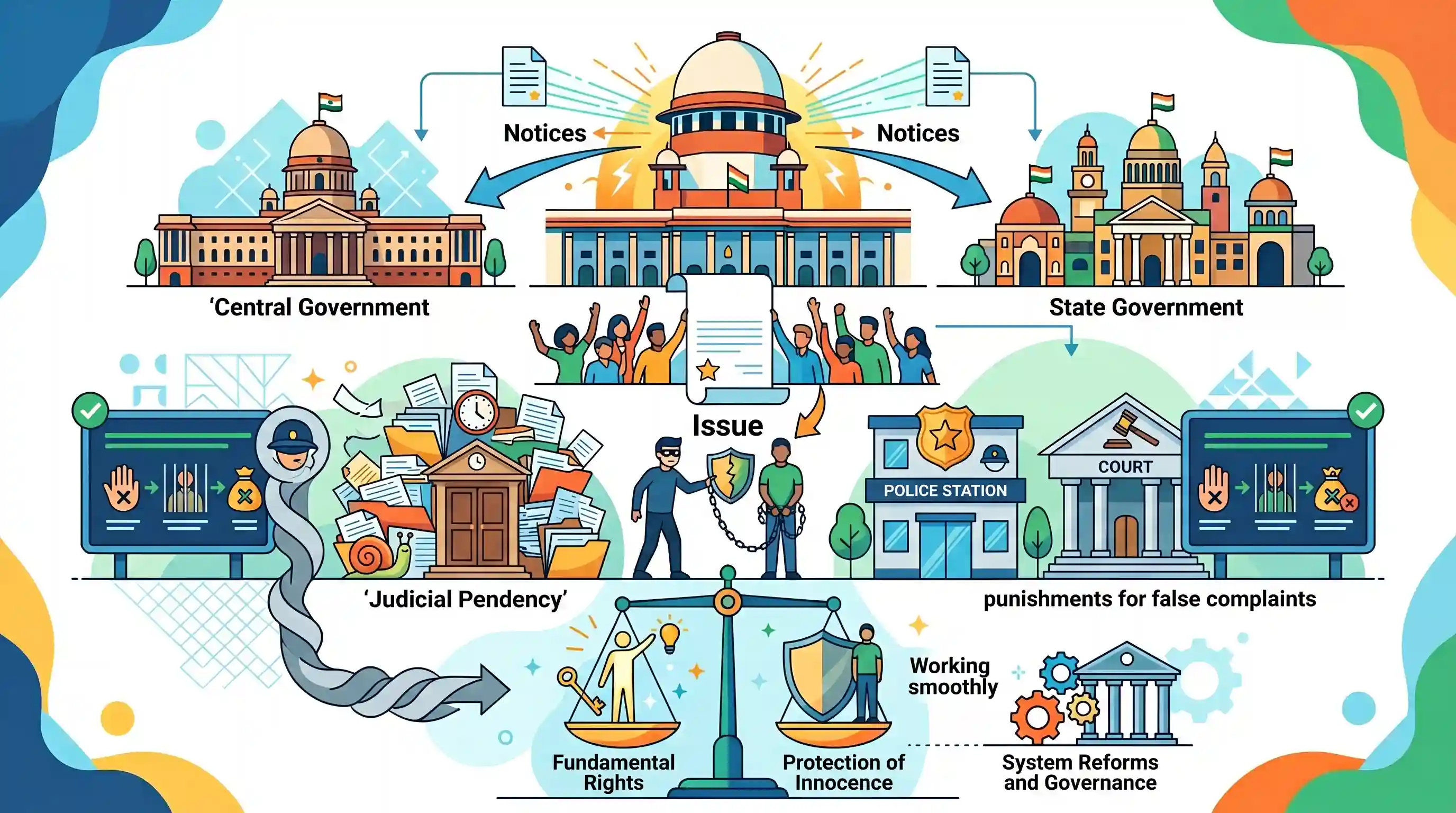
The Supreme Court has issued notices to the Centre and state governments regarding a Public Interest Litigation (PIL) that seeks measures to prevent the filing of fake cases and malicious prosecutions. The PIL, highlighting the misuse of protective laws and its contribution to judicial pendency, suggests mandating the display of information boards at police stations and courts detailing the punishments for false complaints under the Bharatiya Nyaya Sanhita, 2023. The plea emphasizes the need to balance fundamental rights and protect innocent individuals from the devastating impacts of fabricated legal disputes.
Key Points
- The Supreme Court has sought responses from the Centre and states on a PIL aimed at curbing fake cases and malicious prosecutions.
- The petition highlights the misuse of laws meant for vulnerable groups, such as the SC/ST Act and dowry laws, to settle personal disputes and extort money.
- The petitioner urged the installation of information boards at police stations and courts to warn the public about the penal consequences of filing false complaints under the Bharatiya Nyaya Sanhita, 2023.
- The PIL emphasized that malicious prosecutions severely burden the judicial system and infringe upon the fundamental rights of the falsely accused, citing the example of ISRO scientist Nambi Narayanan.
Important Terms
Bharatiya Nyaya Sanhita (BNS), 2023

India's primary criminal code since 2023, replacing the Indian Penal Code (IPC). Chapter XIV specifically penalizes false evidence and malicious charges to prevent the misuse of legal machinery.
UPSC context
GS Paper II: Criminal Justice System reforms, modernizing colonial-era laws, and administrative accountability.
Public Interest Litigation (PIL)
A legal mechanism allowing any citizen or group to move the court for the protection of public interest, often bypassing traditional standing requirements to address systemic issues.
UPSC context
GS Paper II: Judicial Activism, constitutional remedies, and citizen-led legal reforms.
Malicious Prosecution
The wrongful initiation of legal proceedings against a person without probable cause and with improper motives, resulting in damage to their reputation, liberty, or finances.
UPSC context
GS Paper II: Rights of the accused, judicial integrity, and police-prosecutorial misconduct.
Judicial Pendency
The large backlog of unresolved cases in the Indian court system, often cited as a barrier to the timely delivery of justice and the Rule of Law.
UPSC context
GS Paper II: Issues relating to the functioning of the Judiciary and governance reforms.
Article 21
A constitutional provision guaranteeing that no person shall be deprived of their life or personal liberty except by legal procedure; it is the cornerstone of protections against wrongful arrest.
UPSC context
GS Paper II: Indian Constitution, Fundamental Rights, and Supreme Court interpretations of dignity.
SC/ST (Prevention of Atrocities) Act
Specialized legislation designed to prevent crimes and discrimination against marginalized communities; the PIL argues its provisions are sometimes misused in civil or land disputes.
UPSC context
GS Paper II: Social Justice, welfare of vulnerable sections, and balancing protective laws.
Prelims Trap
"The SC/ST (Prevention of Atrocities) Act imposes an absolute bar on anticipatory bail, and no court can grant it under any circumstances."
High Courts retain the inherent power to grant pre-arrest bail if the complaint is prima facie false or maliciously motivated.
Static Concepts Connected
How does public law remedy address malicious prosecution?
- Article 21 Violation: Wrongful incarceration and malicious prosecution violate the right to life with dignity (Article 21), as recognized in the Nambi Narayanan case.
- Constitutional Tort: The State can be held liable to pay compensation to victims for constitutional torts committed by its officials or police.
- Due Process: Any procedure depriving liberty must be just, fair, and reasonable, guarding against arbitrary police action.
What are the core principles governing PIL admissibility in India?
- Relaxed Locus Standi: The traditional rule of locus standi is relaxed, allowing any public-spirited citizen to approach the court for public causes.
- Public Interest Focus: PILs cannot be used for personal vendetta, political motives, or purely private rights disputes.
- Frivolous Petitions: Courts frequently impose heavy exemplary costs on frivolous or malicious PILs to deter the wastage of judicial time.
Cross-Topic Patterns
Protective Laws vs. Article 21
The tension between affirmative protection (SC/ST Act, anti-dowry laws) and individual liberty frequently requires judicial balancing, such as the Arnesh Kumar guidelines, to prevent arbitrary arrests.
Overcriminalization and judicial pendency
Malicious prosecutions directly exacerbate India's massive judicial pendency, linking substantive criminal law reforms (BNS 2023) to the broader governance crisis of judicial efficiency.

Expect a multi-statement prelims question linking anticipatory bail under the SC/ST Act, Article 21 remedies, and BNS 2023 provisions.
Linked PYQs · 2
Linked PYQs · 2
- 2024MainsGS2
Explain the reasons for the growth of public interest litigation in India. As a result of it, has the Indian Supreme Court emerged as the world's most powerful judiciary ?
- 2020MainsGS2
Judicial Legislation is antithetical to the doctrine of separation of powers as envisaged in the Indian Constitution. In this context justify the filing of large number of public interest petitions praying for issuing guidelines to executive authorities.
