RTE Act Implementation Hurdles and Judiciary Intervention
Source:The Hindu ↗
Why It Matters
This topic assesses the practical hurdles in implementing landmark welfare legislation like the RTE Act and the role of the judiciary in holding governments accountable for constitutional guarantees regarding inclusive education.
Summary
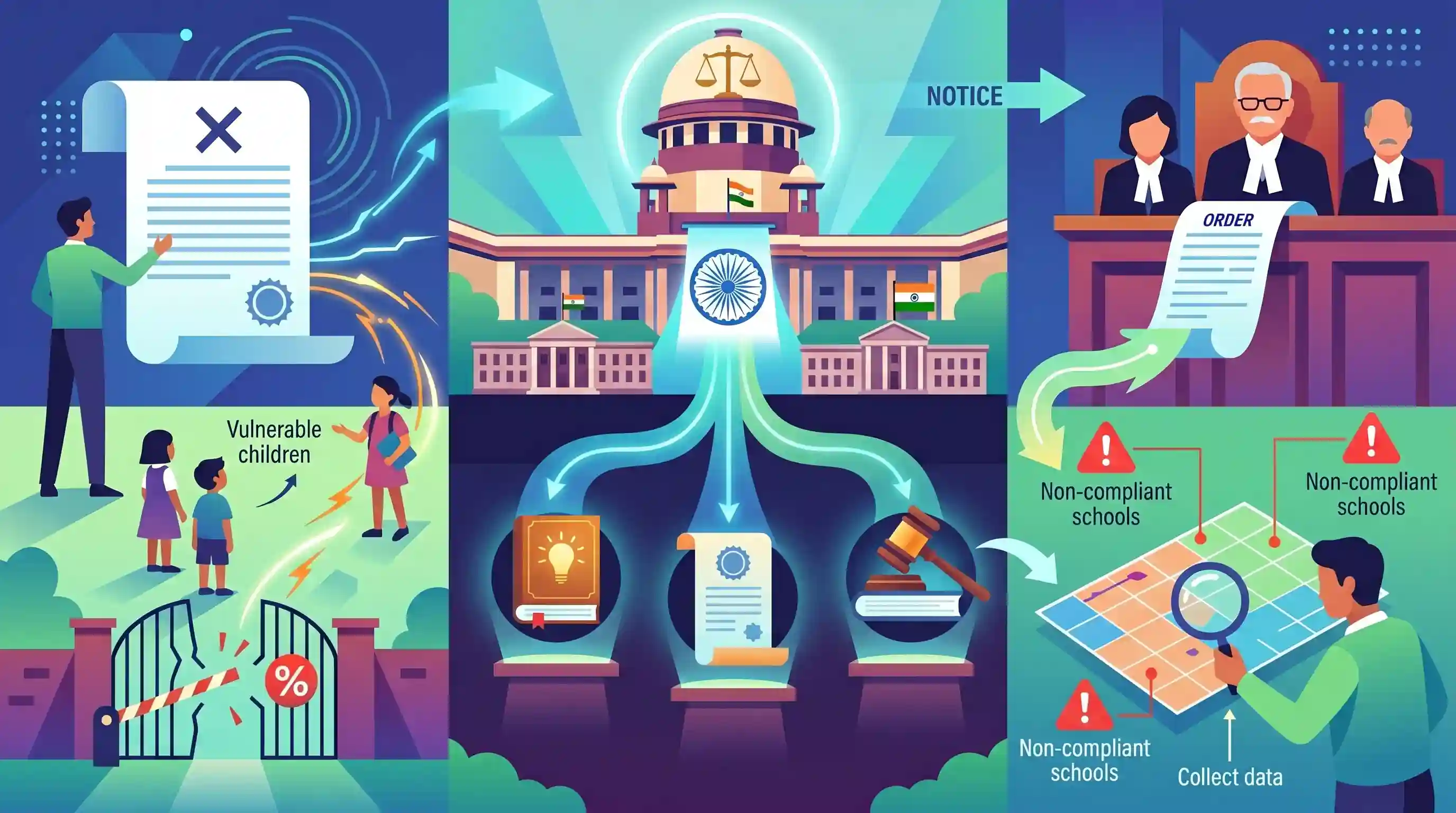
The Supreme Court of India has sought responses from the Central and Punjab governments over a public interest litigation (PIL) alleging the failure to implement the 25% quota in private unaided schools for economically weaker and disadvantaged children. The petitioner argued that the mandate, under Section 12(1)(c) of the Right of Children to Free and Compulsory Education (RTE) Act, 2009, remains unenforced in Punjab, thereby violating the 2012 Supreme Court judgment which upheld its constitutional validity. The bench, headed by CJI Surya Kant, instructed the petitioner to conduct a ground-level survey in a district to identify non-compliant institutions and submit additional material.
Key Points
- A PIL in the Supreme Court accuses the Punjab government of failing to implement the RTE Act's Section 12(1)(c) for 15 years.
- Section 12(1)(c) of the 2009 Act mandates a 25% quota for children from weaker sections and disadvantaged groups at entry-level classes in private unaided schools.
- The Supreme Court directed the petitioner to conduct a district-level survey, especially in a backward area, to identify private schools defying the Act.
- The petition further calls for setting up a transparent monitoring mechanism, such as publicly accessible dashboards, to track RTE compliance across Punjab.
Important Terms
Right of Children to Free and Compulsory Education (RTE) Act, 2009

A 2009 law providing free and compulsory elementary education to children aged 6–14. It enforces Article 21A, setting standards for teacher-student ratios, infrastructure, and non-discrimination.
UPSC context
GS Paper 2: Polity/Social Justice. Tests knowledge of fundamental rights, statutory laws, and welfare schemes for vulnerable sections.
Section 12(1)(c) of the RTE Act
A specific mandate under the RTE Act requiring private unaided schools to reserve 25% of entry-level seats for children from economically weaker sections (EWS) and disadvantaged groups.
UPSC context
GS Paper 2: Governance. Crucial for questions on social inclusion, educational equality, and private sector responsibilities in public service.
Article 21A
A fundamental right added by the 86th Constitutional Amendment (2002), making free and compulsory education a state obligation for children aged 6 to 14 years.
UPSC context
GS Paper 2: Indian Constitution. Tests understanding of the expansion of Fundamental Rights and the shift from DPSP to justiciable rights.
Public Interest Litigation (PIL)
Legal action initiated in a court for the protection of 'public interest.' It relaxes 'locus standi,' allowing public-spirited citizens to seek judicial redress for others' rights.
UPSC context
GS Paper 2: Judiciary. Focuses on judicial activism, access to justice, and the role of the SC/HC in enforcing constitutional mandates.
2012 RTE Judgment
The 2012 Supreme Court verdict (Society for Unaided Private Schools v. UOI) that upheld the constitutional validity of the 25% quota, exempting only minority unaided institutions.
UPSC context
GS Paper 2: Polity. Relevant for judicial precedents regarding the balance between private property rights and the state's welfare obligations.
Private Unaided Schools
Schools that do not receive financial assistance or grants from the government to meet their expenses, yet are subject to certain state regulations and RTE mandates.
UPSC context
GS Paper 2: Education/Polity. Tests the distinction between aided, unaided, and minority institutions under Articles 19, 21A, and 30.
Prelims Trap
The 25% RTE quota applies to all private unaided schools, including minority institutions.
The Supreme Court (Pramati case, 2014) explicitly exempted all minority educational institutions—both aided and unaided—from the RTE Act to protect their Article 30(1) autonomy.
Static Concepts Connected
What is the mechanism of the 25% quota under Section 12 of the RTE Act?
- Applicability: Applies to entry-level classes in private unaided non-minority schools for EWS and disadvantaged groups.
- State Reimbursement: State governments must reimburse schools based on their per-child expenditure in public schools or the private school's actual fee, whichever is lower.
- Constitutional Basis: Operationalizes Article 21A, inserted by the 86th Constitutional Amendment (2002), making education a Fundamental Right for children aged 6-14.
How does the RTE Act interact with minority educational rights under Article 30?
- Article 30(1): Grants religious and linguistic minorities the fundamental right to establish and administer educational institutions of their choice.
- Complete Exemption: The Supreme Court (Pramati case, 2014) ruled that the RTE Act does not apply to aided or unaided minority institutions to protect their autonomy.
Cross-Topic Patterns
RTE vs. Article 15(6) EWS Quota
The RTE Act’s 25% quota predates the 103rd Amendment. While RTE exclusively targets school-level education (ages 6-14), Article 15(6) enables distinct EWS reservations across broader higher educational institutions.
Judiciary seeking ground-level data in PILs
The Supreme Court directing the petitioner to conduct a local survey highlights a shift in PIL jurisprudence, demanding empirical ground-level data rather than relying solely on government affidavits to check executive inaction.

A multi-statement Prelims question comparing RTE 25% quota mechanics with the 103rd Amendment (EWS) and minority exemptions is highly likely.
Linked PYQs · 3
Linked PYQs · 3
- 2018PrelimsGS1
Consider the following statements: 1. As per the Right to Education (RTE) Act, to be eligible for appointment as a teacher in a State, a person would be required to possess the minimum qualification laid down by the concerned State Council of Teacher Education. 2. As per the RTE Act, for teaching primary classes, a candidate is required to pass a Teacher Eligibility Test conducted in accordance with the National Council of Teacher Education guidelines. 3. In India, more than 90% of teacher education institutions are directly under the State Governments. Which of the statements given above is/are correct?
- 2011PrelimsGS1
Which of the following can aid in furthering the Government’s objective of inclusive growth? 1. Promoting Self-Help Groups 2. Promoting Micro, Small and Medium Enterprises 3. Implementing the Right to Education Act Select the correct answer using the codes given below:
- 2022MainsGS2
The Right of Children to Free and Compulsory Education Act, 2009 remains inadequate in promoting incentive-based system for children's education without generating awareness about the importance of schooling. Analyse.
