Statutory Regulation of Political Parties and Electoral Reforms
Source:The Hindu ↗
Why It Matters
This development is crucial for UPSC aspirants as it underscores significant loopholes in the Representation of the People Act, 1951, particularly concerning the internal democracy and financial transparency of political parties. It bridges the critical GS-2 topics of Electoral Reforms, the role of the Election Commission, and the debate on bringing political parties under the ambit of the RTI Act to curb money laundering in elections.
Summary
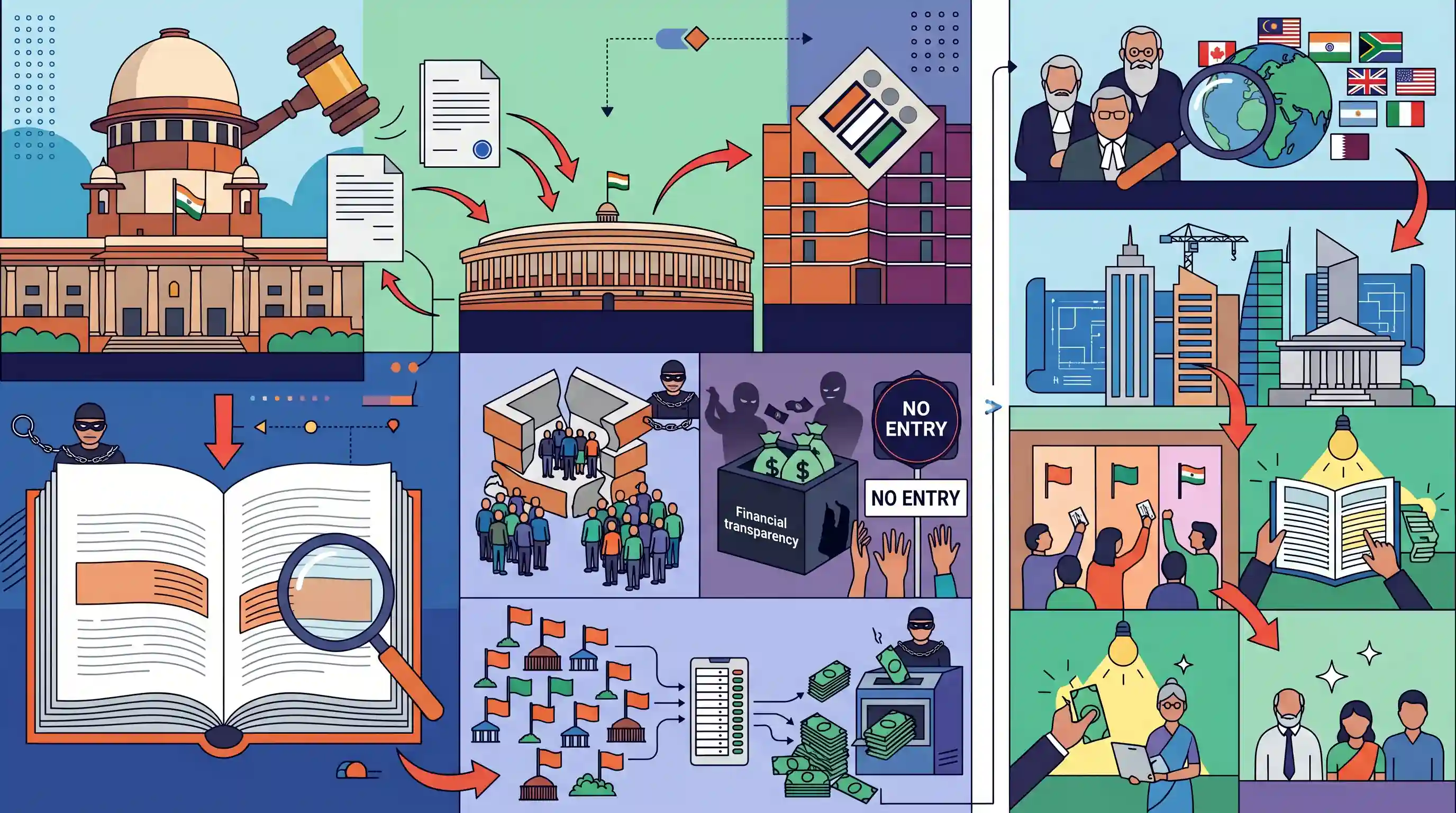
The Supreme Court of India has sought responses from the Centre and the Election Commission of India (ECI) regarding a plea advocating for a comprehensive statutory framework to regulate the functioning of political parties. The petition, filed by Ashwini Kumar Upadhyay, argues that the current legal framework—namely Sections 29A and 29C of the Representation of the People Act, 1951—is highly inadequate as it merely allows for the registration of parties without enforcing internal democracy, financial transparency, or accountability. The plea highlights a systemic misuse, claiming that around 90% of registered parties do not contest elections but act as fronts to launder black money and evade taxes. The petitioner further contends that because political parties are not classified as "public authorities" under the RTI Act, their operations remain opaque. Consequently, the plea requests that the Law Commission of India be directed to examine international best practices and recommend legislation to curb the criminalisation of politics and the misuse of electoral funding.
Key Points
- The Supreme Court has issued notices to the Union Government and the Election Commission of India on a petition seeking comprehensive statutory regulation for political parties.
- The plea argues that Section 29A of the Representation of the People Act (RPA), 1951, only provides for the registration of parties without mandating internal democracy, accountability, or transparency.
- The petitioner alleges that nearly 90% of political parties are non-contesting entities created primarily to launder black money and evade taxes.
- The petition highlights that political parties are not deemed "public authorities" under the RTI Act, thus bypassing public scrutiny of their finances and functioning.
- The plea seeks directions for the Law Commission of India to study global best practices and propose robust laws to curb corruption, casteism, communalism, and criminalisation in politics.
Important Terms
Representation of the People Act, 1951

A 1951 law governing India's electoral framework, regulating candidate qualifications, disqualifications (Section 8), and the registration of political parties (Section 29A) to ensure free and fair elections.
UPSC context
GS2: Salient features of the RPA; Electoral Reforms. Tests understanding of the legal basis for candidate eligibility and party registration.
Election Commission of India (ECI)
An autonomous constitutional authority under Article 324 responsible for managing Union and State elections. It currently lacks the explicit statutory power to deregister parties for non-performance or minor violations.
UPSC context
GS2: Constitutional Bodies. Tests knowledge of the Commission's regulatory powers and its limitations in enforcing internal party democracy.
Right to Information (RTI) Act, 2005
A 2005 law enabling citizens to access government information. The legal debate centers on whether political parties should be classified as 'public authorities' to mandate financial and operational transparency.
UPSC context
GS2: Transparency and Accountability. Evaluates the conflict between the privacy of political strategy and the public's right to know funding sources.
Section 13A of the Income Tax Act
A provision granting 100% tax exemption to registered political parties on specified incomes, provided they maintain audited accounts and report individual donations exceeding ₹20,000 to the Election Commission.
UPSC context
GS2/GS3: Electoral funding and black money. Tests awareness of the financial incentives and regulatory loopholes available to political organizations.
Law Commission of India
A non-statutory body advising the government on legal reforms. Its 255th Report (2015) is a benchmark for recommendations on regulating party finances, internal democracy, and curbing the criminalisation of politics.
UPSC context
GS2: Important aspects of governance. Tests familiarity with expert proposals for systemic electoral and judicial improvements.
Registered Unrecognised Political Parties (RUPPs)
Parties registered with the ECI that do not satisfy the criteria for 'National' or 'State' party status. They are often scrutinized for using tax benefits without contesting elections.
UPSC context
GS2: Electoral Reforms. Relevant for discussing the misuse of political status for money laundering and the need for stricter deregistration norms.
Prelims Trap
"The Election Commission of India has explicit statutory power to de-register political parties for not holding internal elections."
The ECI can register parties under Section 29A of the RPA 1951, but it lacks the explicit statutory power to de-register them except in rare cases like registration obtained by fraud.
Static Concepts Connected
What are the ECI's powers regarding the de-registration of political parties?
- Registration power: Granted under Section 29A of the Representation of the People Act, 1951.
- De-registration limits: Supreme Court ruled ECI cannot de-register a party for violating the Constitution or internal norms; it can only do so for fraud or if declared unlawful.
- Law Commission stance: The 170th and 255th reports recommended amending the RPA to grant ECI explicit powers to de-register non-compliant parties.
What are Registered Unrecognised Political Parties (RUPPs)?
- Definition: Newly registered parties, those not securing enough vote-share for state/national status, or those that never contest elections.
- Tax Exemption: They enjoy 100% exemption on income from voluntary contributions under Section 13A of the Income Tax Act, provided they file returns.
- Misuse mechanism: ECI data shows over 2,000 RUPPs exist, many serving merely as tax-evasion conduits rather than genuine electoral participants.
Cross-Topic Patterns
RUPPs, Tax Evasion and PMLA
The proliferation of non-contesting political parties connects to money laundering. Tax exemptions under the IT Act are heavily exploited to convert black money, linking RPA 1951 loopholes to the PMLA.
RTI Act and Political Funding Opacity
The CIC previously declared national parties as "public authorities" under the RTI Act, a ruling political parties defied. This plea revives the broader syllabus debate on political opacity versus public accountability.

Expect a Prelims question interlinking ECI's inability to de-register parties, RUPP tax exemptions under the IT Act, and RTI exemptions.
Linked PYQs · 4
Linked PYQs · 4
- 2001PrelimsGS1
Consider the following statements regarding the political parties in India: I. The Representation of the People Act, 1951 provides for the registration of political parties. II. Registration of political parties is carried out by the Election Commission. III. A national level political party is one which is recognised in four or more States. IV. During the 1999 general elections, there were six National and 48 State level parties recognised by the Election Commission. Which of these statements are correct?
- 2017MainsGS2
To enhance the quality of democracy in India the Election Commission of India has proposed electoral reforms in 2016. What are the suggested reforms and how far are they significant to make democracy successful?
- 2024MainsGS2
Examine the need for electoral reforms as suggested by various committees with particular reference to "one nation one election" principle.
- 2025MainsGS2
Discuss the 'corrupt practices' for the purpose of the Representation of the People Act, 1951. Analyze whether the increase in the assets of the legislators and/or their associates, disproportionate to their known sources of income, would constitute 'undue influence' and consequently a corrupt practice.
