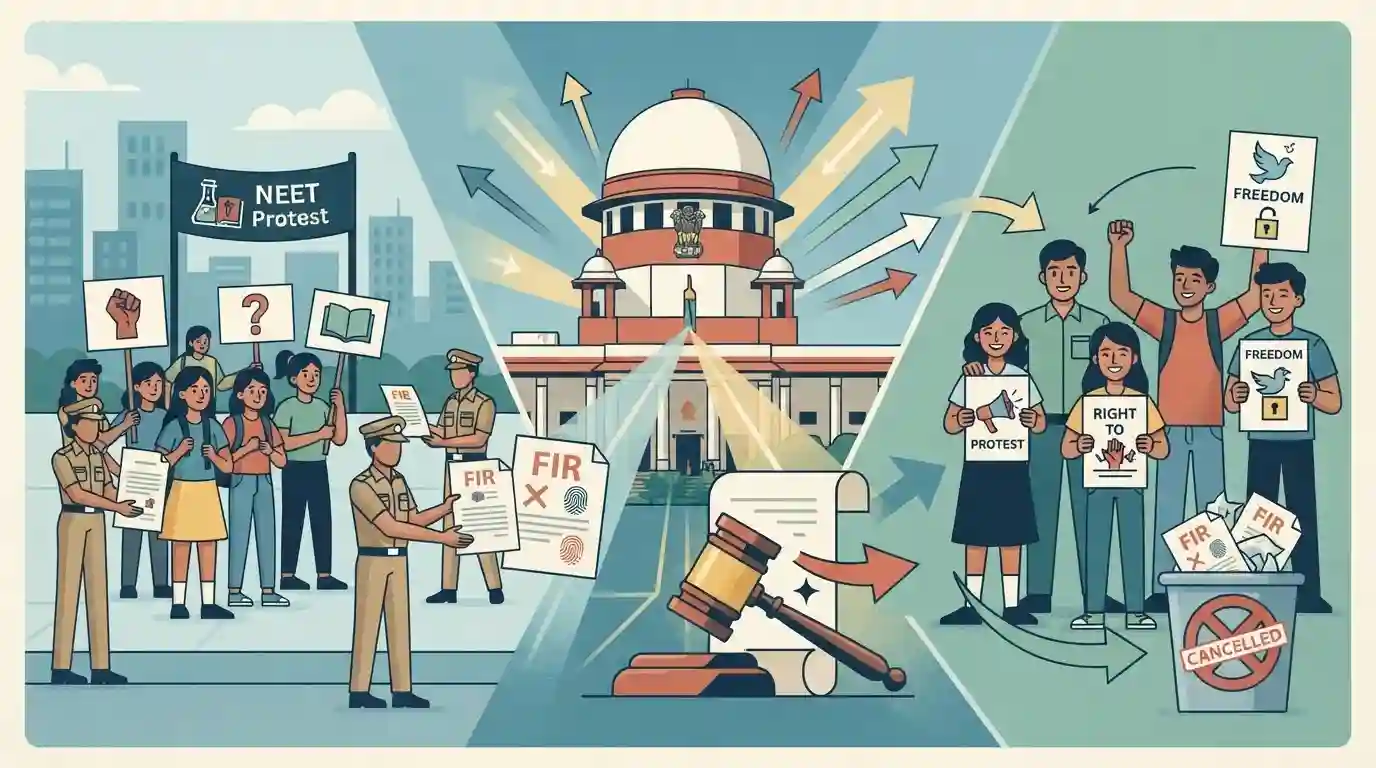
Supreme Court quashes all FIRs against nationwide NEET protesters
Source:Indian Express ↗
ఇది ఎందుకు ముఖ్యం
It highlights the judiciary's role in protecting fundamental freedoms like the right to dissent and peaceful protest, while utilizing extraordinary constitutional powers to prevent the misuse of criminal machinery against citizens.
సారాంశం
The Supreme Court has ordered the scrapping of all FIRs filed against NEET protesters nationwide, offering significant legal relief to students and activists involved in the agitations.
ముఖ్య అంశాలు
- The Supreme Court of India has quashed and scrapped all First Information Reports (FIRs) registered against NEET protesters across the country.
- The ruling highlights the judiciary's intervention to protect students and citizens exercising their democratic right to peaceful protest and dissent.
- It underscores the scope of judicial powers in granting blanket relief and preventing the harassment of protesters through criminal legal proceedings.
ముఖ్యమైన పదాలు
Article 142

An extraordinary constitutional provision that empowers the Supreme Court of India to pass any decree or order necessary for doing complete justice in any cause or matter pending before it.
UPSC context
UPSC Mains: Polity & Governance. Tests understanding of judicial powers, the doctrine of separation of powers, and the Supreme Court's role as an equity court.
NEET
National Eligibility cum Entrance Test, an all-India pre-medical entrance examination conducted in India for students aspiring to study undergraduate medical and dental courses.
UPSC context
UPSC Prelims/Mains: Social Issues & Governance. Relevant for transparency in educational examinations, federal education policy, and student welfare issues.
Supreme Court
The apex judicial court of India and the final interpreter of the Constitution, possessing original, appellate, and advisory jurisdictions along with exceptional plenary powers.
UPSC context
UPSC Prelims & Mains: Indian Polity. Tests the structure, jurisdiction, judicial review, and extraordinary constitutional remedies available within the Indian judiciary.
ప్రిలిమ్స్ ఉచ్చు
Article 142 grants unfettered and absolute discretion to the Supreme Court to override any statute in the interest of justice.
Aspirants often assume Article 142 powers are absolute and unlimited; however, the Supreme Court itself has ruled that it cannot contravene explicit statutory provisions or fundamental rights.
అనుసంధానమైన స్థిర భావనలు
What are the constitutional dimensions and limitations of Article 142 of the Indian Constitution?
- Complete Justice: Enables the Supreme Court to pass any decree or order necessary for doing complete justice in any pending cause or matter.
- Statutory Limits: Cannot be used to supplant substantive law applicable to a case or bypass express statutory provisions (Supreme Court Bar Association v. Union of India, 1998).
- Nationwide Reach: Enforcement power extends nationwide, and decrees are executed as if they were orders of Parliament or legislative enactments.
అంతర-అంశ నమూనాలు
Right to Protest vs Public Order
While peaceful protest is protected under Article 19(1)(a), the state can impose reasonable restrictions under Article 19(2) relating to public order, sovereignty, and integrity of India.
Judicial Activism in Examination Scandals
The use of Article 142 to grant blanket relief mirrors past interventions in institutional exam controversies, testing the boundary between judicial activism and executive policy.

Article 142 complete justice powers + Article 19(1)(a) reasonable restrictions will be tested in a multi-statement prelims question.
అనుసంధాన PYQలు · 1
అనుసంధాన PYQలు · 1
- 2023MainsGS2
“Constitutionally guaranteed judicial independence is a prerequisite of democracy.” Comment.
