Supreme Court Schedules Hearing on Pegasus Spyware Petitions
Source:The Hindu ↗
Why It Matters
The Pegasus spyware controversy is a seminal case study for UPSC aspirants on the tension between national security (GS3) and fundamental rights (GS2). It touches upon constitutional protections under Article 21 (Right to Privacy), the boundaries of executive power in intelligence gathering, and the necessity of robust institutional frameworks to prevent state-sponsored cyber abuses.
Summary
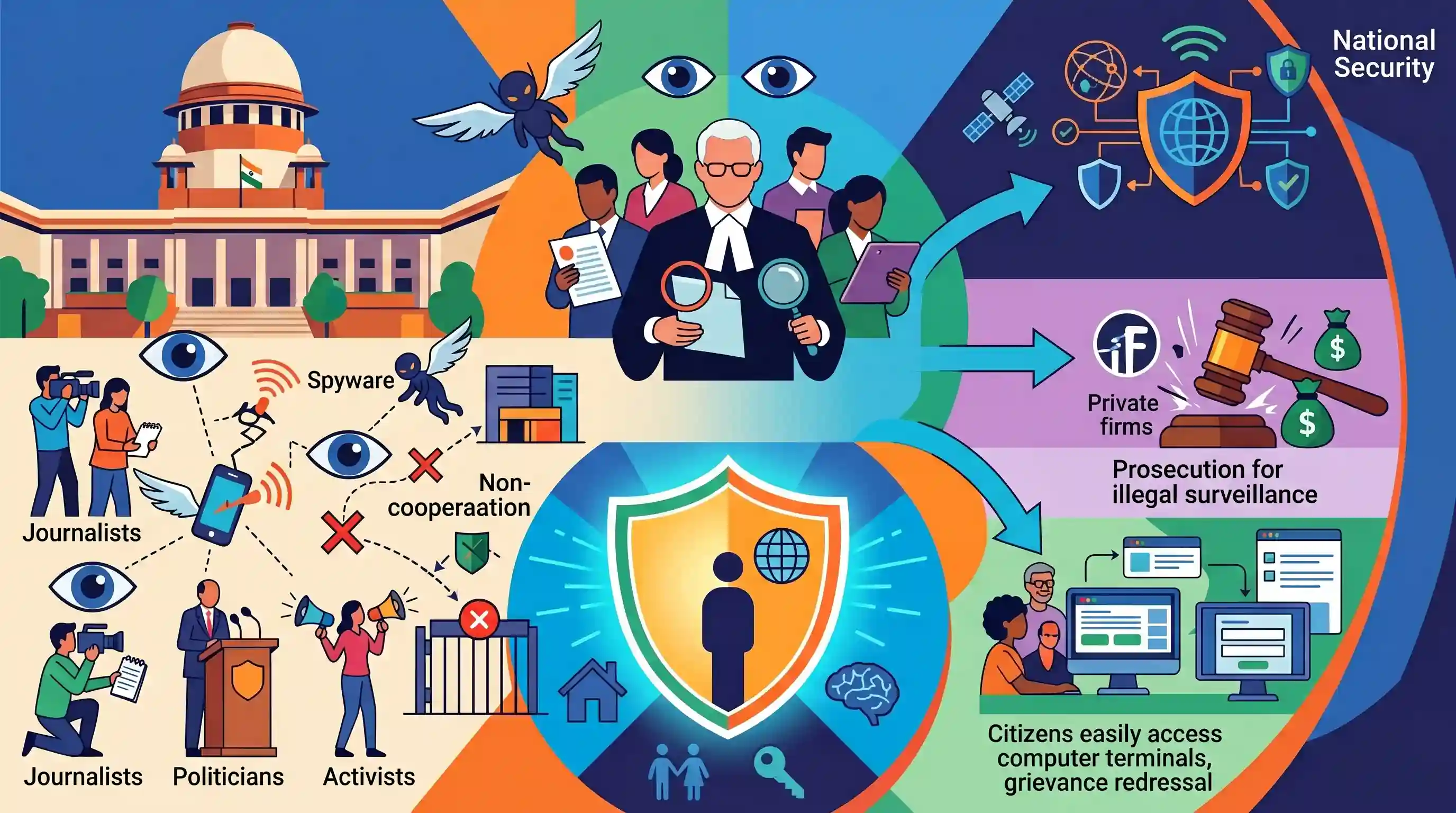
The Supreme Court of India is set to hear petitions concerning the alleged use of Pegasus spyware by the government for unauthorized surveillance of journalists, politicians, and activists. The case revisits the findings of a technical committee and a report by former Supreme Court judge Justice R.V. Raveendran, which highlighted the presence of malware on some devices and noted a lack of cooperation from the Union government. Justice Raveendran's recommendations include establishing a specialized cyber-investigation agency, prosecuting private firms for illegal surveillance, and creating a grievance redressal mechanism for citizens to safeguard the fundamental Right to Privacy without compromising national security.
Key Points
- The Supreme Court has scheduled a hearing on petitions alleging the unauthorized use of Israeli military-grade spyware Pegasus by the government to surveil citizens.
- A technical committee previously examined 29 devices, finding malware in some but failing to definitively confirm Pegasus, partly due to the Union government's non-cooperation.
- Justice R.V. Raveendran's report recommended establishing a special investigation agency for cyber-attacks and creating a citizen grievance mechanism for surveillance and malware implantation.
- The report emphasized striking a balance between national cybersecurity needs and the individual's fundamental Right to Privacy against unauthorized surveillance.
Important Terms
Pegasus Spyware

A military-grade "zero-click" malware developed by the Israeli firm NSO Group. It can infiltrate smartphones to extract data and control hardware without user interaction.
UPSC context
GS Paper 3: Internal Security and Cyber Threats; GS Paper 2: Right to Privacy. Tests understanding of sophisticated cyber-warfare tools.
Justice R.V. Raveendran Committee
A Supreme Court-appointed expert panel (2021) to probe Pegasus allegations. Key recommendations included establishing a specialized cyber-investigation agency and enhancing legal protections for privacy.
UPSC context
GS Paper 2: Judiciary; Governance. Tests knowledge of judicial oversight and institutional reforms to check executive overreach.
Right to Privacy
An intrinsic part of the Right to Life and Personal Liberty under Article 21, as declared in the K.S. Puttaswamy (2017) judgment.
UPSC context
GS Paper 2: Indian Constitution and Fundamental Rights. A core pillar for questions on civil liberties vs. state power.
Chilling Effect
A legal concept where surveillance or state pressure causes individuals to self-censor, discouraging the exercise of constitutional rights like freedom of speech and press.
UPSC context
GS Paper 2: Fundamental Rights (Article 19). Evaluates the impact of state actions on the democratic watchdog role of the media.
National Security Exception
The principle that the State cannot bypass judicial review simply by citing "national security." Any invasion of privacy must be legal, necessary, and proportionate.
UPSC context
GS Paper 2: Separation of Powers; Judiciary vs Executive. Crucial for understanding the limits of state power in sensitive security matters.
Prelims Trap
The Supreme Court appointed technical committee definitively proved the Indian government's use of Pegasus spyware.
The Raveendran committee found malware on 5 of 29 devices but could not definitively confirm it was Pegasus, specifically noting the Union government's non-cooperation.
Static Concepts Connected
What are the primary legal frameworks governing electronic surveillance in India?
- Telegraph Act, 1885: Section 5(2) allows interception of messages on grounds of sovereignty, state security, foreign relations, or public order.
- IT Act, 2000: Section 69 broadens state powers, permitting interception, monitoring, and decryption of digital information for investigation of offenses.
- Procedural Safeguards: The 1996 PUCL vs UoI judgment mandated procedural safeguards, including high-level review committees to prevent arbitrary wiretapping by agencies.
How did the Puttaswamy judgment (2017) restrict arbitrary state surveillance?
- Fundamental Right: Elevated privacy from a common law right to a fundamental right protected under Article 21 (Right to Life and Personal Liberty).
- Three-Fold Test: Mandated that any state interference with privacy must meet legality (existence of law), necessity (legitimate state aim), and proportionality (nexus between objective and means).
Cross-Topic Patterns
Zero-click malware & GS3 Cyber Security
Pegasus highlights the evolution from traditional phishing to "zero-click" exploits. UPSC frequently links such advanced cyber threats with CERT-In's mandate and India's evolving data protection frameworks like the DPDP Act.
Judicial Review vs. National Security Privilege
The executive citing 'national security' to avoid filing an affidavit echoes recent constitutional friction in cases like Electoral Bonds, testing the boundaries between judicial oversight and executive privilege.

Expect a GS2/GS3 intersection question testing the proportionality doctrine against IT Act interception rules and zero-click spyware.
Linked PYQs · 4
Linked PYQs · 4
- 2017MainsGS2
Examine the scope of Fundamental Rights in the light of the latest judgement of the Supreme Court on Right to Privacy.
- 2017MainsGS3
Discuss the potential threats of Cyber attack and the security framework to prevent it.
- 2024PrelimsGS1
Under which of the following Articles of the Constitution of India, has the Supreme Court of India placed the Right to Privacy ?
- 2021PrelimsGS1
'Right to Privacy' is protected under which Article of the Constitution of India?
