Supreme Court Criticizes Insurers for Ambiguous Policy Terms
Source:The Hindu ↗
কেন এটি গুরুত্বপূর্ণ
The judgment is highly relevant for UPSC aspirants as it touches upon multiple governance facets: the judiciary's role in protecting consumers against standard-form corporate contracts, the operational deficiencies of tribunals (MACTs), and the need for regulatory evolution (by IRDAI) to match contemporary developments like cross-border transport agreements. It illustrates the practical application of 'beneficial legislation' and judicial review of executive/regulatory vacuums.
সারসংক্ষেপ
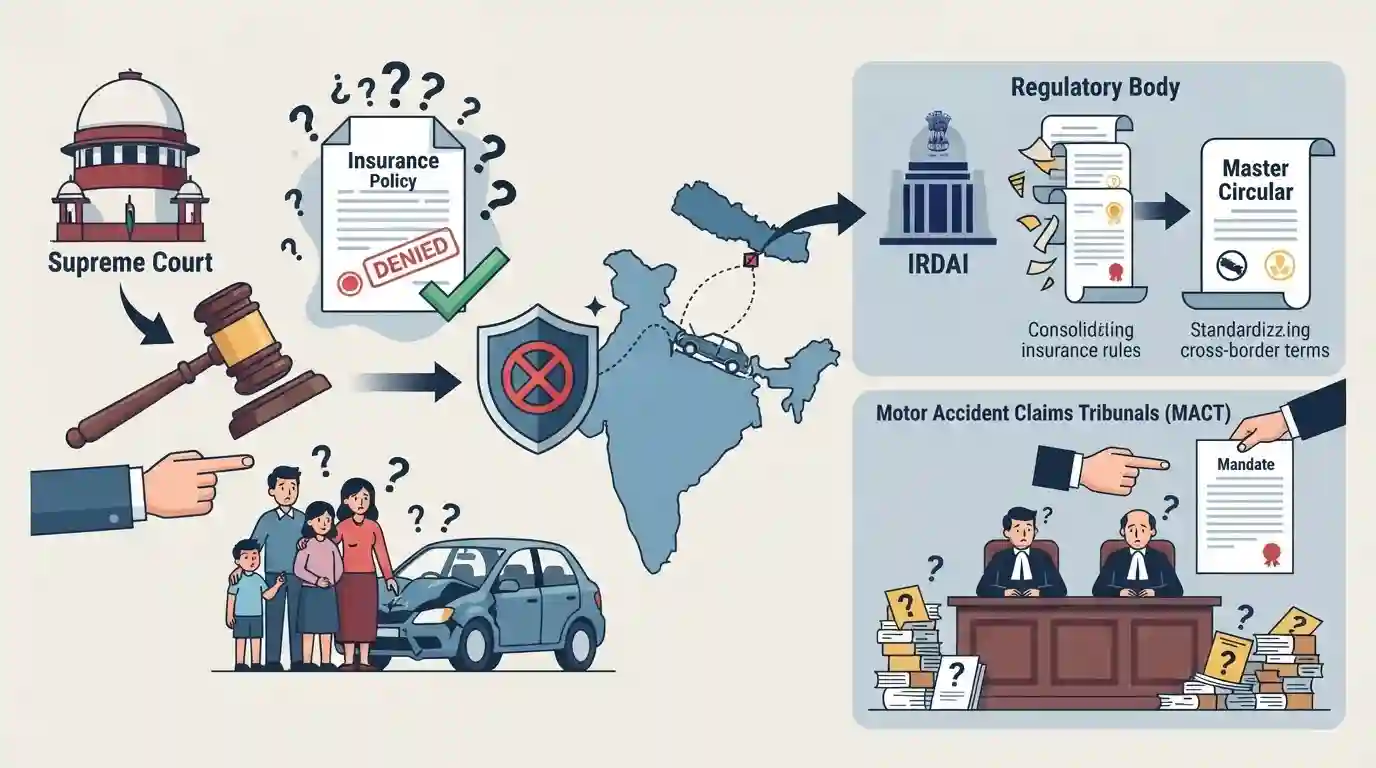
The Supreme Court of India recently chastised insurance companies for deploying ambiguous and sloppy terms in policies to avoid paying claims, causing undue hardship to policyholders. Adjudicating a motor accident claim originating in Nepal, the Court held that insurers cannot deny cross-border coverage unless it is expressly excluded in the policy document. The Bench emphasized that the Motor Vehicles Act, 1988, is beneficial legislation and ambiguities in standard-form contracts must be resolved in favor of the insured. Highlighting a regulatory vacuum between the Inter-Country Transport Vehicles Rules, 2021 and existing insurance norms, the Court advised the Insurance Regulatory and Development Authority of India (IRDAI) to formulate a master circular standardizing cross-border terms. Additionally, the Court reprimanded Motor Accident Claims Tribunals (MACTs) for passing inadequately reasoned orders, leading to avoidable delays and mounting appeals.
মূল বিষয়
- The Supreme Court criticized insurance companies for using 'ambiguous' and 'sloppy' policy terms to evade liability, leading to prolonged litigation for policyholders.
- The SC ruled that unless an insurance policy explicitly excludes coverage outside India, it will be presumed to cover such accidents, rejecting the insurer's attempt to deny a claim for an accident in Nepal.
- When standard-form contract terms are ambiguous, courts must adopt interpretations that advance the beneficial objective of the Motor Vehicles Act, 1988.
- The Court identified a regulatory gap where the Inter-Country Transport Vehicles Rules, 2021 permit cross-border travel, but insurance rules remain unclear; it advised IRDAI to issue a standardizing master circular.
- The Supreme Court also strongly critiqued Motor Accident Claims Tribunals (MACTs) for issuing poorly reasoned orders, which creates structural delays and increases the burden of appeals on higher courts.
গুরুত্বপূর্ণ শব্দ
Insurance Regulatory and Development Authority of India (IRDAI)

A statutory regulatory body under the Ministry of Finance responsible for regulating, promoting, and ensuring the orderly growth of the insurance and reinsurance industries in India while protecting policyholder interests.
UPSC context
GS Paper III: Indian Economy and Regulatory Bodies. Tests understanding of financial sector oversight and consumer protection.
Motor Accident Claims Tribunals (MACTs)
Specialized courts established under the Motor Vehicles Act to adjudicate claims and award just compensation to victims or families of motor accidents involving property damage, injury, or death.
UPSC context
GS Paper II: Statutory and Quasi-Judicial Bodies. Tests awareness of dispute resolution mechanisms and judicial efficiency.
Motor Vehicles Act, 1988
A comprehensive law passed by the Parliament of India that regulates all aspects of road transport vehicles, driver licensing, vehicle registration, traffic control, and liability insurance.
UPSC context
GS Paper II: Government Policies and Interventions. Tests understanding of regulatory legislation, public safety, and statutory transport frameworks.
Inter-Country Transport Vehicles Rules, 2021
Rules notified by the Ministry of Road Transport and Highways to facilitate, regulate, and standardize the movement of passenger and goods vehicles between India and neighboring reciprocating countries under valid permits.
UPSC context
GS Paper II: Government Policies and Interventions. Tests awareness of cross-border transport regulations, trade connectivity, and regional diplomacy.
Supreme Court of India
The highest judicial forum and final court of appeal under the Constitution of India, possessing original, appellate, and advisory jurisdiction with the power of judicial review.
UPSC context
GS Paper II: Indian Polity and Judiciary. Tests understanding of the structure, powers, and functioning of the apex judicial institution.
প্রিলিমস ফাঁদ
Motor Accident Claims Tribunals (MACTs) are established directly by the Central Government to ensure uniform nationwide third-party compensation.
Under Section 165 of the Motor Vehicles Act 1988, Motor Accident Claims Tribunals are constituted by State Governments, not the Central Government.
সংযুক্ত স্থির ধারণা
What is the doctrine of "Contra Proferentem" in contract law?
- Interpretation rule: It dictates that ambiguous, vague, or sloppy contract clauses must be interpreted against the party that drafted them.
- Standard-form contracts: It is heavily applied to standard-form contracts (contracts of adhesion) where consumers have no power to negotiate individual terms.
- Consumer protection: Indian courts use it to protect consumers from corporate entities using technical loopholes to deny legitimate benefits.
What is the constitutional and statutory status of Motor Accident Claims Tribunals (MACTs)?
- Statutory origin: Constituted by State Governments under Section 165 of the Motor Vehicles Act, 1988, for specific local areas.
- Exclusive jurisdiction: They hold exclusive jurisdiction over third-party compensation claims, completely ousting the jurisdiction of ordinary civil courts.
- Quasi-judicial powers: They act as quasi-judicial bodies, holding powers of a Civil Court for summoning witnesses and enforcing execution of orders.
আন্তঃবিষয় প্যাটার্ন
Cross-border transport & regional integration
Linking Inter-Country Transport Rules with India's 'Neighbourhood First' policy highlights how regulatory insurance gaps can physically impede sub-regional connectivity, affecting pacts like the BBIN Motor Vehicles Agreement.
Judicial guidance vs executive vacuum
The Supreme Court directing statutory regulators like IRDAI to draft master circulars showcases judicial guidance filling governance vacuums without breaching the strict separation of powers.

Prelims 2026 may test the statutory origins of MACTs (State vs Central establishment) alongside IRDAI's consumer protection mandate.
সংযুক্ত PYQ · 3
সংযুক্ত PYQ · 3
- 2025MainsGS2
Comment on the need of administrative tribunals as compared to the court system. Assess the impact of the recent tribunal reforms through rationalization of tribunals made in 2021.
- 2016MainsGS2
What is a quasi-judicial body? Explain with the help of concrete examples.
- 2020MainsGS2
Judicial Legislation is antithetical to the doctrine of separation of powers as envisaged in the Indian Constitution. In this context justify the filing of large number of public interest petitions praying for issuing guidelines to executive authorities.
