Supreme Court Ruling on Mining Buffer Zones for Wetland Reserves
Source:The Hindu ↗
কেন এটি গুরুত্বপূর্ণ
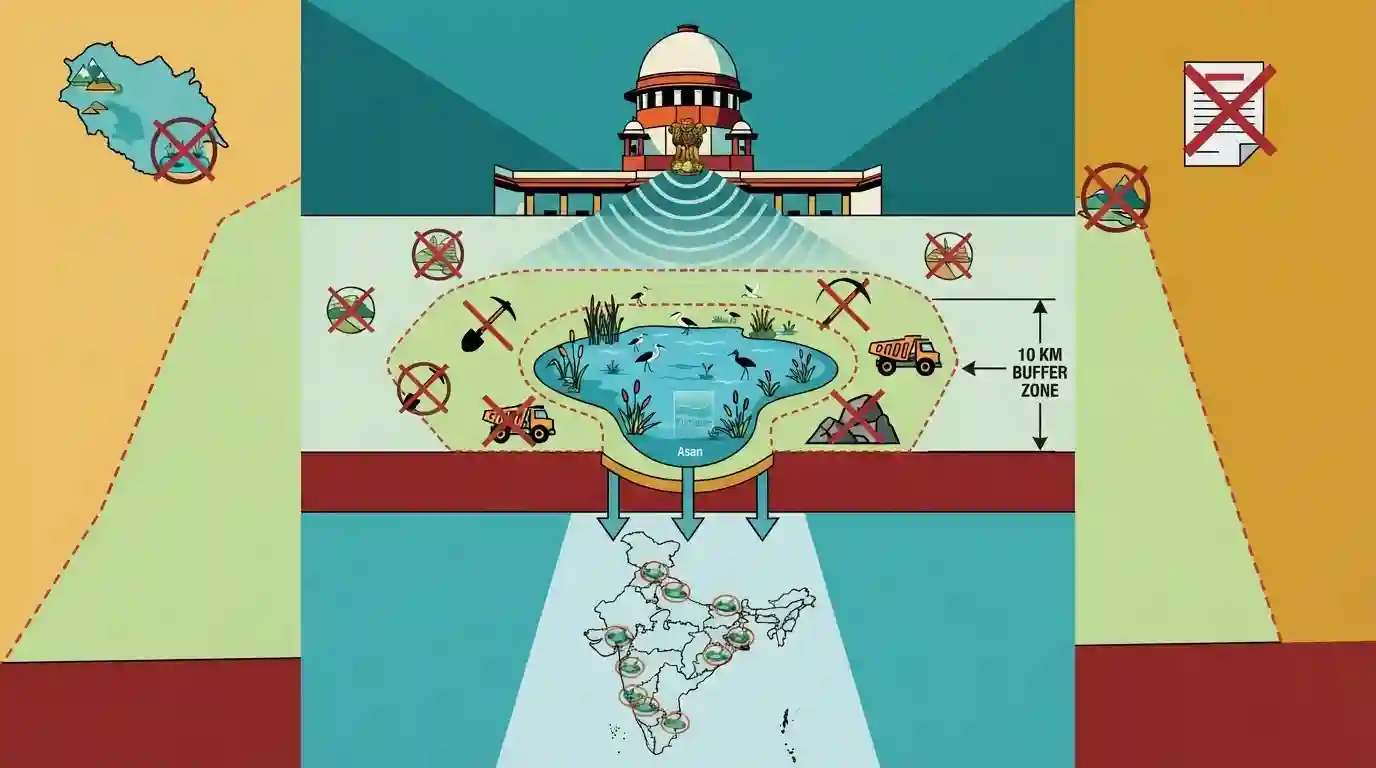
This ruling significantly strengthens India's environmental conservation framework by elevating the protection status of wetland and community conservation reserves, mandating a 10 km mining-free buffer similar to national parks and wildlife sanctuaries. It highlights the legal mechanisms used to protect fragile ecosystems like the Himalayas and underscores the judicial enforcement of Ramsar Convention commitments in domestic environmental governance.
সারসংক্ষেপ
The Supreme Court ruled that a 10 km radius mining ban imposed around the Asan wetland conservation reserve (a Ramsar site in Uttarakhand) applies uniformly to all community and wetland conservation reserves across India. In response to a plea by Himachal Pradesh challenging the applicability of the ban, the Court directed the National Board for Wildlife or MoEFCC to verify the geographical boundaries of the Asan reserve. The Court emphasized that the fragile Himalayan terrain requires consistent environmental regulations, effectively extending stringent conservation buffers (traditionally for national parks and sanctuaries) to other critical wetland ecosystems.
মূল বিষয়
- The Supreme Court of India clarified that its previous ban on mining activities within a 10 km radius of the Asan wetland conservation reserve in Uttarakhand extends to all wetland and community conservation reserves across the country for the sake of parity.
- This clarification came during a hearing of an application filed by Himachal Pradesh, which argued that the 10 km mining buffer restriction imposed in Uttarakhand should not apply to its territory.
- The court directed the Standing Committee of the National Board for Wildlife (NBWL) or the Ministry of Environment, Forests and Climate Change (MoEFCC) to factually determine if the Asan reserve is situated within the territory of Himachal Pradesh.
- If the Asan reserve is found to lie in Himachal Pradesh, the 10 km mining ban will be extended there; if not, the state's competent authority will decide on mining permissions according to existing laws.
- The Bench, led by Chief Justice of India Surya Kant, emphasized that the entire fragile Himalayan terrain must be governed by a uniform set of environmental conservation directives.
- The initial interim order was passed on February 14, 2024, highlighting the ecological significance of the Asan reserve, which is a designated Ramsar site under the Ramsar Convention.
গুরুত্বপূর্ণ শব্দ
Ramsar Convention

An international treaty signed in 1971 in Ramsar, Iran, promoting the conservation and wise use of wetlands of international importance (Ramsar Sites) and their resources through national action and global cooperation.
UPSC context
GS Paper III (Environment & Ecology); tested under biodiversity, conservation frameworks, and international treaties.
Wetlands (Conservation and Management) Rules
Rules notified under India's Environment (Protection) Act, 1986, creating State Wetland Authorities and prohibiting destructive activities to decentralize and regulate the conservation and sustainable use of designated wetlands.
UPSC context
GS Paper III (Ecology and Environment); tests understanding of domestic environmental regulation, federal management of wetlands, and statutory definitions.
National Board for Wildlife
An apex statutory body constituted under India's Wildlife (Protection) Act, 1972, chaired by the Prime Minister, responsible for promoting wildlife conservation and approving projects in and around protected areas.
UPSC context
GS Paper III (Environment); frequently tested in Prelims and Mains regarding environmental statutory bodies and conservation clearances.
Standing Committee of the National Board of Wildlife
A functional subcommittee of the NBWL, chaired by the Union Environment Minister, which practically executes clearances, approvals, and reviews of developmental and industrial projects near protected areas.
UPSC context
GS Paper III (Environment); crucial for questions on environmental clearances, infrastructure-wildlife conflict, and executive statutory processes.
Ministry of Environment, Forests and Climate Change
The nodal administrative agency in the Indian government responsible for planning, promoting, coordinating, and overseeing the implementation of environmental, forestry, and climate change policies.
UPSC context
GS Paper III (Governance and Environment); central to discussions on administrative policy, conservation schemes, and environmental legislation.
Supreme Court of India
The highest constitutional court and final court of appeal in India, which plays a major role in environmental jurisprudence through public interest litigations and progressive ecological interpretations.
UPSC context
GS Paper II (Polity/Judiciary); tests constitutional role, judicial activism, and the enforcement of environmental rights under Article 21.
প্রিলিমস ফাঁদ
The 10 km mining buffer around wetlands is legally mandated by the Wetlands (Conservation and Management) Rules, 2017.
The 10 km ban is a Supreme Court judicial mandate extending Eco-Sensitive Zone principles from National Parks to conservation reserves. It is not statutorily found in the Wetland Rules.
সংযুক্ত স্থির ধারণা
Difference between Conservation and Community Reserves under WPA 1972
- Conservation Reserves: Declared primarily on government-owned lands, typically acting as buffer zones or migration corridors linking existing National Parks and Wildlife Sanctuaries.
- Community Reserves: Designated on private or community lands to legally recognize voluntary local conservation efforts while ensuring sustainable resource use.
- Legal Backing: Both categories were introduced into Indian law via the Wildlife (Protection) Amendment Act of 2002.
National Board for Wildlife (NBWL): Structure and Mandate
- Statutory Status: It is a statutory organization constituted under the Wildlife (Protection) Act, 1972, replacing the earlier advisory Indian Board for Wildlife.
- Chairperson: It is chaired by the Prime Minister of India, whereas the Vice-Chairperson is the Minister of Environment.
- Core Function: Serves as the apex body for approving developmental projects, mining, and boundary alterations in and around protected areas.
আন্তঃবিষয় প্যাটার্ন
Judicial vs Executive ESZs
The SC frequently enforces strict 10 km buffers via judicial activism, often superseding the MoEFCC's attempts to notify flexible, site-specific Eco-Sensitive Zones (ESZs) based on state economic requests.
Himalayan ecology vs Federalism
Himachal Pradesh challenging Uttarakhand's ecological buffer highlights the recurrent tension between a state's economic interests (mining revenue) and trans-boundary environmental governance in the fragile Himalayan ecosystem.

Expect a multi-statement question in 2026 testing land ownership rules for Community vs Conservation Reserves and NBWL's clearance mandate.
সংযুক্ত PYQ · 5
সংযুক্ত PYQ · 5
- 2023MainsGS3
Comment on the National Wetland Conservation Programme initiated by the Government of India and name a few India's wetlands of international importance included in the Ramsar Sites.
- 2018MainsGS3
What is wetland? Explain the Ramsar concept of 'wise use' in the context of wetland conservation. Cite two examples of Ramsar sites from India.
- 2025MainsGS3
Mineral resources are fundamental to the country's economy and these are exploited by mining. Why is mining considered an environmental hazard? Explain the remedial measures required to reduce the environmental hazard due to mining.
- 2019PrelimsGS1
Consider the following statements: 1. Under Ramsar Convention, it is mandatory on the part of the Government of India to protect and conserve all the wetlands in the territory of India. 2. The Wetlands (Conservation and Management) Rules, 2010 were framed by the Government of India based on the recommendations of Ramsar Convention. 3. The Wetlands (Conservation and Management) Rules, 2010 also encompass the drainage area or catchment regions of the wetlands as determined by the authority. Which of the statements given above is/are correct?
- 2014PrelimsGS1
With reference to 'Eco-Sensitive Zones', which of the following statements is/are correct? 1. Eco-Sensitive Zones are the areas that are declared under the Wildlife (Protection) Act, 1972. 2. The purpose of the declaration of Eco-Sensitive Zones is to prohibit all kinds of human activities in those zones except agriculture. Select the correct answer using the code given below.
