Supreme Court Mandates Mining Buffer Zone for All Wetland Reserves
Source:The Hindu ↗
Why It Matters
The Asan Conservation Reserve is Uttarakhand's first Ramsar site and highly significant for UKPSC Prelims. Supreme Court directives on Eco-Sensitive Zones (ESZs) and mining bans are core topics in both the Environment and Indian Polity sections of the exam.
Summary
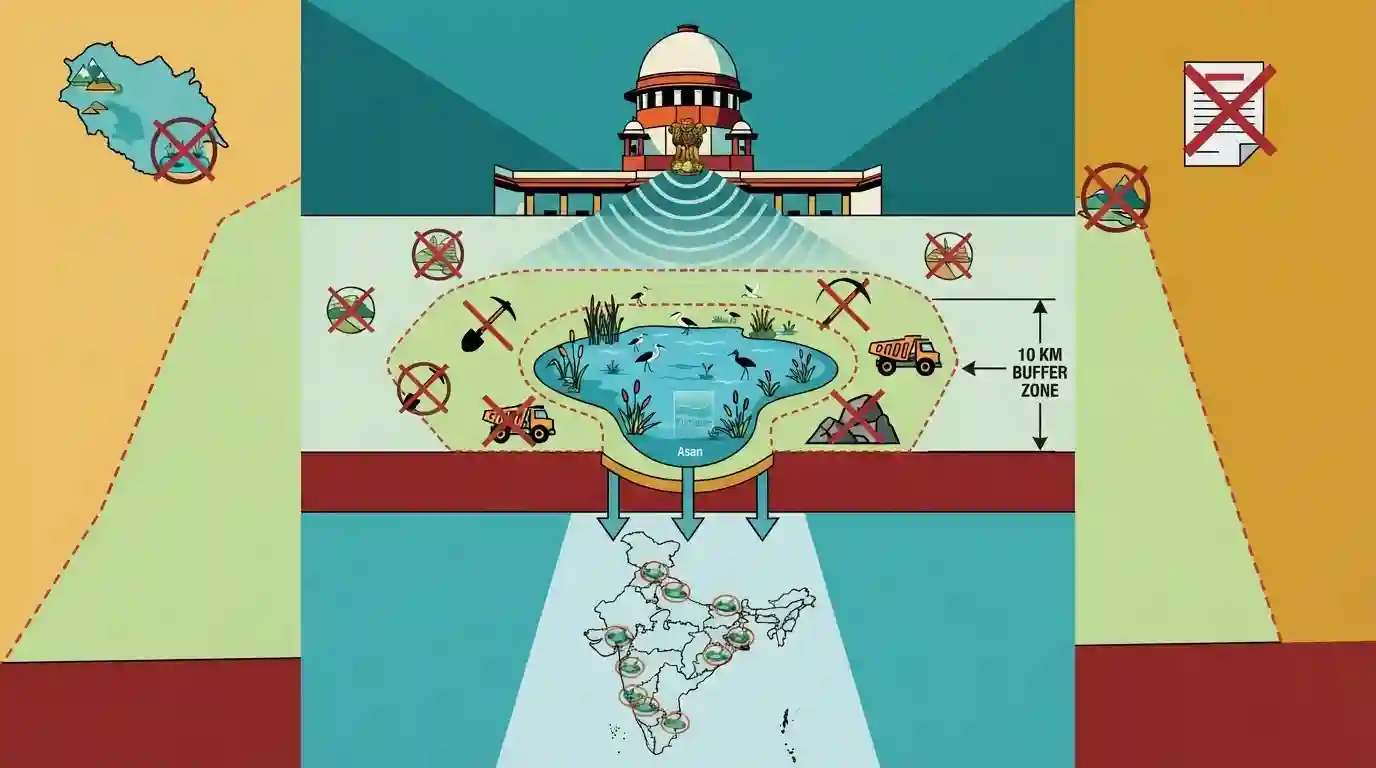
The Supreme Court of India has ordered that a 10 km buffer zone prohibiting mining activities must be enforced around all wetland conservation reserves nationwide. The decision extends an earlier restriction that specifically applied to Uttarakhand's Asan Conservation Reserve to ensure uniform environmental protection across the country, rejecting Himachal Pradesh's plea for exemption.
Key Points
- The Supreme Court has mandated a 10 km buffer zone prohibiting mining operations around all wetland conservation reserves in India.
- This nationwide extension originated from restrictions initially imposed around the Asan Conservation Reserve, Uttarakhand's first Ramsar site.
- The Court rejected an application from Himachal Pradesh seeking exemption from the 10 km buffer zone, emphasizing parity across all states.
- The ruling strengthens the framework of Eco-Sensitive Zones (ESZs) to protect fragile wetland ecosystems from industrial degradation.
Important Terms
National Board for Wildlife (NBWL)

A statutory organization established under the Wildlife (Protection) Act, 1972. It is chaired by the Prime Minister and acts as the apex body for reviewing and approving projects in and around protected areas.
UPSC context
GS Paper III (Environment); tests statutory regulatory bodies, wildlife conservation laws, and the environmental clearance process in India.
Conservation Reserve
A category of protected area declared on government-owned land under Section 36A of the Wildlife (Protection) Act, 1972. They typically function as ecological corridors or buffer zones connecting established parks and sanctuaries.
UPSC context
GS Paper III (Environment); tests categories of protected areas, statutory environmental classifications, and participatory conservation strategies.
Asan Conservation Reserve
A 444-hectare wetland situated in Uttarakhand’s Dehradun district. Declared Uttarakhand's first Ramsar site in 2020, it is located along the Central Asian Flyway and serves as a major habitat for migratory waterbirds.
UPSC context
GS Paper I (Geography) & GS Paper III (Environment); tests Ramsar sites, key geographic locations, and wetland conservation in India.
Ramsar Convention
An international treaty signed in Ramsar, Iran, in 1971. It provides the framework for national action and international cooperation for the conservation and wise use of wetlands of international importance.
UPSC context
GS Paper III (Environment); tests multilateral environmental agreements, wetland ecosystems, biodiversity conservation, and conservation frameworks.
Ministry of Environment, Forest and Climate Change (MoEFCC)
The central administrative organ of the Government of India responsible for planning, promoting, and coordinating environmental, forestry, and ecological conservation programs, policies, and statutory clearances.
UPSC context
GS Paper II (Polity/Governance); tests administrative ministries, policy execution, and governance systems related to natural resources and environment.
Supreme Court of India
The apex judicial body in India established under Article 124 of the Constitution. It acts as the final interpreter of the law and the constitution, often spearheading environmental protection through judicial activism.
UPSC context
GS Paper II (Polity/Judiciary); tests judicial review, public interest litigation, constitutional interpretations, and ecological jurisprudence under Article 21.
Prelims Trap
The 10 km mining buffer zone around Conservation Reserves is a statutory mandate explicitly written into the Wild Life (Protection) Act, 1972.
Eco-Sensitive Zones (ESZs) and mining buffer rules are notified under the Environment (Protection) Act, 1986, not the Wild Life (Protection) Act, 1972, despite protecting areas declared under the latter.
Static Concepts Connected
How do Conservation Reserves differ from Community Reserves under WLPA, 1972?
- Land ownership: Conservation Reserves are declared on government-owned land, typically adjacent to National Parks or Sanctuaries, after consulting local communities.
- Community lands: Community Reserves are declared on private or community-owned lands where communities/individuals volunteer to conserve wildlife and its habitat.
- Statutory origin: Both categories were introduced via the Wild Life (Protection) Amendment Act, 2002 to protect corridors without displacing local populations.
What is the statutory framework governing Eco-Sensitive Zones (ESZs)?
- Enabling Act: ESZs around protected areas are notified by the MoEFCC under Section 3 of the Environment (Protection) Act, 1986.
- Activity regulation: Activities in ESZs are categorized into prohibited (e.g., commercial mining), regulated (e.g., felling trees), and permitted (e.g., ongoing agricultural practices).
Cross-Topic Patterns
Judicial federalism in resource extraction
The Supreme Court's uniform ban overrides state-specific economic pleas, illustrating how environmental judicial activism shapes central-state dynamics and federal control over mineral concessions.
Ramsar obligations and domestic jurisprudence
India's commitments under the Ramsar Convention increasingly drive domestic judicial policy, translating localized wetland disputes (like Asan) into nationwide ecological mandates.

Multi-statement questions in 2026 will likely test the distinct statutory origins of ESZs (EPA 1986) versus Conservation Reserves (WLPA).
Linked PYQs · 3
Linked PYQs · 3
- 2021UKPSC_PRELIMSGS1
What are 'Ramsar Sites'?
- 2024UKPSC_PRELIMSGS1
Which Constitutional Amendment Act relates to the protection and improvement of environment and safeguarding of forests and wildlife ?
- 2024UKPSC_PRELIMSGS1
Which of the following helps some hydrophytes to thrive in wetlands and marshes where water level fluctuates time to time ?
