Supreme Court Sets Conditions for Green Firecrackers in Delhi NCR
Source:Indian Express ↗
Why It Matters
The article is highly relevant for GS2 (Judiciary and Fundamental Rights) and GS3 (Environment), serving as a direct case study for how the Supreme Court constitutionalizes environmental issues. It specifically addresses the classic UPSC debate on balancing the Right to Life and a Clean Environment (Article 21) with the Right to Trade/Livelihood (Article 19) and Freedom of Religion (Article 25).
Summary
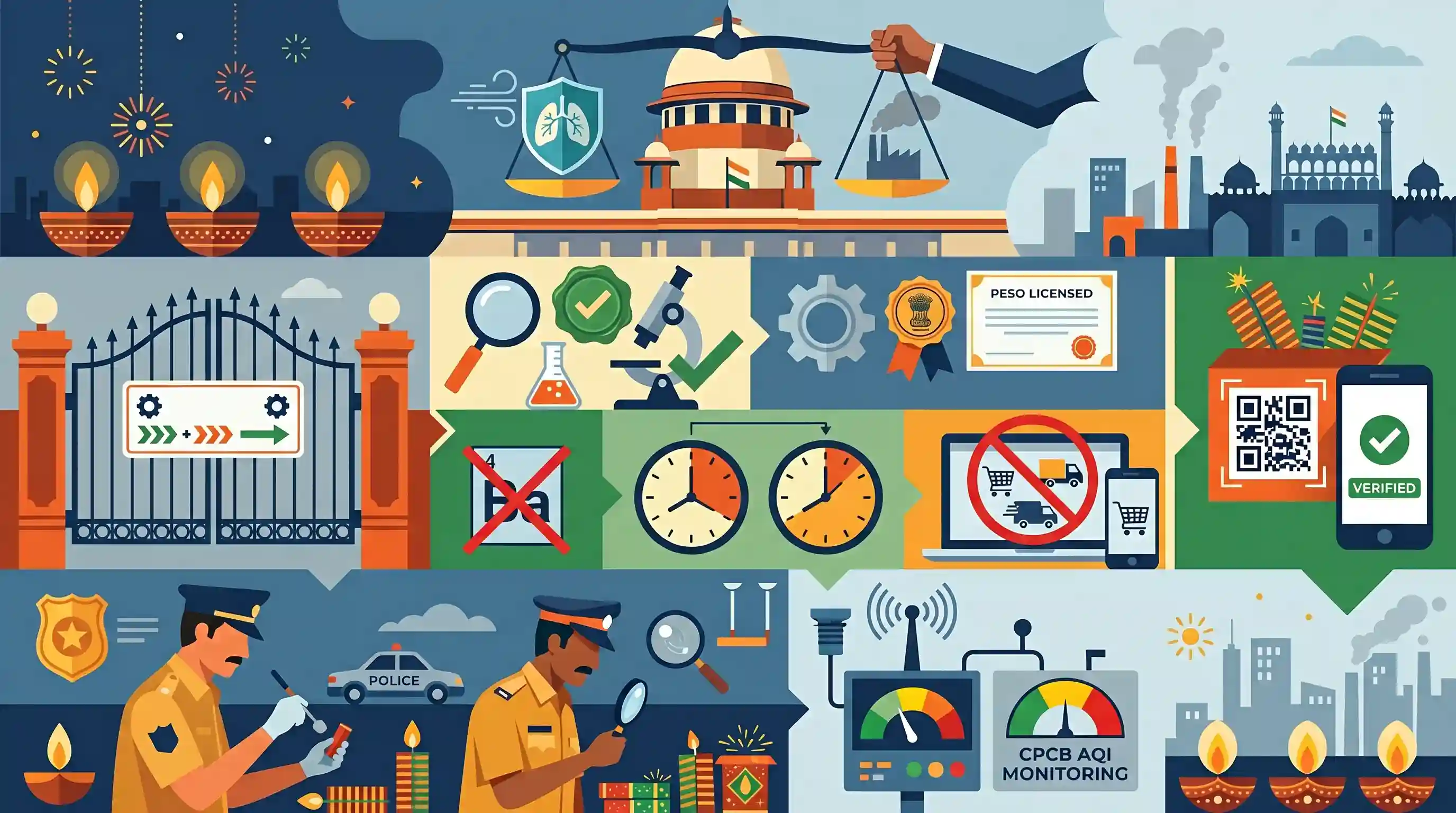
The Supreme Court of India has conditionally permitted the sale and use of 'green firecrackers' in the Delhi-NCR region for the upcoming Diwali festival, modifying its previous blanket ban. The relaxation is strictly regulated: crackers must be certified by NEERI, licensed by PESO, and free of toxic Barium. Usage is confined to specific two-hour windows on October 19 and 20. To ensure compliance and prevent circumvention, the Court banned e-commerce sales of firecrackers, mandated QR codes on packaging for verification, and ordered random police sampling. The CPCB will monitor the Air Quality Index (AQI) during this period. The decision reflects the judiciary's ongoing effort to balance the fundamental right to a clean environment (Article 21) with cultural practices and the economic rights of firecracker manufacturers, as established in the landmark 2018 Arjun Gopal judgment.
Key Points
- The Supreme Court modified its blanket ban on firecrackers in Delhi-NCR, allowing the sale and use of 'green firecrackers' for limited hours (6-7 AM and 8-10 PM) on October 19 and 20.
- Only firecrackers certified by NEERI and licensed by PESO are permitted; crackers containing the toxic element Barium and joined firecrackers (laries) remain strictly banned.
- Strict enforcement measures include a prohibition on e-commerce sales, mandatory QR codes on packaging for verification, and random sampling by police patrols.
- The Central Pollution Control Board (CPCB) and state boards are directed to closely monitor the Air Quality Index (AQI) to assess the short-term impact of the relaxed rules.
- The directive stems from the ongoing Arjun Gopal vs Union of India case (2018), which seeks to balance the right to a clean environment under Article 21 with citizens' religious sentiments and the livelihood of firecracker manufacturers.
Important Terms
Green Firecrackers

Low-emission fireworks developed by CSIR-NEERI that reduce particulate matter by 30%. They avoid toxic barium nitrate and include variants like SWAS and STAR to minimize air and noise pollution.
UPSC context
GS Paper III (Environment): Important for understanding pollution control measures and sustainable technology during festive seasons.
National Environmental Engineering Research Institute (NEERI)
A Nagpur-based lab under the Council of Scientific and Industrial Research (CSIR). It is the nodal agency for R&D and certification of "green cracker" formulations and safety standards.
UPSC context
GS Paper III (S&T / Environment): Tests knowledge of indigenous research institutions and their roles in solving environmental challenges.
Petroleum and Explosives Safety Organization (PESO)
A nodal agency under the Ministry of Commerce and Industry (DPIIT) that regulates safety for explosives and petroleum. It licenses firecracker manufacturers who follow NEERI-approved green formulations.
UPSC context
GS Paper II (Governance): Crucial for understanding the regulatory framework and safety standards for hazardous substances.
Central Pollution Control Board (CPCB)
A statutory body under MoEFCC established via the Water Act (1974). It sets national air quality standards, monitors pollution levels, and coordinates state-level pollution control boards.
UPSC context
GS Paper II & III: Tests understanding of statutory bodies, federal coordination, and environmental governance in India.
State Pollution Control Boards (SPCBs)
Statutory bodies created under the Water Act (1974) and Air Act (1981) to enforce environmental laws at the state level. They monitor local air/water quality and industrial compliance.
UPSC context
GS Paper II & III: Relevant for state-level environmental regulation and decentralized pollution control enforcement.
Article 21 (Right to Clean Environment)
A fundamental right protecting life and personal liberty. It has been judicially expanded to include the "right to a clean environment," forming the basis for environmental public interest litigation.
UPSC context
GS Paper II (Polity): Key for judicial interpretation of fundamental rights and the evolution of environmental jurisprudence.
Arjun Gopal Case (2018)
The landmark 2018 Supreme Court judgment that banned conventional firecrackers and permitted only certified green crackers. It balanced cultural traditions with the right to health and clean air.
UPSC context
GS Paper II (Judiciary): Landmark case for judicial activism and balancing economic rights with environmental protection.
Prelims Trap
PESO, which regulates and licenses green firecrackers, operates under the Ministry of Environment, Forest and Climate Change.
PESO (Petroleum and Explosives Safety Organisation) actually functions under the DPIIT, Ministry of Commerce and Industry, not the Environment Ministry.
Static Concepts Connected
What are the technical characteristics of Green Firecrackers?
- Emissions reduction: They are designed to reduce particulate matter (PM 2.5 and PM 10) emissions by approximately 30-35% compared to conventional firecrackers.
- Banned chemicals: They are strictly devoid of toxic heavy metals and elements like Barium (traditionally used for green light), Arsenic, Lithium, and Lead.
- Major variants: Developed by CSIR-NEERI, major types include SWAS (Safe Water Releaser), STAR (Safe Thermite Cracker), and SAFAL (Safe Minimal Aluminium).
What is the mandate of the Petroleum and Explosives Safety Organisation (PESO)?
- Nodal Ministry: It functions as a regulatory authority under the Department for Promotion of Industry and Internal Trade (DPIIT), Ministry of Commerce and Industry.
- Core Mandate: It administers the Explosives Act 1884 and Petroleum Act 1934, regulating the manufacture, storage, transport, and handling of explosive and hazardous substances.
Cross-Topic Patterns
Fundamental Rights Balancing Act
This issue forces the judiciary to balance Article 21 (Clean Environment) with Article 19(1)(g) (Livelihood of fireworks manufacturers) and Article 25 (Right to practice religion).
QR Codes for Traceability
Using QR codes to verify chemical compliance mirrors recent governance mandates in the pharmaceutical (API tracking) and agriculture (seed authenticity) sectors to combat counterfeiting.

Expect a Prelims question combining green firecracker chemistry (barium ban, SWAS/SAFAL) with PESO's nodal ministry (Commerce).
Linked PYQs · 3
Linked PYQs · 3
- 2015MainsGS2
Does the right to clean environment entail legal regulations on burning crackers during Diwali? Discuss in the light of Article 21 of the Indian Constitution and Judgement(s) of the Apex Court in this regard.
- 2022MainsGS2
“The most significant achievement of modern law in India is the constitutionalization of environmental problems by the Supreme Court.” Discuss this statement with the help of relevant case laws.
- 2021MainsGS3
Describe the key points of the revised Global Air Quality Guidelines (AQGs) recently released by the World Health Organisation (WHO). How are these different from its last update in 2005? What changes in India's National Clean Air Programme are required to achieve these revised standards?
