Menstrual Hygiene Rights and Article 21 Constitutional Interpretation
Source:Indian Express ↗
Why It Matters
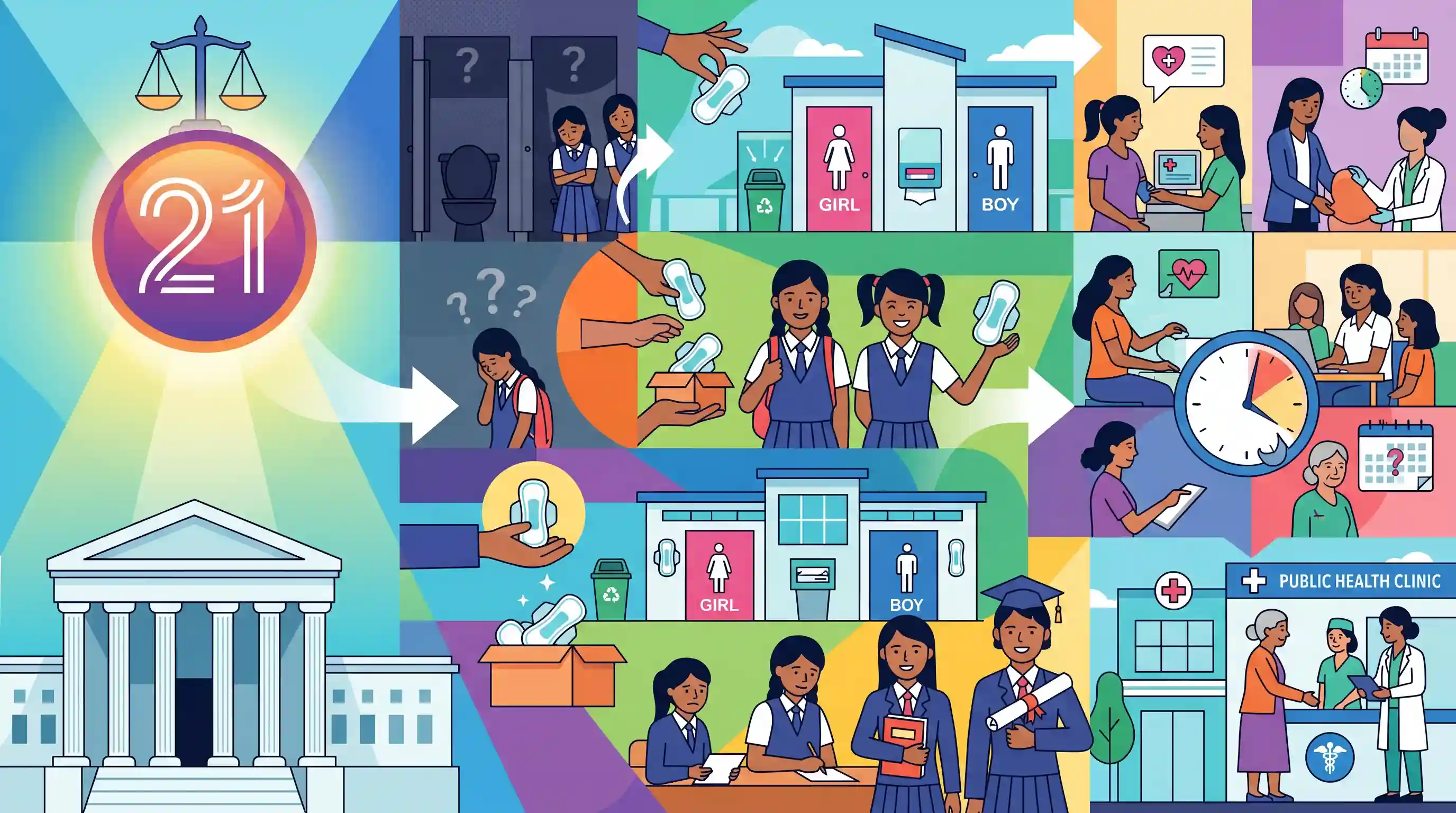
The Supreme Court's ruling acts as a landmark precedent for gender justice, expanding the scope of Article 21 to cover menstrual hygiene. It provides critical material for Mains answers on women's empowerment, the systemic gaps in educational infrastructure (WASH in schools), and the need for a continuum approach to healthcare policy formulation (from puberty to menopause).
Summary
The Supreme Court has recognized menstrual hygiene as intrinsic to the right to life under Article 21, directing government and private schools to provide free sanitary pads, gender-segregated toilets, and safe disposal facilities. This judgment addresses the systemic stigma and lack of sanitation that cause interrupted schooling and avoidable drop-outs among adolescent girls. Furthermore, the ruling, along with Maharashtra's recent introduction of public menopause clinics, highlights the necessity of viewing women's reproductive health as a lifelong continuum rather than addressing it in isolated fragments, thereby ensuring that gender equality and dignity are structurally embedded in public health and education policy.
Key Points
- The Supreme Court ruled that menstrual hygiene is an essential facet of the right to life under Article 21, ordering all schools to provide free sanitary pads and gender-segregated toilets within three months.
- Poor sanitation infrastructure and societal stigma surrounding menstruation have historically led to interrupted education and high drop-out rates for adolescent girls.
- The ruling challenges the systemic issue of public policies treating the male body as the default, emphasizing that girls' dignity and comfort are systemic obligations central to equality.
- Coupled with Maharashtra's launch of India's first public menopause clinics, the editorial advocates for a comprehensive health-policy framework that treats women's reproductive health as a lifelong continuum rather than in fragments.
Important Terms
Article 21 of the Constitution

Guarantees that no person shall be deprived of their life or personal liberty except according to procedure established by law. The Judiciary has expanded this to include the right to dignity, health, and privacy.
UPSC context
GS II: Fundamental Rights. Essential for understanding the Supreme Court's 'living document' interpretation and its application to social justice issues.
Right to Menstrual Hygiene
Now recognized by the Supreme Court as a fundamental right under Article 21. It ensures menstruating individuals can manage their health with dignity, access products, and use private, safe facilities without stigma.
UPSC context
GS II: Social Justice/Judiciary. Tests the ability to link biological realities with constitutional protections and gender equality.
Menstrual Hygiene Management (MHM)
The comprehensive process of using clean materials to absorb menstrual blood, having access to private facilities for changing, and ensuring safe, environmentally compliant disposal of menstrual waste.
UPSC context
GS II: Welfare Schemes/Education. Relates to infrastructure mandates in schools and the impact of sanitation on girl-child dropout rates.
Menopause Clinics
Specialized public health facilities introduced first by Maharashtra to provide medical consultation, mental health counseling, and screenings for bone and cardiovascular health for women transitioning out of their reproductive years.
UPSC context
GS II: Issues relating to Health. Highlights a shift toward a 'life-cycle' approach to women's health in public policy.
Substantive Equality
A legal principle where the state moves beyond 'equal treatment' to actively remove structural barriers and provide specific resources (like sanitary pads) to ensure true equality of opportunity for disadvantaged groups.
UPSC context
GS II: Indian Constitution. Critical for analyzing how the state fulfills its obligation to marginalized or biologically disadvantaged sections.
Ministry of Health and Family Welfare (MoHFW)
The nodal ministry for India's 'Menstrual Hygiene Policy for School-going Girls.' It coordinates with states to ensure assessment, product distribution, and hygiene standards in educational institutions.
UPSC context
GS II: Statutory/Regulatory Bodies and Policies. Tests knowledge of departmental responsibilities in implementing pan-India health mandates.
Prelims Trap
"The Supreme Court mandate for free sanitary pads and segregated toilets applies strictly to government and government-aided schools."
The Supreme Court explicitly directed both government AND private schools to provide these facilities within three months, making it a universal mandate across the education sector.
Static Concepts Connected
What is Substantive Equality under Article 14?
- Formal vs Substantive: Formal equality treats everyone identically, whereas substantive equality accounts for systemic disadvantages and biological differences to ensure true parity.
- Constitutional Basis: Rooted in Article 14 and supported by Article 15(3), which allows the State to make special provisions for women and children.
- Judicial Application: Courts use it to mandate accommodations, like menstrual infrastructure, ensuring state policies don't treat the male body as the default standard.
How is the Right to Education (RTE) linked to Article 21?
- Article 21A: Inserted by the 86th Constitutional Amendment, making free and compulsory education a fundamental right for children aged 6 to 14.
- Enabling Infrastructure: The SC interprets that RTE cannot be realized without basic dignity; thus, a lack of gender-sensitive sanitation directly violates both Article 21 and 21A.
Cross-Topic Patterns
WASH infrastructure and Female LFPR
Lack of sanitation causes adolescent drop-outs, directly linking Water, Sanitation, and Hygiene (WASH) deficits in schools to India's chronically low Female Labour Force Participation Rate (FLFPR).
Moving beyond maternal healthcare
Maharashtra’s menopause clinics represent a vital policy shift from maternal-only health schemes (like PMMVY) to a life-cycle approach addressing geriatric and midlife women's health needs.

Expect a 2026 Prelims statement testing if the SC's menstrual hygiene mandate applies to private schools, or a Mains Q on health continuum.
Linked PYQs · 3
Linked PYQs · 3
- 2023MainsGS2
Explain the constitutional perspectives of Gender Justice with the help of relevant Constitutional Provisions and case laws.
- 2020MainsGS2
In order to enhance the prospects of social development, sound and adequate health care policies are needed particularly in the fields of geriatric and maternal health care. Discuss.
- 2024MainsGS1
Distinguish between gender equality, gender equity and women's empowerment. Why is it important to take gender concerns into account in programme design and implementation?
