Supreme Court Rules Bar Council Cannot Punish Law Students
Source:The Hindu ↗
આ શા માટે મહત્વનું છે
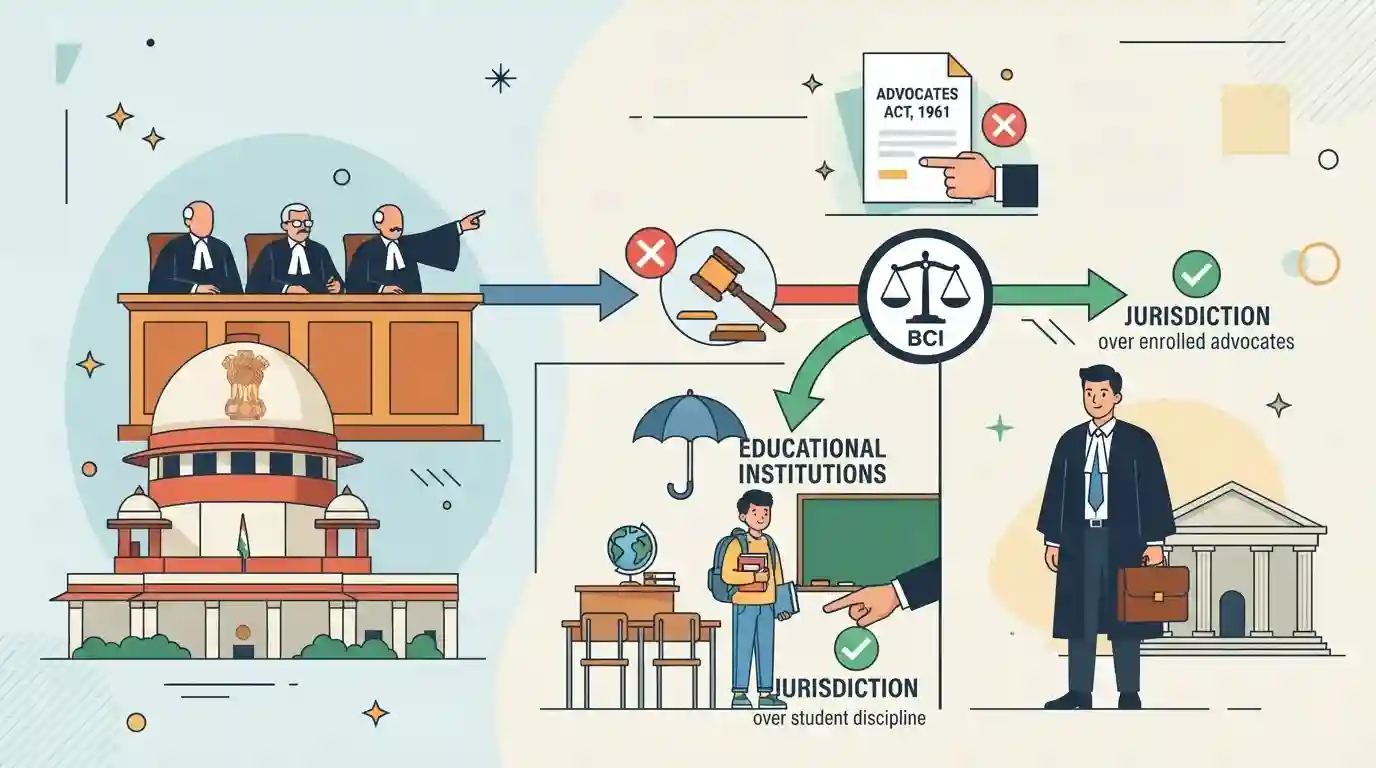
This ruling sets a crucial boundary for regulatory bodies like the Bar Council of India, affirming that statutory bodies cannot exercise punitive powers over individuals not explicitly covered under their governing legislation, thereby protecting student rights and defining institutional jurisdictions.
સારાંશ
The Supreme Court of India ruled that the Bar Council of India (BCI) lacks the legal power under the Advocates Act, 1961, to penalise or take disciplinary action against law students. The apex court clarified that the BCI's regulatory jurisdiction extends only to enrolled advocates, leaving student discipline within the purview of respective educational institutions.
મુખ્ય મુદ્દા
- The Supreme Court ruled that the Bar Council of India (BCI) does not possess the statutory authority under the Advocates Act, 1961, to punish law students or take disciplinary action against them.
- The BCI's regulatory and disciplinary jurisdiction is restricted to enrolled advocates and practicing lawyers, not students pursuing legal education in universities or colleges.
- The ruling reinforces the principle of statutory limitation on regulatory bodies, emphasizing that they cannot exceed powers explicitly conferred upon them by legislation.
- Universities and educational institutions retain the primary authority to maintain discipline and handle matters concerning students.
મહત્વપૂર્ણ શબ્દો
Bar Council of India (BCI)

A statutory body established under the Advocates Act, 1961, to regulate legal practice, professional conduct, and legal education standards in India.
UPSC context
Important for UPSC Prelims and Mains (GS Paper II - Statutory Bodies & Governance); tests understanding of regulatory powers over legal professionals.
Advocates Act 1961
The principal legislation enacted by Parliament in 1961 to regulate the legal profession, establish a unified class of advocates, and set up the BCI and State Bar Councils.
UPSC context
Important for UPSC Prelims and Mains (GS Paper II - Polity and Governance); tests statutory frameworks governing professions and regulatory jurisdiction.
Supreme Court of India
The apex constitutional court of India, possessing judicial review powers to interpret statutes like the Advocates Act, 1961, and delimit the jurisdiction of regulatory bodies.
UPSC context
Core for UPSC Mains GS Paper II (Indian Judiciary, Judicial Review, and Separation of Powers); tests the role of the apex court in checking overreach.
સંલગ્ન સ્થિર ખ્યાલો
What are the statutory powers and functions of the Bar Council of India under the Advocates Act, 1961?
- Professional Rules: Enrolment Standards: Prescribes standards of professional conduct and etiquette for advocates, and lays down procedure to be followed by disciplinary committees.
- Education Oversight: Legal Education: Recognises universities whose degree in law shall be qualification for enrolment as an advocate and visits/inspects universities.
- Bar Examination: All-India Bar: Organises the All-India Bar Examination (AIBE) and maintains the roll of advocates through State Bar Councils.
આંતર-વિષય પેટર્ન
Legal Education Oversight vs University Autonomy
While BCI sets professional entry standards, internal campus discipline and anti-ragging measures belong to university bodies under UGC guidelines, demonstrating the dual governance of higher education.

Expect a statement-based prelims question on whether statutory bodies like BCI possess disciplinary jurisdiction over pre-enrolment students.
સંલગ્ન PYQ · 2
સંલગ્ન PYQ · 2
- 2022PrelimsGS1
With reference to India, consider the following statements: 1. Government law officers and legal firms are recognised as advocates, but corporate lawyers and patent attorneys are excluded from recognition as advocates. 2. Bar Councils have the power to lay down the rules relating to legal education and recognition of law colleges. Which of the statements given above is/are correct?
- 2018MainsGS2
How far do you agree with the view that tribunals curtail the jurisdiction of ordinary courts? In view of the above, discuss the constitutional validity and competency of the tribunals in India.
