Supreme Court directives on national highway safety and Article 142
Source:Indian Express ↗
Why It Matters
The article provides a textbook example of judicial activism and the Supreme Court's use of Article 142 to fill administrative vacuums. It also expands the interpretation of Article 21 (Right to Life) to include commuter safety, making it highly relevant for Mains GS2 (Polity and Governance). Additionally, the data and directives on National Highway safety are crucial fodder for GS3 (Infrastructure) and essay topics on urbanization and public safety.
Summary
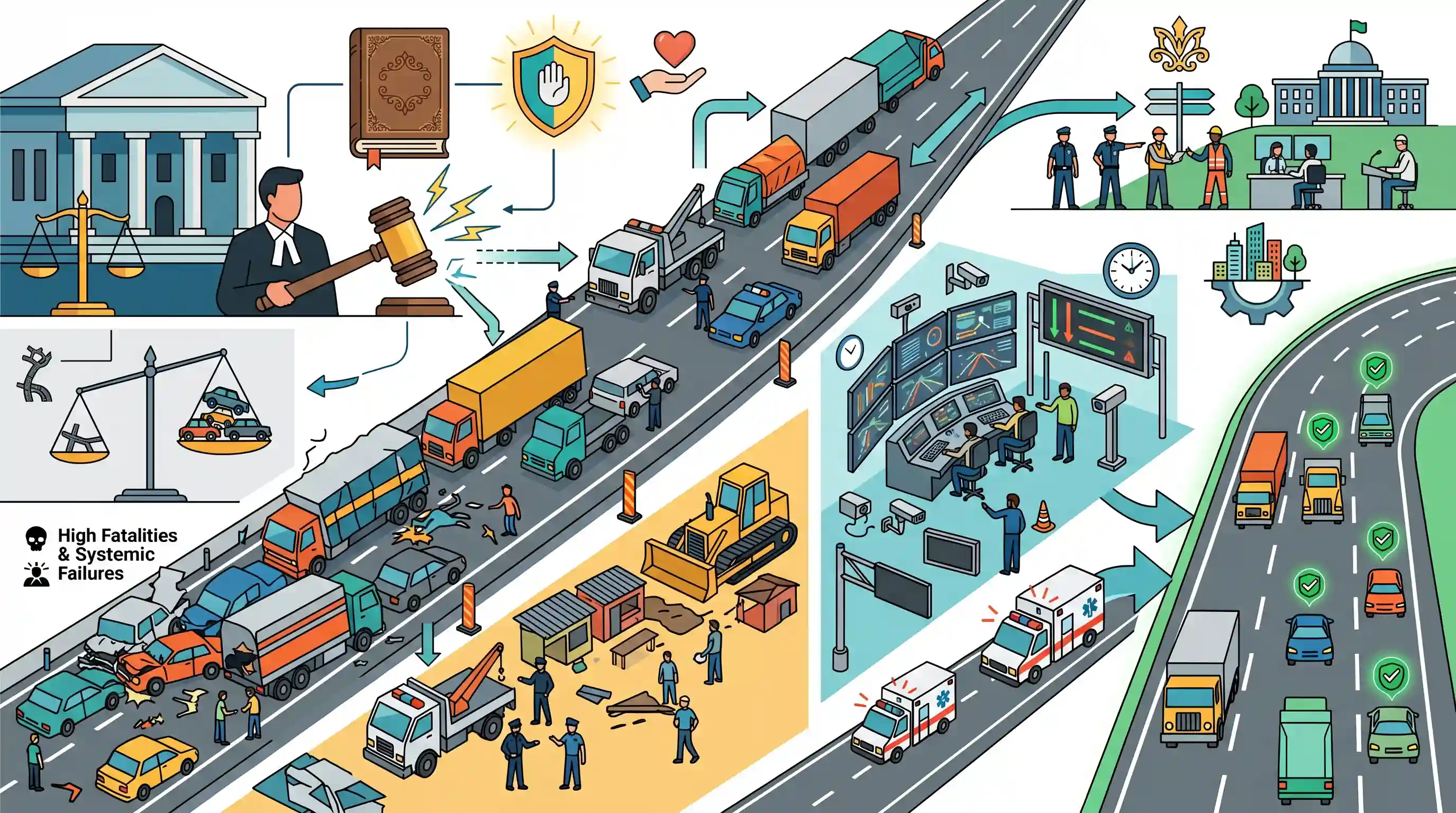
The Supreme Court, exercising its extraordinary powers under Article 142 of the Constitution to do "complete justice," has issued a comprehensive 13-point directive to the National Highways Authority of India (NHAI) and state road departments to curb road accidents. Initiated as a suo motu case following 34 fatalities in two accidents, the Court emphasized that the Right to Life (Article 21) encompasses the safety of commuters. The directives mandate strict enforcement against illegal parking of commercial vehicles on carriageways, the demolition of unauthorized eateries within the Right of Way, the deployment of Advanced Traffic Management Systems (ATMS), and the provision of 24x7 surveillance and Basic Life Support ambulances. The intervention underscores the systemic failures in highway management, noting the disproportionately high fatality rate (30%) on National Highways relative to their share of the road network (2%).
Key Points
- The Supreme Court invoked its extraordinary powers under Article 142 to issue a 13-point directive on road safety, ruling that commuter safety is integral to the Right to Life under Article 21.
- The suo motu case was triggered by two major accidents in Rajasthan (Bharatmala Expressway) and Telangana (NH-163) that collectively claimed 34 lives.
- Strict prohibitions were imposed on heavy commercial vehicles parking on carriageways and the operation of unauthorized dhabas or eateries within the Right of Way (ROW).
- The Court mandated the implementation of Advanced Traffic Management Systems (ATMS) and 24x7 highway surveillance teams on all National Highways.
- District Magistrates and Superintendents of Police have been tasked with enforcing demolition of illegal structures, alongside mandatory deployment of Basic Life Support (BLS) ambulances and recovery cranes.
- Despite comprising only 2% of India's road network, National Highways account for nearly 30% of total road traffic fatalities, highlighting a severe infrastructure management gap.
Important Terms
Article 142 of the Constitution

Constitutional provision granting the Supreme Court extraordinary power to pass any decree or order necessary for doing 'complete justice' in any pending matter.
UPSC context
GS Paper 2: Indian Judiciary. Tests knowledge of the Court's plenary powers and judicial activism.
Article 21 of the Constitution
Fundamental Right guaranteeing that no person shall be deprived of their life or personal liberty except according to procedure established by law.
UPSC context
GS Paper 2: Fundamental Rights. Tests the judiciary's role in expanding rights to include safety and environment.
Suo Motu Cognizance
The legal authority of a court to take up a case on its own motion without any formal petition or complaint being filed.
UPSC context
GS Paper 2: Judicial Activism. Tests understanding of the judiciary's proactive role in governance.
National Highways Authority of India (NHAI)
A statutory body constituted under the NHAI Act, 1988, responsible for the development, maintenance, and management of the National Highways network in India.
UPSC context
GS Paper 3: Infrastructure. Tests knowledge of statutory bodies and road transport management.
Advanced Traffic Management System (ATMS)
An integrated technology solution using AI, sensors, and cameras for real-time traffic monitoring, incident detection, and safety enforcement on highways.
UPSC context
GS Paper 3: Science and Technology/Infrastructure. Tests technological interventions for public safety and governance.
Right of Way (RoW)
The legal right to pass over or use a specific strip of land for public purposes like roads, pipelines, or utilities.
UPSC context
GS Paper 3: Infrastructure. Tests understanding of land use and hurdles in infrastructure project execution.
National Highway Act, 1988
The primary legislation governing the declaration of National Highways and the Central Government's power to acquire land and develop highway infrastructure.
UPSC context
GS Paper 3: Infrastructure. Tests the legal framework for road network development and management.
Prelims Trap
The Supreme Court can invoke Article 142 to override specific provisions of existing statutes in the interest of complete justice.
While Article 142 empowers the SC to do 'complete justice', settled jurisprudence dictates that this power cannot be used to override or ignore express statutory laws.
Static Concepts Connected
What are the limitations on the Supreme Court's power under Article 142?
- Not statutory override: It cannot be used to supplant, override, or ignore express substantive statutory provisions passed by the legislature.
- Subject to Fundamental Rights: Orders passed under Article 142 must not violate any Fundamental Rights guaranteed by the Constitution.
- Gap-filling role: It is an equitable power meant to fill legislative or executive vacuums, not to usurp the executive's policy-making domain.
How has the Supreme Court expanded the ambit of Article 21?
- Judicial interpretation: Post-Maneka Gandhi (1978), the SC ruled that the right to 'life' means living with human dignity, not mere animal existence.
- Implied rights: Through continuous interpretation, it includes implied rights like privacy, clean environment, livelihood, and now, commuter safety against systemic state failures.
Cross-Topic Patterns
Article 142 & Executive Inertia
The SC frequently uses Article 142 (e.g., highway liquor bans, BS-VI transitions) to enforce safety and environmental norms where administrative agencies display systemic inertia.
Bharatmala & Safety Engineering Deficits
Rapid high-speed road expansion under GS3 often outpaces safety enforcement, illustrating the friction between massive infrastructure growth targets and human-centric design.

Expect a GS2 Mains question assessing whether the SC's frequent use of Article 142 for governance issues oversteps the separation of powers.
Linked PYQs · 3
Linked PYQs · 3
- 2023MainsGS2
“The Constitution of India is a living instrument with capabilities of enormous dynamism. It is a constitution made for a progressive society.” Illustrate with special reference to the expanding horizons of the right to life and personal liberty.
- 2024MainsGS2
Explain the reasons for the growth of public interest litigation in India. As a result of it, has the Indian Supreme Court emerged as the world's most powerful judiciary ?
- 2014PrelimsGS1
Consider the following pairs : National Highway Cities connected 1. NH 4 : Chennai and Hyderabad 2. NH 6 : Mumbai and Kolkata 3. NH 15 : Ahmedabad and Jodhpur Which of the above pairs is/are correctly matched?
