सुप्रीम कोर्ट ने कोलकाता डॉक्टर मामले को कलकत्ता उच्च न्यायालय में स्थानांतरित किया
स्रोत:द हिंदू ↗
क्यों मायने रखता है
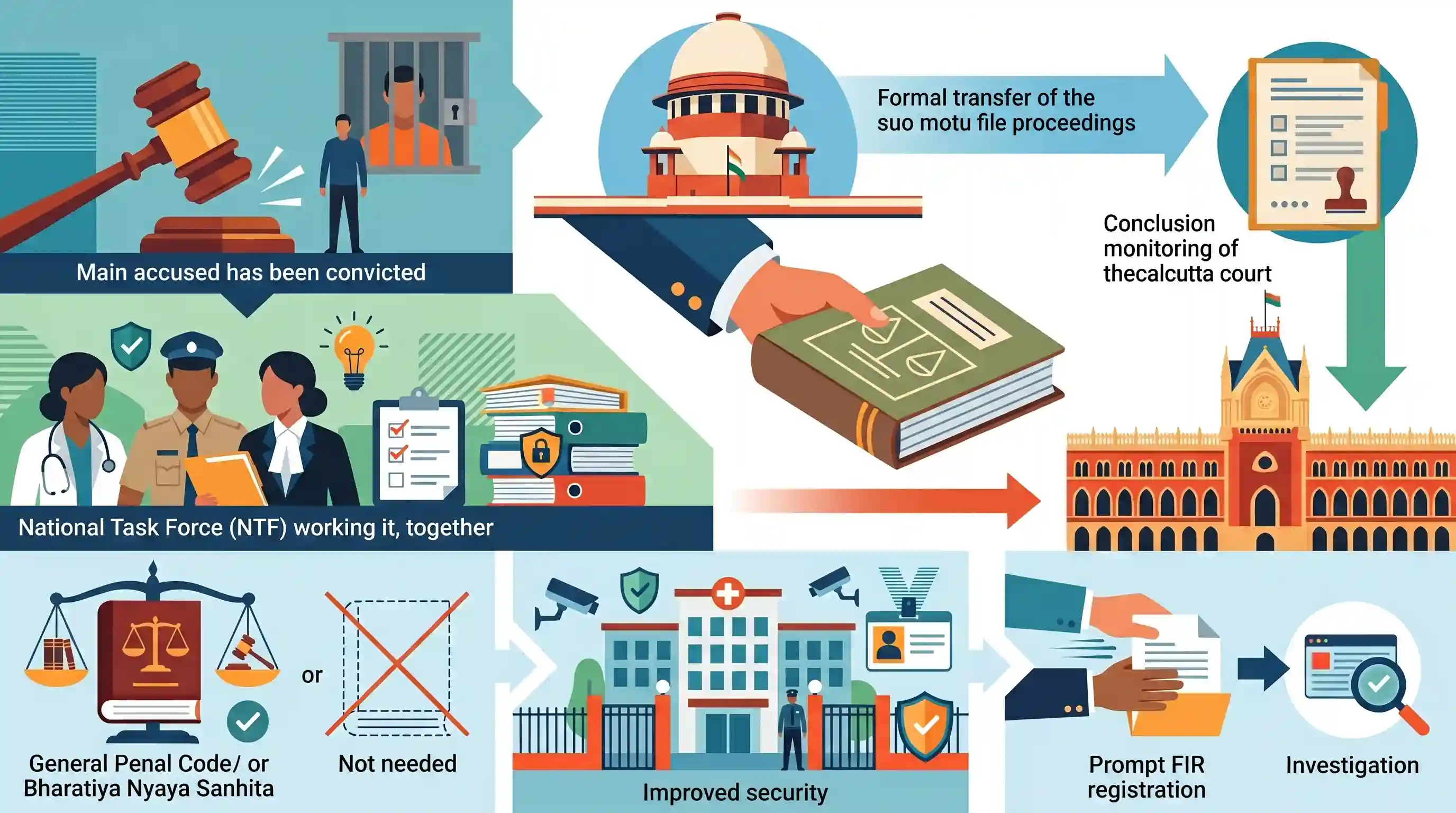
The case is significant for understanding the Supreme Court's exercise of suo motu powers, the decentralization of case monitoring to High Courts, and the policy debate on whether specific central laws are needed for the protection of healthcare workers versus relying on comprehensive criminal codes like the Bharatiya Nyaya Sanhita.
सारांश
The Supreme Court has formally transferred the suo motu proceedings regarding the rape and murder of a trainee doctor at R.G. Kar Medical College to the Calcutta High Court. Noting that the main accused has already been convicted and a National Task Force (NTF) has submitted its comprehensive guidelines for healthcare professionals' safety, the apex court ended its direct monitoring. The NTF concluded that existing laws, including the Bharatiya Nyaya Sanhita, are adequate, thus advising against a separate central law for doctors, while issuing strict recommendations for hospital security and prompt FIR registration.
मुख्य बिंदु
- The Supreme Court transferred the suo motu case involving the rape and murder of a trainee doctor at R.G. Kar Medical College to the Calcutta High Court for further monitoring.
- The SC refused pleas to shift the proceedings to the Delhi High Court, directing the Calcutta HC Chief Justice to constitute a Division Bench for the case.
- The trial court has already convicted the main accused, sentencing him to life imprisonment.
- A National Task Force (NTF) formed by the SC reported that a new central law for healthcare workers' safety is unnecessary, as existing State laws and the Bharatiya Nyaya Sanhita are sufficient.
- The NTF recommended short, medium, and long-term security measures for hospitals, including restricted access, adequate rest areas, and mandatory filing of FIRs within six hours of any violence against medical staff.
महत्वपूर्ण शब्द
Bharatiya Nyaya Sanhita, 2023 (BNS)

India's new criminal code that replaced the colonial-era Indian Penal Code (IPC) on July 1, 2024, modernizing definitions of crimes and punishments.
UPSC context
GS II/Polity & Governance: Fundamental shift in criminal justice; tests knowledge of legal reforms and gender justice provisions.
National Task Force (NTF)
A court-appointed expert body established by the Supreme Court to formulate national safety protocols and security measures for healthcare professionals across India.
UPSC context
GS II/Health Governance: Role of specialized committees in policy formulation; tests issues of workplace safety and health sector reforms.
Suo Motu Cognizance
A legal power allowing Indian courts to initiate proceedings on their own motion without a formal petition, typically for matters of public interest.
UPSC context
GS II/Judiciary: Judicial activism vs. restraint; tests understanding of the Supreme Court's original jurisdiction and Public Interest Litigation (PIL).
कलकत्ता उच्च न्यायालय
The highest judicial authority in a state or union territory, exercising original and appellate jurisdiction as well as superintendence over subordinate courts.
UPSC context
GS II/Judiciary: Tests federal judicial structure and the specific jurisdiction/supervisory powers of High Courts under Article 226/227.
Supreme Court of India
The apex judicial body in India under Article 124, serving as the final interpreter of the Constitution and the highest court of appeal.
UPSC context
GS II/Judiciary: Role in upholding Rule of Law; tests knowledge of constitutional powers like Articles 32 and 142.
Workplace Safety for Women
The legal and institutional frameworks ensuring protection from hazards, violence, and harassment at the place of employment, particularly for female professionals.
UPSC context
GS I/Social Issues & GS II/Governance: Gender-based violence and institutional accountability; tests knowledge of POSH Act and constitutional protections.
प्रारंभिक ट्रैप
"The Central government enacted a dedicated national law in 2024 to protect healthcare professionals from workplace violence."
India has no dedicated peacetime Central law for healthcare workers. The Epidemic Diseases Amendment was pandemic-specific, and the SC-appointed NTF specifically advised against enacting a new Central law.
संबंधित अवधारणाएँ
Under what Constitutional provisions can the Supreme Court transfer cases?
- Article 139A: 42वें संशोधन अधिनियम (1976) द्वारा शामिल किया गया, यह SC को उच्च न्यायालयों के बीच मामलों को स्थानांतरित करने या उन्हें अपने पास मंगवाने की शक्ति प्रदान करता है।
- Article 142: The SC can invoke its extraordinary powers to transfer cases anywhere within the territory of India to ensure "complete justice".
- Substantial Law Question: Cases can be transferred if they involve substantial questions of law of general importance, either suo motu or via petitions.
How is medical negligence penalized under the Bharatiya Nyaya Sanhita (BNS)?
- Section 106 Distinction: The BNS structurally differentiates criminal liability for medical negligence from general negligence causing death.
- Lesser Penalty: Imprisonment for registered medical professionals is capped at two years, compared to up to five years for the general public.
- Registered Professionals: The protection applies strictly to registered medical professionals performing medical procedures, preventing undue harassment over standard complications.
अंतर-विषय पैटर्न
Healthcare security intersects with BNS
The debate over hospital safety bridges criminal justice reform (BNSS Zero FIR mandates) with health governance, testing the adequacy of general penal codes versus specialized occupational safety legislations.
Lifecycle of Suo Motu interventions
The SC returning this case to the Calcutta HC illustrates the lifecycle of suo motu interventions—stepping in for acute systemic failures via Article 142, then delegating implementation back to state constitutional courts.

A 2026 prelims question on BNS/BNSS is highly likely, specifically targeting the exceptions for medical professionals and Zero FIR mandates.
संबद्ध PYQ · 2
संबद्ध PYQ · 2
- 2025MainsGS2
"Constitutional morality is the fulcrum which acts as an essential check upon the high functionaries and citizens alike...." In view of the above observation of the Supreme Court, explain the concept of constitutional morality and its application to ensure balance between judicial independence and judicial accountability in India.
- 2020MainsGS2
In order to enhance the prospects of social development, sound and adequate health care policies are needed particularly in the fields of geriatric and maternal health care. Discuss.
