Supreme Court Quashes Criminal Case Over Fake ST Certificate
Source:Indian Express ↗
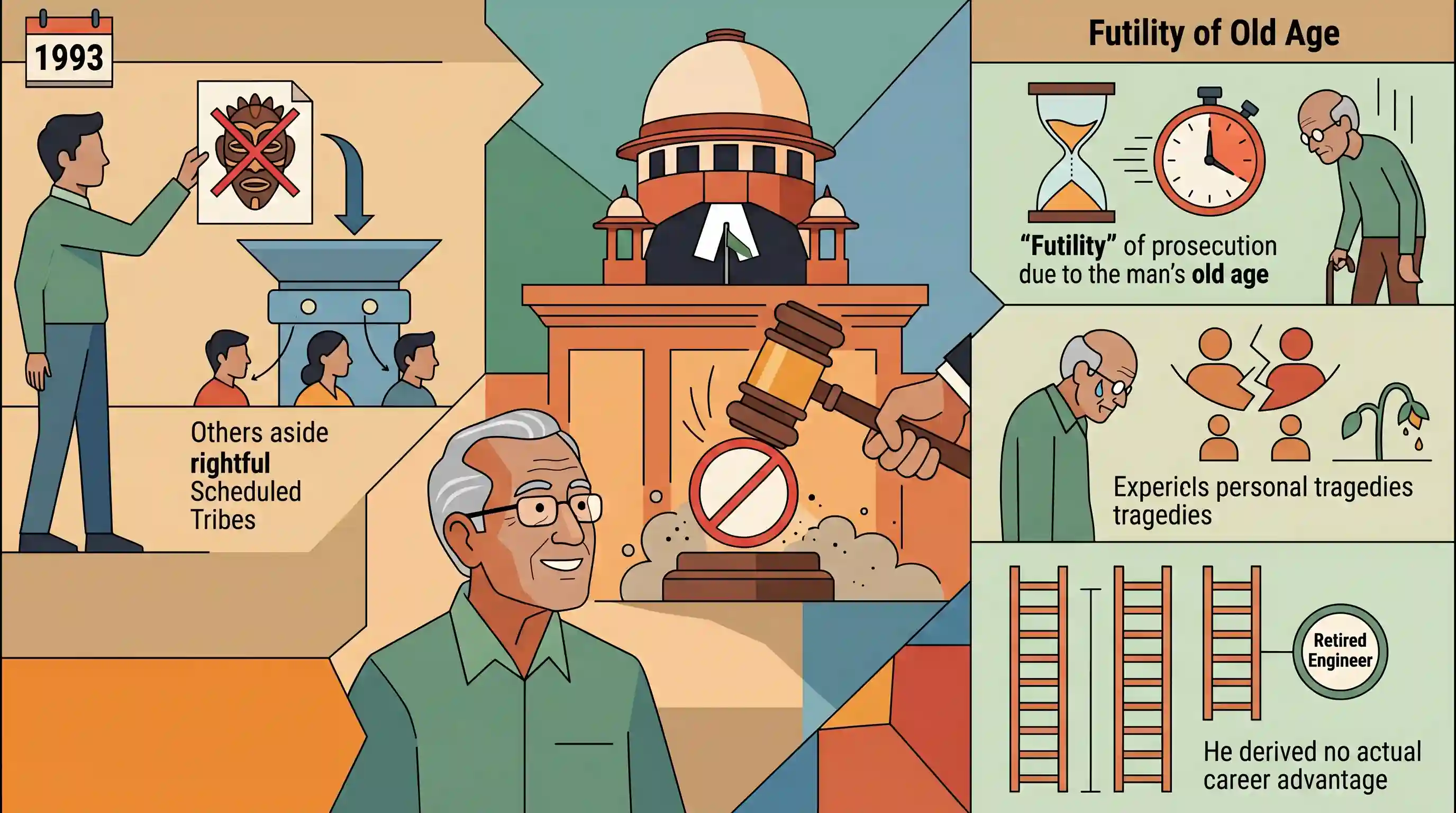
Why It Matters
This case illustrates the intersection of affirmative action policies and judicial discretion. It highlights the serious ethical and legal implications of submitting fake caste certificates to usurp benefits meant for marginalized groups, while also demonstrating how the judiciary balances the strict application of the law with compassion and pragmatism in cases of extreme delay where no actual benefit was derived.
Summary
The Supreme Court quashed a criminal case against a septuagenarian retired engineer who allegedly submitted a fake Scheduled Tribe (ST) certificate in 1993. While the Court condemned the act of using dubious means to claim affirmative action benefits—emphasizing that it deprives rightful candidates of their due under Article 342—it exercised judicial discretion to end the proceedings. The decision was based on the futility of continuing the prosecution given the man's old age, personal tragedies, and the fact that he derived no actual career advantage from the fake certificate.
Key Points
- A retired engineer was accused of submitting a fake Scheduled Tribe (ST) certificate in 1993, claiming roots in the 'Majhwar' community.
- The Supreme Court strongly condemned the practice of producing fake certificates, noting it denies rightful candidates the benefits of affirmative action.
- Despite the illegal nature of the act, the Court quashed the criminal proceedings due to the accused's advanced age (over 70) and personal tragedies.
- The Court also observed that the man never derived any actual career benefit from the fake certificate, rendering the delayed prosecution futile.
Important Terms
Article 342 of the Constitution

Empowers the President to notify communities as Scheduled Tribes for specific states/UTs. Subsequent modifications to this list can only be made through an Act of Parliament.
UPSC context
GS Paper II: Indian Polity. Tests knowledge of the constitutional process for identifying and protecting vulnerable sections.
Article 142 of the Constitution
Grants the Supreme Court plenary power to pass orders or decrees necessary for doing 'complete justice' in any pending case, even overriding statutory limitations.
UPSC context
GS Paper II: Judiciary. Key for understanding the Apex Court's extraordinary powers and judicial activism.
Judicial Discretion
The power of the judiciary to make decisions based on fairness and the specific circumstances of a case, rather than following rigid legal technicalities.
UPSC context
GS Paper II: Governance/Judiciary. Tests the balance between the letter of the law and equitable justice.
Scheduled Tribes (ST)
Indigenous communities recognized under Article 342 for their unique socio-cultural identity and historical disadvantage, entitled to constitutional safeguards and affirmative action benefits.
UPSC context
GS Paper II: Social Justice. Crucial for topics related to welfare schemes and rights of marginalized sections.
Central Public Works Department (CPWD)
A premier central government agency under the Ministry of Housing and Urban Affairs responsible for the planning and maintenance of India's public infrastructure.
UPSC context
GS Paper III: Infrastructure/Governance. Relevant for understanding government institutional machinery and public service delivery.
Affirmative Action
Policy of providing preferential treatment to marginalized groups in education and employment to address historical injustices and ensure social equity.
UPSC context
GS Paper II: Social Justice. Central to discussions on reservation, equality, and constitutional morality.
Prelims Trap
The President can amend the Scheduled Tribes list by issuing a subsequent official notification.
Under Article 342(2), once the initial Presidential notification is made, any subsequent inclusion or exclusion can ONLY be done by an Act of Parliament, not the President.
Static Concepts Connected
How are communities added to or removed from the Scheduled Tribes list?
- Initial Notification: The President specifies STs for a State/UT, after consulting the Governor in the case of a State, under Article 342(1).
- Subsequent Modifications: Any inclusion or exclusion from this officially notified list can only be enacted by an Act of Parliament under Article 342(2).
What is the significance of the Kumari Madhuri Patil judgment (1994)?
- Scrutiny Committees: Mandated state governments to form expert Scrutiny Committees to rigorously verify caste/tribe certificates and prevent reservation fraud.
- Void Ab Initio: Established that employment or admission secured via a fake certificate is legally void ab initio, leading to mandatory termination regardless of years served.
Cross-Topic Patterns
Ethics: Integrity vs. Compassion
Illustrates a GS4 ethical dilemma: balancing the strict enforcement of public integrity (anti-fraud in reservations) against compassionate judicial discretion (the futility of prosecuting a traumatized septuagenarian).
Article 142 & Complete Justice
Connects to the SC's frequent use of Article 142 to quash non-compoundable criminal proceedings when justice demands it, prioritizing substantive equity over procedural rigidity.

Expect a Prelims question contrasting the President's initial power to notify STs (Art 342) with Parliament's exclusive power to amend it.
Linked PYQs · 2
Linked PYQs · 2
- 2024PrelimsGS1
Consider the following statements : 1. It is the Governor of the State who recognizes and declares any community of that State as a Scheduled Tribe. 2. A community declared as a Scheduled Tribe in a State need not be so in another State. Which of the statements given above is/are correct?
- 2023MainsGS4
Corruption is the manifestation of the failure of core values in the society." In your opinion, what measures can be adopted to uplift the core values in the society ?
