Supreme Court Review on Stray Dog Removal and Urban Public Safety
Source:The Hindu ↗
Why It Matters
This issue is crucial for UPSC aspirants as it touches upon the intersection of judicial intervention in public administration (PILs), the responsibilities of Urban Local Bodies (ULBs) in managing civic issues, and the ethical dilemmas of human-animal conflict in urban environments.
Summary
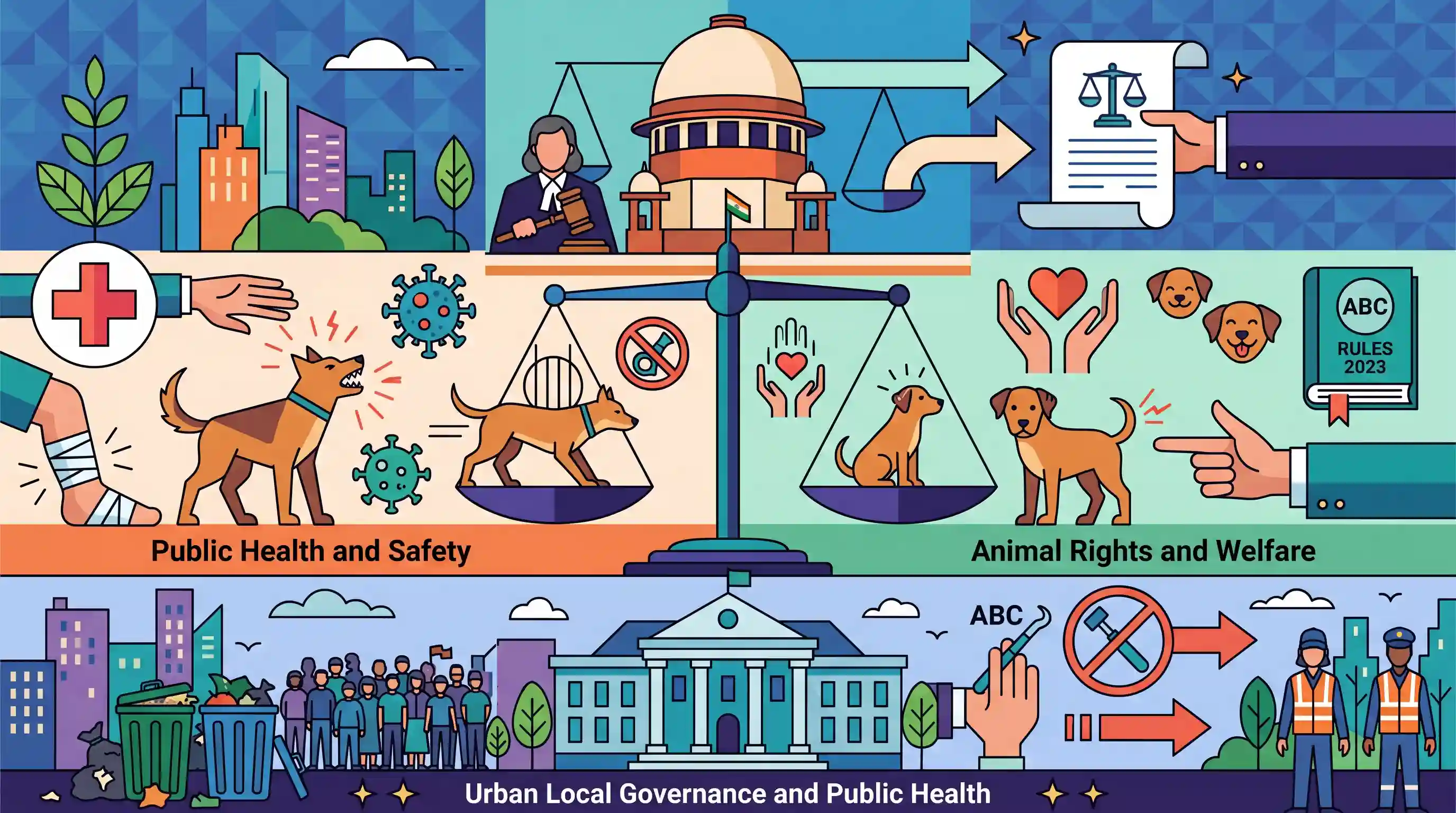
The Supreme Court has reserved its order on a plea challenging its August 2025 suo motu directive to remove and confine stray dogs from the streets of Delhi NCR. The case highlights a sharp conflict between public health and animal welfare. The Union Government defended the removal, pointing to rising dog bite cases and rabies fatalities, while animal rights advocates argued that mass relocation violates the Animal Birth Control (ABC) Rules, 2023. The Court also criticized municipal authorities for failing to sterilise the dogs, bringing urban local governance into focus.
Key Points
- The Supreme Court reserved its order on pleas challenging an earlier suo motu directive that mandated removing stray dogs from Delhi NCR streets.
- The Union Government highlighted a severe public health crisis, citing 25,201 dog bite cases in Delhi in 2024 and fatal rabies infections among children.
- Animal rights advocates argued that the relocation order violates the Animal Birth Control (ABC) Rules, 2023, which prohibit removing strays from their original habitats.
- Advocates also noted a lack of adequate shelter infrastructure for an estimated 8 lakh stray dogs, which could lead to logistical chaos and cruelty.
- The Court pulled up civic authorities for their failure to effectively sterilise stray dogs, underscoring gaps in urban local body administration.
Important Terms
Animal Birth Control (ABC) Rules, 2023

Rules under the Prevention of Cruelty to Animals Act, 1960, mandating that stray dogs be sterilized, vaccinated, and returned to their original locations (Catch-Neuter-Vaccinate-Return) to humanely manage their population.
UPSC context
GS Paper II (Government Policies) and GS Paper III (Animal Welfare/Biodiversity). Tests understanding of regulatory frameworks managing human-animal conflict.
Municipal Corporations
Urban local bodies responsible for public health and sanitation. Under Article 243W and the ABC Rules 2023, they are the primary agencies for implementing sterilization and immunization programs.
UPSC context
GS Paper II (74th Constitutional Amendment Act and Devolution of Powers). Tests knowledge of administrative responsibilities in urban governance.
Suo Motu Cognizance
A Latin term meaning 'on its own motion,' describing the power of the Supreme Court and High Courts to initiate legal proceedings without a formal petition from any party.
UPSC context
GS Paper II (Structure, Organization, and Functioning of the Judiciary). Tests conceptual knowledge of judicial activism and constitutional powers under Articles 32 and 142.
Public Interest Litigation (PIL)
A legal mechanism allowing individuals or groups to file cases on behalf of the public interest, particularly for marginalized sections, significantly broadening the judiciary's reach in India.
UPSC context
GS Paper II (Judiciary). Essential for understanding tools for social justice and the evolution of judicial oversight in India.
Animal Welfare Board of India (AWBI)
A statutory advisory body established under the Prevention of Cruelty to Animals Act, 1960, tasked with advising the government on animal welfare laws and monitoring their implementation.
UPSC context
GS Paper II (Statutory, Regulatory, and Quasi-judicial bodies). Tests knowledge of specialized institutions overseeing animal rights and welfare.
Prelims Trap
The Animal Welfare Board of India (AWBI) was established under the Wildlife (Protection) Act, 1972.
AWBI is a statutory advisory body established under Section 4 of the Prevention of Cruelty to Animals Act, 1960, not the WPA.
Static Concepts Connected
How does the Indian Constitution address animal welfare and cruelty prevention?
- Fundamental Duties: Article 51A(g) makes it a duty of every citizen to have compassion for living creatures.
- Directive Principles: Article 48 directs the State to organize agriculture and animal husbandry, and prohibit the slaughter of cows, calves, and other milch/draught cattle.
- Seventh Schedule: Prevention of cruelty to animals falls under the Concurrent List (Entry 17), allowing both Parliament and State legislatures to enact laws.
- Twelfth Schedule: Item 15 places the management of cattle pounds and prevention of cruelty to animals under the purview of Urban Local Bodies.
What are the key characteristics of Rabies and the 'One Health' approach to combat it?
- Zoonotic Disease: Rabies is a viral zoonotic disease that is almost 100% fatal once clinical symptoms appear, primarily transmitted through dog bites.
- One Health Approach: It recognizes the interconnection between people, animals, and their shared environment, coordinating public health and veterinary systems.
- ABC Rules 2023: It mandates a "catch-sterilize-vaccinate-release" model, legally prohibiting the mass relocation or culling of community street dogs to manage populations.
Cross-Topic Patterns
Judicial activism vs. Municipal administration
The SC's suo motu directive and subsequent review highlights the tension between judicial intervention and administrative failures of Urban Local Bodies (ULBs) under the 74th Amendment.
Rabies & the 'One Health' framework
Managing zoonotic diseases like Rabies requires bridging veterinary science and public health, a recurring UPSC theme previously seen with Nipah, COVID-19, and Avian Influenza.

Expect a 2026 Prelims question linking Article 51A(g), 12th Schedule (ULB duties), and the statutory basis of the AWBI.
Linked PYQs · 3
Linked PYQs · 3
- 2024MainsGS2
Explain the reasons for the growth of public interest litigation in India. As a result of it, has the Indian Supreme Court emerged as the world's most powerful judiciary ?
- 2024MainsGS2
Analyse the role of local bodies in providing good governance at local level and bring out the pros and cons merging the rural local bodies with the urban local bodies.
- 2015MainsGS4
What is meant by 'environmental ethics'? Why is it important to study? Discuss any one environmental issue from the viewpoint of environmental ethics.
