Supreme Court Reservation Policy for Administrative Staff
Source:The Hindu ↗
Why It Matters
The introduction of a formal reservation policy in the administrative wing of the Supreme Court highlights the evolving scope of affirmative action and institutional representation within India's highest judicial body. It is relevant for understanding Article 16 (equality of opportunity in public employment) and the administrative powers of the judiciary.
Summary
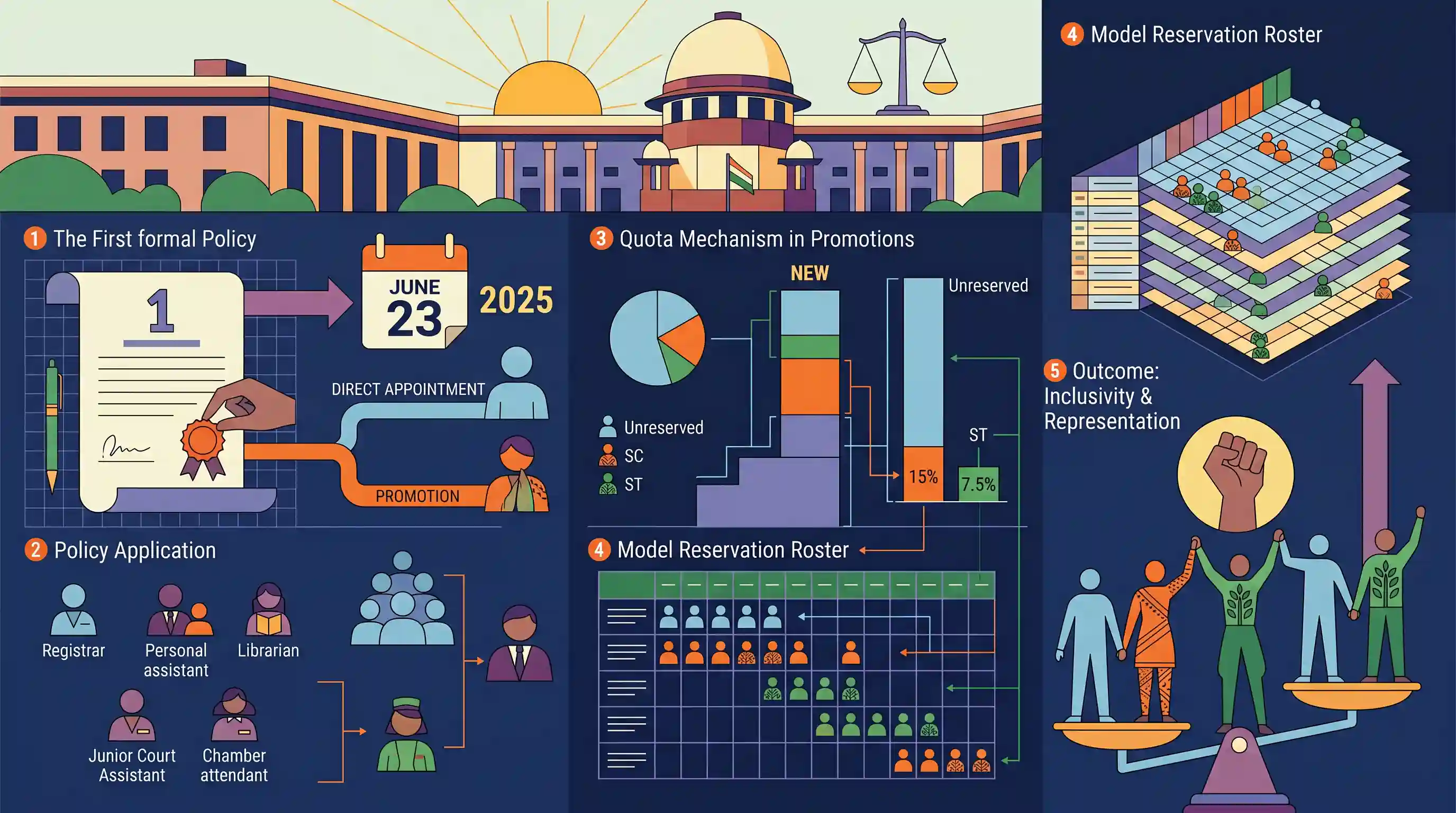
The Supreme Court of India has introduced its first formal reservation policy for the direct appointment and promotion of its staff members. Effective from June 23, 2025, the policy mandates a 15% quota for Scheduled Caste (SC) employees and a 7.5% quota for Scheduled Tribe (ST) employees in promotions. The policy, backed by a Model Reservation Roster, covers various administrative and support positions within the court, reflecting a move toward greater affirmative action and inclusivity in the apex court's administration.
Key Points
- The Supreme Court of India has implemented a formal reservation policy for the direct appointment and promotion of its staff for the first time.
- The policy provides a 15% promotional quota for Scheduled Caste (SC) employees and a 7.5% quota for Scheduled Tribe (ST) employees.
- A Model Reservation Roster and Register has been established on the internal network (Supnet), effective from June 23, 2025.
- The quota benefits apply to several positions, including registrars, senior personal assistants, assistant librarians, junior court assistants, and chamber attendants.
Important Terms
Model Reservation Roster

A post-based 200-point tracking mechanism ensuring designated percentages for reserved categories (SC/ST/OBC) are maintained within a cadre's total strength, rather than just filling individual annual vacancies.
UPSC context
GS-II/Social Justice; tests understanding of affirmative action mechanisms and the transition from vacancy-based to post-based reservation systems.
Article 146
A constitutional provision empowering the Chief Justice of India (CJI) to appoint Supreme Court staff and prescribe their conditions of service, ensuring the judiciary’s administrative independence from the executive.
UPSC context
GS-II/Polity; critical for questions on judicial independence, the separation of powers, and the CJI's administrative authorities.
R.K. Sabharwal Case (1995)
A 1995 five-judge Constitution Bench ruling that mandated reservation in government appointments be post-based rather than vacancy-based to prevent exceeding quota ceilings and ensure consistent representation.
UPSC context
GS-II/Judiciary; a landmark precedent frequently cited in discussions about the legal evolution and limits of reservation policies.
Post-based Reservation
A system where reservation quotas are calculated based on the total number of posts available in a specific cadre, ensuring that reserved seats remain within that category even after incumbents retire.
UPSC context
GS-II/Governance; relevant for understanding the mechanics of public employment and social justice implementation in India.
Supreme Court of India (Administrative Status)
The country’s apex court which, under Article 146, maintains administrative autonomy to manage its internal recruitment and staff promotions, recently introducing its first formal reservation policy for SC/ST/OBC employees.
UPSC context
GS-II/Polity; focuses on the institution's role as an employer and its internal governance vs. its judicial functions.
Prelims Trap
Parliament legally mandates and regulates the reservation policies for the administrative staff of the Supreme Court.
Article 146 grants the Chief Justice of India exclusive power to appoint SC staff and determine their service conditions. Parliament does not directly dictate SC staff reservation; it is the CJI's administrative prerogative.
Static Concepts Connected
What is the constitutional basis for reservation in promotions?
- Indra Sawhney (1992): The Supreme Court originally ruled that Article 16(4) only applies to initial appointments, explicitly barring reservations in promotions.
- 77th Amendment (1995): Inserted Article 16(4A), allowing the State to make provisions for reservation in matters of promotion for SCs and STs if they are inadequately represented.
- 85th Amendment (2001): Amended Article 16(4A) to explicitly include the principle of 'consequential seniority' for SC/ST employees promoted through reservation quotas.
How does Article 146 secure the Supreme Court's administrative independence?
- Exclusive Appointing Authority: The Chief Justice of India (or a directed judge) has the sole, exclusive authority to appoint the officers and servants of the Supreme Court.
- Service Conditions: The CJI prescribes rules regarding staff service conditions, though rules relating to salaries, allowances, or pensions require the President's approval.
- Charged Expenditure: All administrative expenses of the Supreme Court, including staff salaries and allowances, are charged upon the Consolidated Fund of India, making them non-votable.
Cross-Topic Patterns
Higher Judiciary vs. Administrative Quotas
While administrative staff receive SC/ST quotas under Article 146, the Collegium system for appointing higher judiciary Judges (Articles 124 & 217) legally operates without any constitutional reservation mandate.
Evolution of Article 16(4A) overrides
The SC adopting promotional quotas administratively is deeply symbolic, given Parliament enacted the 77th Amendment specifically to override the SC's own judicial ban on promotional quotas in the Indra Sawhney case.

Expect a multi-statement Prelims question contrasting Article 146 (CJI's staff appointment powers) with Article 124 (Judge appointments).
Linked PYQs · 3
Linked PYQs · 3
- 2023PrelimsGS1
Consider the following statements: Statement-I: The Supreme Court of India has held in some judgements that the reservation policies made under Article 16(4) of the Constitution of India would be limited by Article 335 for maintenance of efficiency of administration. Statement-II: Article 335 of the Constitution of India defines the term 'efficiency of administration'. Which one of the following is correct in respect of the above statements?
- 2021MainsGS2
Discuss the desirability of greater representation to women in the higher judiciary to ensure diversity, equity and inclusiveness.
- 2018MainsGS2
Whether National Commission for Scheduled Castes (NCSC) can enforce the implementation of constitutional reservation for the Scheduled Castes in the religious minority institutions? Examine.
