Judges Inquiry Act and Independent Powers of Lok Sabha Speaker
Source:The Hindu ↗
Why It Matters
Provides a critical interpretation of the Judges (Inquiry) Act, 1968, clarifying the independent powers of the Presiding Officers of the Lok Sabha and Rajya Sabha in admitting motions for the removal of higher judiciary judges. It emphasizes the balance between judicial accountability and parliamentary competence.
Summary
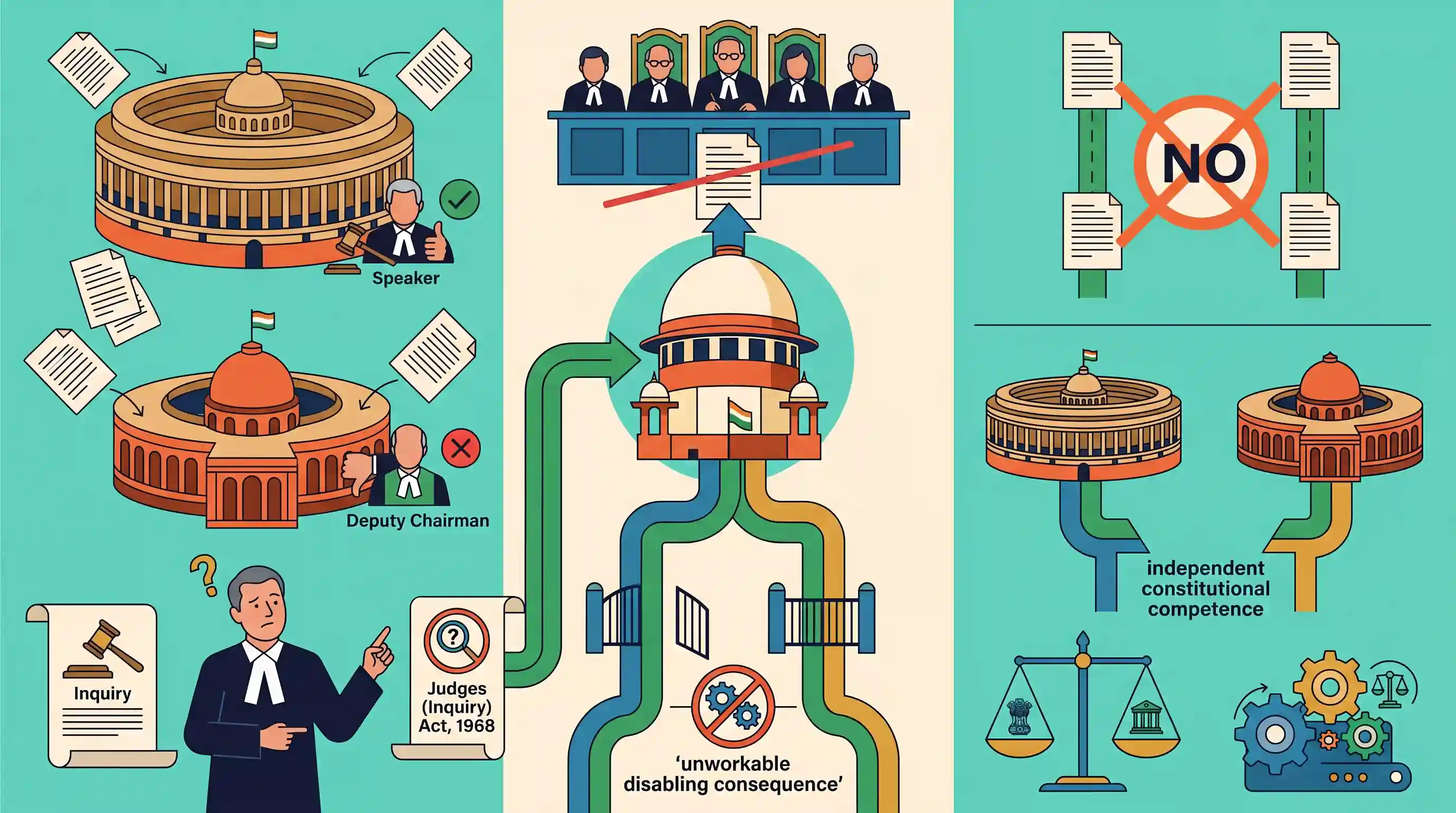
The Supreme Court has rejected a petition by Allahabad High Court judge Yashwant Varma, who challenged the Lok Sabha Speaker's unilateral formation of an inquiry committee to investigate his removal for alleged misbehaviour. Varma contended that because removal notices were given in both the Lok Sabha and Rajya Sabha on the same day, the Judges (Inquiry) Act, 1968 required joint action or admission by both Houses. However, the Rajya Sabha Deputy Chairman rejected the notice while the Lok Sabha Speaker admitted it. The Supreme Court ruled that interpreting the statute as demanding joint admission would effectively give one House veto power over the other's right to initiate proceedings, leading to an unworkable 'disabling consequence.' The ruling clarifies that the statutory provisions aim to prevent redundant, parallel inquiries, rather than limit the independent constitutional competence of either House of Parliament to admit a removal motion.
Key Points
- The Supreme Court dismissed Justice Yashwant Varma's challenge against Lok Sabha Speaker Om Birla's unilateral decision to form an inquiry committee for his removal.
- Justice Varma argued that since removal notices were filed in both Houses on the same day, they should have been admitted jointly per the proviso of Section 3(2) of the Judges (Inquiry) Act, 1968.
- While the Rajya Sabha Deputy Chairman rejected the notice, the Lok Sabha Speaker admitted it and set up a three-member inquiry panel.
- The Supreme Court held that interpreting the law to require joint admission would create a 'disabling consequence,' allowing rejection by one House to arbitrarily paralyze the entire removal process.
- The Court clarified that the proviso to Section 3(2) is intended solely to prevent parallel inquiry committees, preserving the independent competence of each House to act on a removal motion.
Important Terms
Judges (Inquiry) Act, 1968

A 1968 law regulating the statutory procedure for investigating and proving misbehaviour or incapacity of Supreme Court and High Court judges before parliamentary removal.
UPSC context
GS Paper II - Judiciary. Tests understanding of the statutory framework for judicial accountability and the removal process.
Article 124(4)
The constitutional provision detailing the removal of a Supreme Court judge by the President following a parliamentary address supported by a special majority.
UPSC context
GS Paper II - Indian Constitution. Fundamental for questions on judicial tenure and the checks-and-balances between the legislature and judiciary.
Lok Sabha Speaker
The presiding officer of the Lok Sabha who possesses discretionary power to admit or reject a judge's removal motion and constitute an inquiry panel.
UPSC context
GS Paper II - Parliament. Tests knowledge of the Speaker’s quasi-judicial powers in the context of judicial removal.
Inquiry Committee
A three-member panel comprising a Supreme Court judge, a High Court Chief Justice, and an eminent jurist, formed to investigate charges against a judge.
UPSC context
GS Paper II - Statutory Bodies. Essential for describing the procedural sequence of "impeachment" (removal) under the 1968 Act.
Proven Misbehaviour or Incapacity
The two exclusive constitutional grounds required to initiate removal proceedings against a judge, ensuring their security of tenure and independence.
UPSC context
GS Paper II - Judiciary. Tests precision regarding the constitutional language used for judicial removal compared to other high offices.
Separation of Powers
The constitutional principle that ensures the judiciary, legislature, and executive perform their respective functions without encroaching on each other's domain.
UPSC context
GS Paper II - Basic Structure. Central to the Yashwant Varma ruling regarding the independent competence of each House of Parliament.
Prelims Trap
If removal motions against a judge are introduced in both Houses, rejection by one House bars the other from admitting the motion.
The SC ruled this creates an unconstitutional veto. The joint admission proviso prevents parallel inquiries but doesn't override a single House's independent competence.
Static Concepts Connected
What is the statutory procedure for investigating the removal of a High Court judge?
- Initiation: Requires a removal motion signed by at least 100 Lok Sabha MPs or 50 Rajya Sabha MPs.
- Admission Discretion: The Speaker of Lok Sabha or Chairman of Rajya Sabha holds independent, discretionary power to admit or refuse the motion.
- Inquiry Panel: If admitted, a three-member committee (an SC judge, an HC Chief Justice, and a distinguished jurist) investigates the charges.
What are the constitutional grounds and majorities required to remove a judge?
- Strict Grounds: Article 124(4) and Article 217 limit removal strictly to "proved misbehaviour" or "incapacity".
- Special Majority: Requires a majority of the total membership and two-thirds of members present and voting in each House of Parliament.
- Constitutional Terminology: The Constitution uses the term "removal" for judges, reserving the term "impeachment" exclusively for the President of India.
Cross-Topic Patterns
Discretion of Presiding Officers
The absolute discretion of the Speaker/Chairman in admitting judicial removal motions structurally mirrors their authority in admitting breach of privilege motions or certifying Money Bills.
Judicial Review of Parliamentary Acts
While Article 122 protects internal parliamentary proceedings from judicial review, statutory procedures governing parliament (like the Judges Inquiry Act) remain fully subject to Supreme Court interpretation.

A 2026 Prelims question will likely test the independent initiation powers of the Lok Sabha and Rajya Sabha under the Judges (Inquiry) Act.
Linked PYQs · 3
Linked PYQs · 3
- 2019PrelimsGS1
Consider the following statements: 1. The motion to impeach a Judge of the Supreme Court of India cannot be rejected by the Speaker of the Lok Sabha as per the Judges (Inquiry) Act, 1968. 2. The Constitution of India defines and gives details of what constitutes 'incapacity and proved misbehaviour' of the Judges of the Supreme Court of India. 3. The details of the process of impeachment of the Judges of the Supreme Court of India are given in the Judges (Inquiry) Act, 1968. 4. If the motion for the impeachment of a Judge is taken up for voting, the law requires the motion to be backed by each House of the Parliament and supported by a majority of total membership of that House and by not less than two-thirds of total members of that House present and voting. Which of the statements given above is/are correct?
- 2022MainsGS2
Discuss the role of the Vice-President of India as the Chairman of the Rajya Sabha.
- 2020MainsGS2
Once a Speaker, Always a Speaker' ! Do you think this practice should be adopted to impart objectivity to the office of the Speaker of Lok Sabha ? What could be its implications for the robust functioning of parliamentary business in India?
