Centre-State Fiscal Disputes over Concurrent List Education Grants
Source:The Hindu ↗
Why It Matters
This article is a prime case study of Centre-State friction over subjects in the Concurrent List (Education). It illustrates challenges in cooperative federalism, fiscal federalism (using grants to incentivize/coerce central policies), and constitutional disputes resolved under Article 131 (original jurisdiction of the SC). It also touches upon regional linguistic autonomy vs. national integration efforts like the three-language formula.
Summary
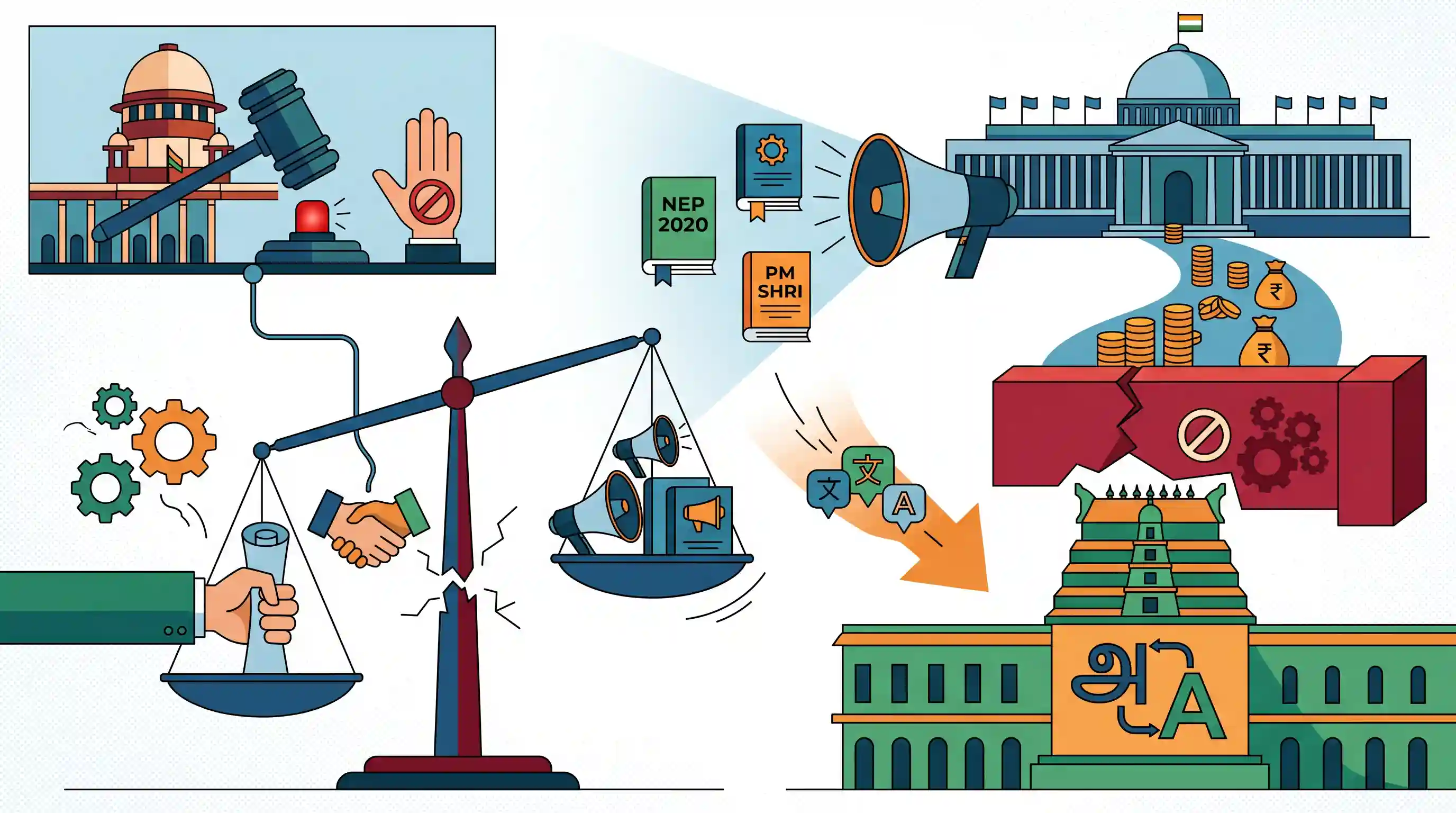
The Supreme Court has declined an urgent hearing for Tamil Nadu’s original suit against the Centre over the withholding of ₹2,151 crore under the Samagra Shiksha Scheme. Tamil Nadu accuses the Union Government of freezing crucial education funds to force the State into implementing the National Education Policy (NEP) 2020, its contentious three-language formula, and the PM SHRI Schools Scheme. Citing a historical two-language policy (Tamil and English), the State argues that using financial conditionalities to dictate education policy undermines cooperative federalism and usurps its constitutional authority over Concurrent List subjects. The dispute highlights the growing friction in Centre-State fiscal relations and the imposition of uniform national policies on dissenting states.
Key Points
- The Supreme Court refused an urgent hearing to Tamil Nadu's original suit against the Centre for withholding over ₹2,151 crore in education funds under the Samagra Shiksha Scheme.
- Tamil Nadu alleges the Union government is holding back funds to coerce the State into fully implementing the National Education Policy (NEP) 2020, including its three-language formula, and the PM SHRI Schools Scheme.
- The State argues that linking the central share of education funds to NEP implementation violates cooperative federalism and infringes on its constitutional legislative powers under Entry 25 of the Concurrent List.
- The funding halt negatively impacts nearly 48 lakh students, 2.2 lakh teachers, and tens of thousands of staff, hindering the implementation of the Right to Education (RTE) Act.
- Tamil Nadu has consistently adhered to a two-language formula (Tamil and English) following a 1968 State Assembly resolution, and demands a judicial declaration that the central conditions are unconstitutional.
Important Terms
Samagra Shiksha Scheme

An overarching Centrally Sponsored Scheme for school education (pre-school to Class 12) that subsumes Sarva Shiksha Abhiyan (SSA), Rashtriya Madhyamik Shiksha Abhiyan (RMSA), and Teacher Education (TE).
UPSC context
GS Paper II (Social Justice/Education) and GS Paper III (Government Budgeting/Centrally Sponsored Schemes).
PM SHRI Schools Scheme
A Centrally Sponsored Scheme aimed at developing over 14,500 schools as 'exemplar' institutions that showcase all components of the National Education Policy (NEP) 2020.
UPSC context
GS Paper II (Governance/Education) - tests understanding of federal scheme implementation and educational reforms.
National Education Policy (NEP) 2020
A comprehensive framework for transforming the Indian education system, emphasizing multi-disciplinary learning, regional languages, and the Three-Language Formula to replace the 1986 policy.
UPSC context
GS Paper II (Social Justice/Education) - critical for questions on social sector development and policy shifts.
Original Jurisdiction
Under Article 131, the Supreme Court's exclusive power to hear and decide disputes between the Centre and one or more States (or between States) at the first instance.
UPSC context
GS Paper II (Polity/Judiciary) - essential for understanding Centre-State legal disputes and federalism.
Three-Language Formula
A policy requiring students to study three languages; under NEP 2020, at least two must be native Indian languages, aiming to promote multilingualism and national unity.
UPSC context
GS Paper II (Education) and GS Paper I (Social Issues/Diversity) - relates to linguistic federalism and cultural identity.
Concurrent List
List III of the Seventh Schedule containing subjects where both Parliament and State Legislatures can legislate. Education was moved here from the State List via the 42nd Amendment (1976).
UPSC context
GS Paper II (Polity) - foundational for questions on the division of powers and legislative competence.
Prelims Trap
"PM SHRI is a Central Sector Scheme entirely funded by the Centre."
Both PM SHRI and Samagra Shiksha are Centrally Sponsored Schemes (CSS) requiring State fund-matching. The dispute centres precisely on withholding the Centre's share.
Static Concepts Connected
What defines Original Jurisdiction under Article 131?
- Exclusivity: The Supreme Court has exclusive original jurisdiction over disputes between the Centre and States, or among States.
- Legal Right: The dispute must involve a question of law or fact on which the existence or extent of a legal right depends.
- Exceptions: It excludes disputes arising from pre-Constitution treaties/agreements and Inter-State Water Disputes (Article 262).
How is 'Education' divided under the 7th Schedule?
- 42nd Amendment: Moved 'Education' from the State List (Entry 11) to the Concurrent List (Entry 25) in 1976.
- Union List: The Centre retains exclusive control over institutions of national importance (Entry 63) and determination of higher-education standards (Entry 66).
- State Role: States primarily administer schools, but their executive actions are bound by overarching Central laws (like the RTE Act).
Cross-Topic Patterns
CSS conditions and Fiscal Federalism
TN's education fund freeze mirrors Kerala and Punjab's recent Supreme Court petitions against the Centre for withholding Rural Development Funds (RDF) or capping state borrowing limits.
Concurrent List & Policy Coercion
Because education is Concurrent, the Centre leverages discretionary grants (Article 282) to push national frameworks (NEP), prompting States to invoke Article 131 to defend their autonomy.

Article 131 original jurisdiction, 42nd Amendment (Education), and Centrally Sponsored Scheme cost-sharing will likely form a hybrid 2026 Prelims question.
Linked PYQs · 5
Linked PYQs · 5
- 2025MainsGS2
Examine the evolving pattern of Centre-State financial relations in the context of planned development in India. How far have the recent reforms impacted the fiscal federalism in India?
- 2015MainsGS2
The concept of cooperative federalism has been increasingly emphasized in recent years. Highlight the drawbacks in the existing structure and the extent to which cooperative federalism would answer the shortcomings.
- 2020MainsGS2
How far do you think cooperation, competition and confrontation have shaped the nature of federation in India? Cite some recent examples to validate your answer.
- 2020MainsGS2
National Education Policy 2020 is in conformity with the Sustainable Development Goal-4 (2030). It intends to restructure and reorient education system in India. Critically examine the statement.
- 2019MainsGS2
From the resolution of contentious issues regarding distribution of legislative powers by the courts, 'Principle of Federal Supremacy' and 'Harmonious Construction' have emerged. Explain.
