Supreme Court Refuses Urgent Hearing on Stray Dog Relocation Plea
Source:The Hindu ↗
Why It Matters
This issue highlights the critical failure of local municipal governance in addressing civic and public health challenges, leading to judicial intervention (suo motu action). It is a vital case study for the debate on judicial overreach versus executive inaction, as well as the ethical and administrative dilemma between animal rights and human safety.
Summary
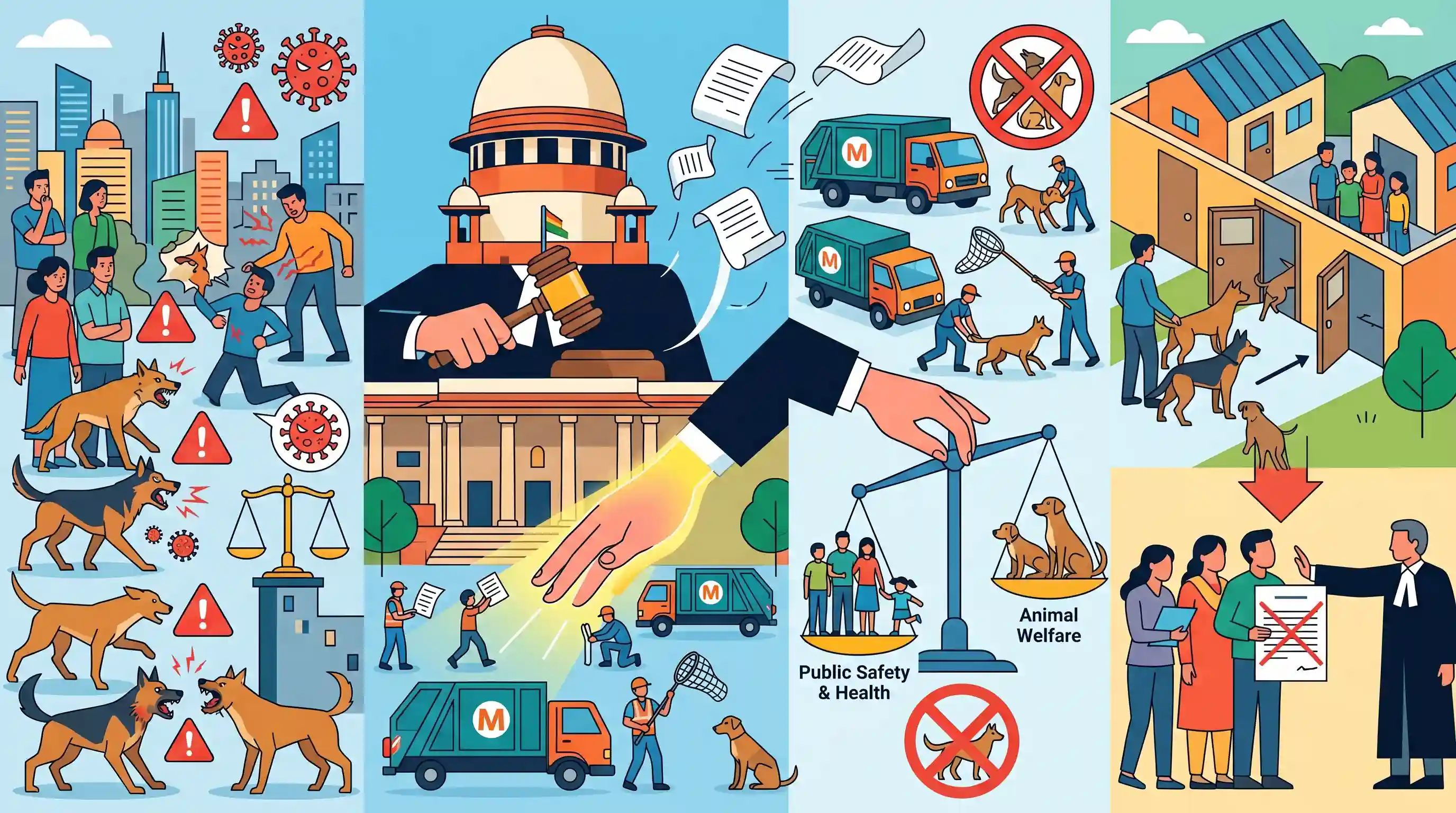
The Supreme Court refused an urgent hearing of a plea challenging a Municipal Corporation of Delhi (MCD) notification concerning the removal of stray dogs. Earlier, taking suo motu cognizance of rising rabies cases and dog attacks, the Supreme Court had directed local authorities across Delhi-NCR to actively pick up stray dogs and relocate them to newly constructed shelters. The Court reprimanded local bodies for their inaction and mandated that detained dogs should not be released back onto the streets, prioritizing public safety and health over prevailing animal relocation practices.
Key Points
- The Supreme Court declined an urgent hearing for a plea against the MCD's notification on picking up stray dogs.
- Previously, the Supreme Court initiated a suo motu case regarding the stray dog menace and subsequent rabies cases in the Delhi-NCR region.
- The apex court heavily criticized local authorities for failing to manage the stray dog issue effectively.
- The Court directed authorities to construct dog shelters within eight weeks, round up stray dogs, and ensure they are detained rather than returned to the streets.
Important Terms
Suo Motu Cognizance

Latin for "on its own motion"; the power of Indian courts to initiate legal proceedings independently without a formal petition from an aggrieved party.
UPSC context
GS Paper II (Judiciary). Tests understanding of judicial proactive powers and the expansion of the judiciary's reach in public interest matters.
Judicial Activism
A judicial philosophy where the court takes a proactive role in protecting citizens' rights and shaping public policy, often filling legislative vacuums or addressing executive inaction.
UPSC context
GS Paper II (Separation of Powers). Tests critical evaluation of the judiciary's role in governance and potential overlap with other branches.
Animal Birth Control (ABC) Rules, 2023
Statutory rules under the Prevention of Cruelty to Animals Act, 1960, mandating 'catch-neuter-vaccinate-return' (CNVR) for stray dogs to control populations and rabies without relocation.
UPSC context
GS Paper II (Public Health/Governance) and GS Paper III (Environment). Tests knowledge of specific policy frameworks for human-wildlife/stray conflict.
Municipal Corporation
A local self-government body in urban areas established via the 74th Constitutional Amendment Act, responsible for public health, sanitation, and local infrastructure.
UPSC context
GS Paper II (Local Governance). Tests understanding of urban decentralization, the 74th Amendment, and the functional challenges of city administration.
Article 21
A fundamental right in the Indian Constitution guaranteeing that no person shall be deprived of their life or personal liberty except according to procedure established by law.
UPSC context
GS Paper II (Fundamental Rights). Vital for discussing the balance between public safety (Right to Life) and other competing rights or animal welfare.
Supreme Court of India
The highest judicial authority in India (Articles 124-147), acting as the ultimate interpreter of the Constitution, protector of fundamental rights, and the final court of appeal.
UPSC context
GS Paper II (Judiciary). Fundamental topic covering original, appellate, and advisory jurisdictions, plus its role as the guardian of the Constitution.
Prelims Trap
Under the Animal Birth Control Rules 2023, local bodies are mandated to capture and permanently relocate stray dogs to shelters.
The ABC Rules 2023 mandate a Catch-Neuter-Vaccinate-Return (CNVR) policy. Permanent relocation is legally prohibited under these rules, making the recent SC directive a notable exception for public safety.
Static Concepts Connected
What is the constitutional framework for animal welfare and local body duties?
- Fundamental Duty: Article 51A(g) mandates all citizens to have compassion for living creatures.
- Concurrent List: Prevention of cruelty to animals falls under the Concurrent List (Entry 17) of the Seventh Schedule.
- 12th Schedule: Article 243W delegates public health, sanitation, and the regulation of animal pounds to Urban Local Bodies.
What is the "One Health" approach to zoonotic diseases like Rabies?
- Integration: It unites human health, veterinary interventions, and environmental ecosystem management into a single collaborative strategy.
- Zoonotic focus: Crucial for eliminating zoonotic diseases like Rabies, where India targets "Zero by 30" under NAPRE.
- Implementation: Requires medical vaccines, mass dog sterilization, and strict municipal solid waste management to control populations.
Cross-Topic Patterns
Right to Life vs Animal Welfare
The SC's directive to detain dogs prioritizes Article 21 (public safety) over the statutory Animal Birth Control Rules and previous rulings emphasizing animal welfare.
Judicial Activism & Local Body Mandates
The Supreme Court’s suo motu reprimand of MCD highlights the enforcement gap in ULBs' 12th Schedule constitutional duties regarding public health and animal pounds.

Conflict between ABC Rules 2023 (CNVR policy) and SC's public-safety directives is prime for a 2026 Prelims question on local governance.
Linked PYQs · 4
Linked PYQs · 4
- 2024MainsGS2
Analyse the role of local bodies in providing good governance at local level and bring out the pros and cons merging the rural local bodies with the urban local bodies.
- 2024MainsGS2
Explain the reasons for the growth of public interest litigation in India. As a result of it, has the Indian Supreme Court emerged as the world's most powerful judiciary ?
- 2020MainsGS2
Judicial Legislation is antithetical to the doctrine of separation of powers as envisaged in the Indian Constitution. In this context justify the filing of large number of public interest petitions praying for issuing guidelines to executive authorities.
- 2018MainsGS4
Explain the process of resolving ethical dilemmas in Public Administration.
