Great Nicobar Island Project and Cultural Rights in Supreme Court
Source:The Hindu ↗
Why It Matters
It touches upon critical themes of balancing national security and economic development infrastructure with environmental protection and the fundamental rights of indigenous communities.
Summary
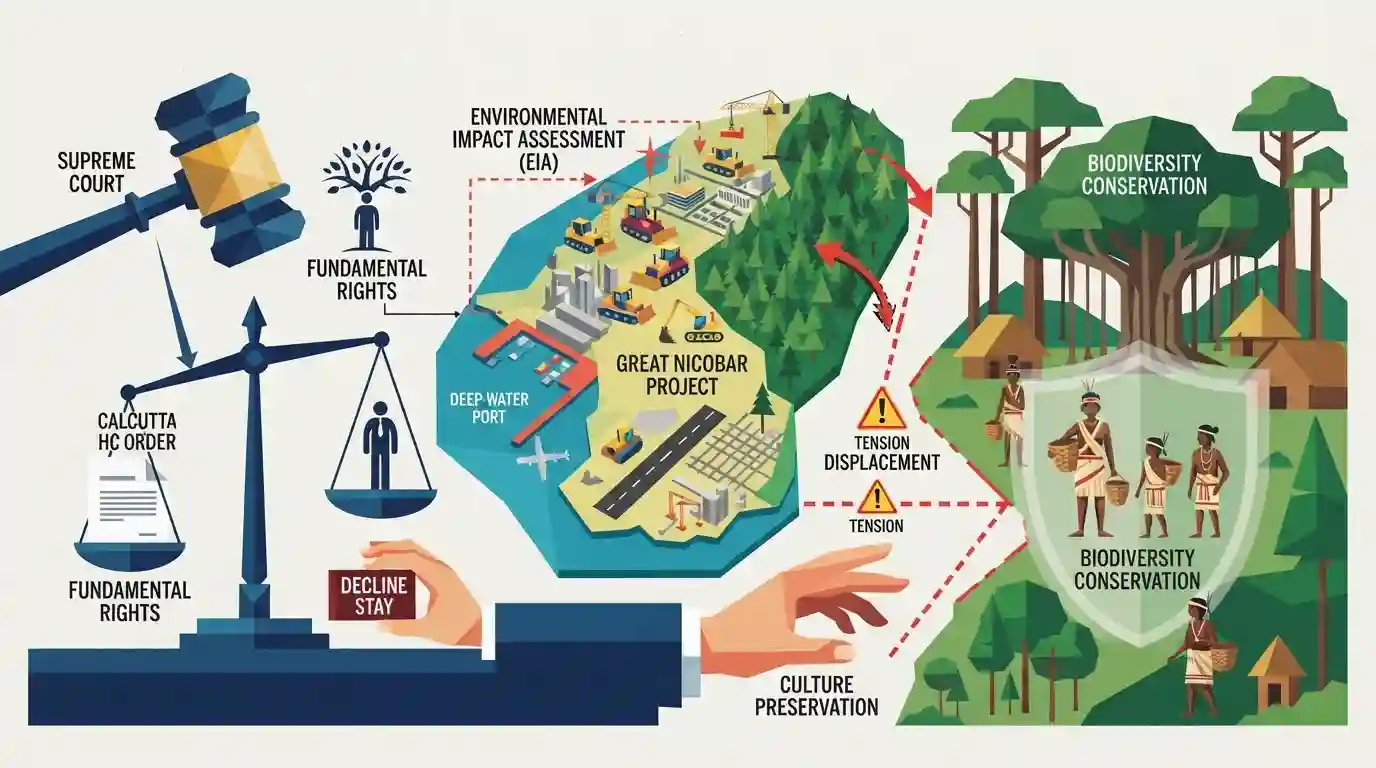
The Supreme Court declined to stay a Calcutta High Court order concerning the Great Nicobar Island project, remarking that the preservation of culture is a fundamental right. The development highlights tensions between large-scale strategic infrastructure projects, environmental impact, and the protection of indigenous tribal culture and rights.
Key Points
- The Supreme Court refused to stay a Calcutta High Court order regarding the controversial Great Nicobar Island project.
- The Supreme Court observed that the preservation of culture and heritage constitutes a fundamental right under the Indian Constitution.
- The massive infrastructure project faces severe ecological and tribal rights concerns regarding indigenous populations and fragile ecosystems in the Andaman and Nicobar archipelago.
Important Terms
Great Nicobar Island Project

A massive infrastructure project on the southernmost Andaman and Nicobar island involving a transshipment port, airport, power plant, and township, raising concerns over environmental degradation and tribal displacement.
UPSC context
Important for GS Paper III (Environment, Biodiversity, EIA) and GS Paper I (Tribal Rights and Culture).
Supreme Court
India's apex judicial body which acts as the guardian of the Constitution and fundamental rights, handling appeals on environmental and public interest litigations.
UPSC context
Core for GS Paper II (Indian Polity, Judiciary, Structure and Function of Courts).
Calcutta High Court
A constitutional court having territorial jurisdiction over West Bengal and the Andaman and Nicobar Islands, currently adjudicating petitions concerning the statutory clearances of the Great Nicobar project.
UPSC context
Relevant for GS Paper II (Indian Polity, High Courts and Judicial Review).
Static Concepts Connected
What are the criteria used to identify Particularly Vulnerable Tribal Groups (PVTGs) in India?
- Technology level: Pre-agricultural level of technology used for sustenance in remote and isolated habitats.
- Population trend: Stagnant or declining population growth rate over successive decades.
- Literacy rate: Extremely low level of literacy compared to other tribal populations.
- Economy type: Subsistence level of economy relying on forest produce and primitive agriculture.
What are the key stages in the Environmental Impact Assessment (EIA) process in India under the EIA Notification 2006?
- Screening phase: Screening of the project to determine whether prior environmental clearance is legally mandatory based on scale and location.
- Scoping phase: Scoping to determine detailed terms of reference for addressing environmental concerns and impact studies.
- Public consultation: Public consultation involving local affected persons and public hearings conducted by State Pollution Control Boards.
- Appraisal stage: Appraisal by an Expert Appraisal Committee which recommends grant or rejection of environmental clearance.
Cross-Topic Patterns
Strategic Projects vs. Environmental Governance
Large infrastructure initiatives in ecologically fragile zones highlight the tensions between executive-driven national security imperatives and judicial enforcement of constitutional safeguards like Article 21 and the Forest Rights Act.
PVTG Protection vs. Mega-Infrastructure
The Shompen and Nicobarese highlight how development projects intersect with the legal protection of Particularly Vulnerable Tribal Groups under India's Fifth and Sixth Schedules or specific Island regulations.

SC remarks on cultural preservation as a fundamental right in tribal projects will likely feature in Polity or Environment MCQs.
Linked PYQs · 2
Linked PYQs · 2
- 2014MainsGS3
Environmental Impact Assessment studies are increasingly undertaken before a project is cleared by the Government. Discuss the environmental impacts of coal-fired thermal plants located at coal pitheads.
- 2017MainsGS2
Examine the scope of Fundamental Rights in the light of the latest judgement of the Supreme Court on Right to Privacy.
