Judicial restraint and procedural hierarchy in criminal justice
Source:The Hindu ↗
Why It Matters
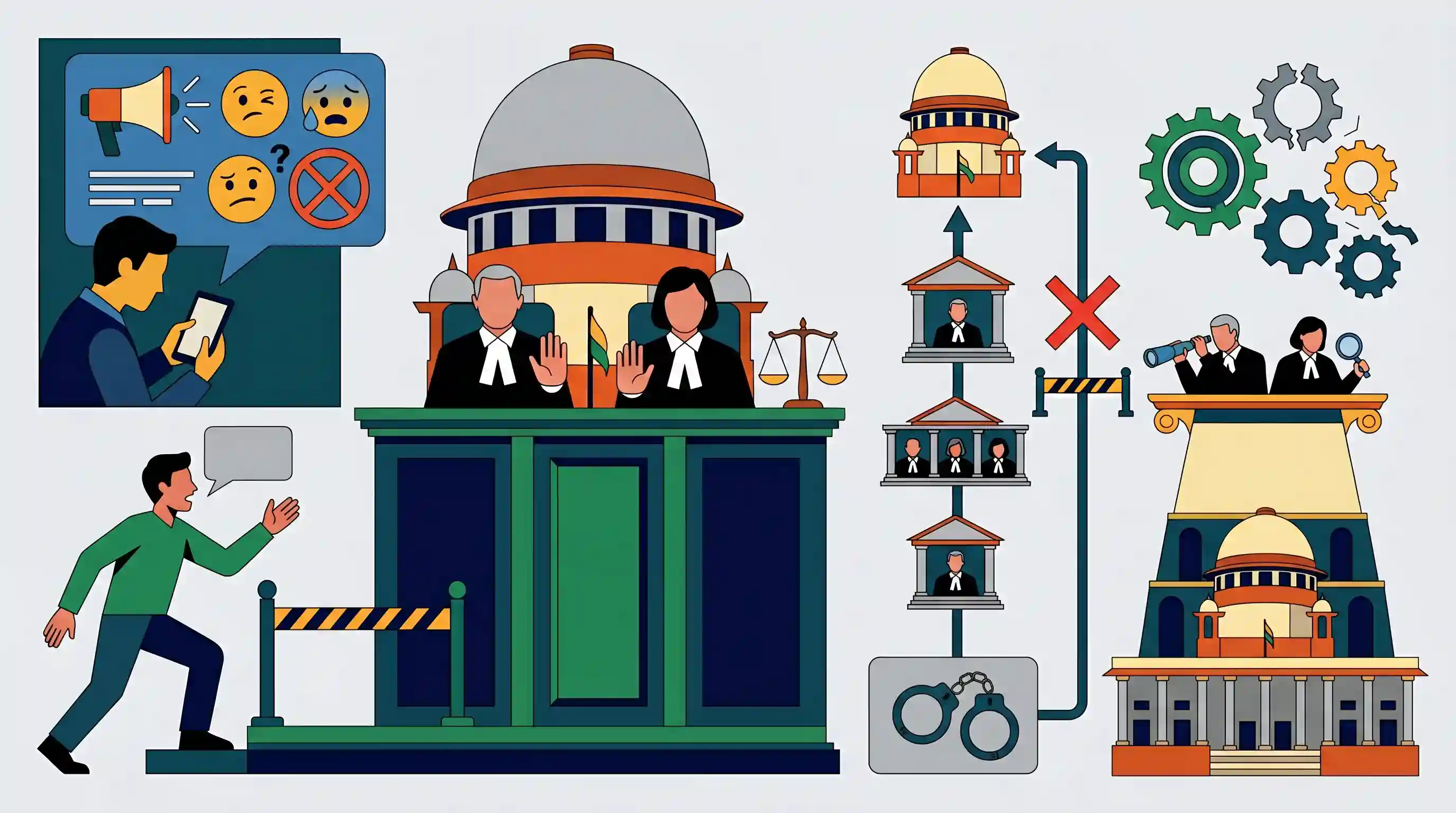
The Supreme Court's ruling underscores the critical balance between public interest advocacy and the rule of law. It clarifies that PILs should not be used to bypass statutory criminal procedures (such as filing an FIR and police investigation), thereby upholding the structural integrity and procedural hierarchy of the Indian judiciary and preventing the administrative inertia that occurs when lower-tier authorities are routinely sidelined.
Summary
On July 6, 2026, a Vacation Bench of the Supreme Court of India refused to entertain an oral Public Interest Litigation (PIL) seeking direct action against derogatory remarks made by social media influencer and BJP Minority Morcha leader Nazia Elahi Khan against Prophet Muhammad. The Bench, consisting of Justices Ahsanuddin Amanullah and Sheel Nagu, ruled that litigants cannot 'short-circuit' the standard legal system by bypassing lower courts and police authorities. It emphasized that procedural hierarchy must be respected to avoid systemic chaos, allowing the Supreme Court to fulfill its proper role as an apex monitoring authority.
Key Points
- On July 6, 2026, a Vacation Bench of the Supreme Court of India, comprising Justices Ahsanuddin Amanullah and Sheel Nagu, declined to entertain an oral plea/PIL seeking direct judicial intervention on derogatory remarks allegedly made by BJP Minority Morcha leader Nazia Elahi Khan against Prophet Muhammad.
- The Supreme Court strongly refused to 'short-circuit' standard legal procedures, emphasizing that complainants must first approach the police to file a complaint and allow a proper investigation to take place.
- The Bench cautioned that rushing directly to the Supreme Court as the 'first port of call' sidelines lower courts and law enforcement, which risks making the entire criminal justice system chaotic and go 'haywire'.
- Justice Amanullah clarified that the Supreme Court's role is to act as an apex monitoring body. By giving lower functionaries a chance to act, the higher judiciary can evaluate whether these institutions are performing their statutory duties effectively.
- The court urged legal practitioners to act responsibly and refrain from 'sensationalising sensitive cases' that could disrupt social and communal harmony.
Important Terms
Public Interest Litigation (PIL)

A legal mechanism allowing any public-spirited citizen or group to file a petition in court for the protection of public interest or constitutional rights of marginalized sections.
UPSC context
GS Paper II (Polity & Constitution): Tests judicial activism, access to justice, and guidelines preventing the misuse of PILs.
Judicial Restraint
A judicial philosophy encouraging judges to limit their own power, showing deference to established statutory procedures, legislative intent, and separation of powers rather than asserting personal preferences.
UPSC context
GS Paper II (Polity): Tests separation of powers, institutional balance, and the distinction between judicial activism and overreach.
Judicial Hierarchy
The structured tier-based organization of courts (from subordinate/district courts to High Courts and the Supreme Court) ensuring sequential appeals and proper jurisdictional limits.
UPSC context
GS Paper II (Polity): Tests understanding of India's integrated judicial structure, original vs appellate jurisdiction, and procedural propriety.
Original Jurisdiction
The authority of a court to hear and decide a case at its first instance, rather than through an appellate review of a lower court's decision.
UPSC context
GS Paper II (Polity): Tests Supreme Court powers under Article 32 (fundamental rights protection) and Article 131 (federal disputes).
Prelims Trap
The Supreme Court cannot refuse an Article 32 petition solely because the petitioner did not exhaust alternative remedies under Article 226 first.
While Article 32 is a Fundamental Right, the Supreme Court has established a self-imposed rule of discipline directing petitioners to High Courts first, unless exceptional circumstances exist.
Static Concepts Connected
What is the Doctrine of Exhaustion of Alternative Remedies under Indian Jurisprudence?
- Nature: A self-imposed rule of policy, convenience, and discretion, rather than an absolute statutory or constitutional bar on courts.
- Application: Courts routinely direct petitioners to seek lower court remedies or High Court writ jurisdiction under Article 226 first.
- Exceptions: Can be bypassed during patent lack of jurisdiction, violation of principles of natural justice, or enforcement of fundamental rights under extreme urgency.
How did the Supreme Court address PIL abuse in the Balwant Singh Chaufal case?
- Petitioner Verification: Mandated that constitutional courts must verify the credentials of a PIL petitioner before entertaining the plea.
- Public Interest Safeguard: Emphasized that PILs must address genuine public injury rather than private, political, or oblique motives.
- Deterrent Costs: Empowered courts to impose exemplary financial costs on vexatious, frivolous, or busybody litigation.
Cross-Topic Patterns
BNSS procedural filters + judicial pendency
New BNSS Section 175(3) mandates strict affidavits before directing investigations, mirroring Supreme Court efforts to check procedural short-circuiting.
Article 32 limitations vs. Judicial Activism
Balancing the status of Article 32 as a basic structure element against self-imposed judicial restraint to manage institutional workload and hierarchy.

The distinction between Article 32 as a fundamental right and the SC's discretion to deny direct entry using exhaustion of remedies will target 2026.
Linked PYQs · 3
Linked PYQs · 3
- 2024MainsGS2
Explain the reasons for the growth of public interest litigation in India. As a result of it, has the Indian Supreme Court emerged as the world's most powerful judiciary ?
- 2020MainsGS2
Judicial Legislation is antithetical to the doctrine of separation of powers as envisaged in the Indian Constitution. In this context justify the filing of large number of public interest petitions praying for issuing guidelines to executive authorities.
- 2006PrelimsGS1
Who was the Chief Justice of India when public interest litigation (PIL) was introduced to the Indian Judicial System?
