AIFs and FPIs Beneficial Ownership Disclosure Limits by Supreme Court
Source:The Hindu ↗
কেন এটি গুরুত্বপূর্ণ
This ruling touches upon critical themes of financial market integrity, corporate transparency, prevention of illicit fund flows via opaque structures (FPIs/AIFs), and the limits of judicial intervention in economic policy and statutory regulation.
সারসংক্ষেপ
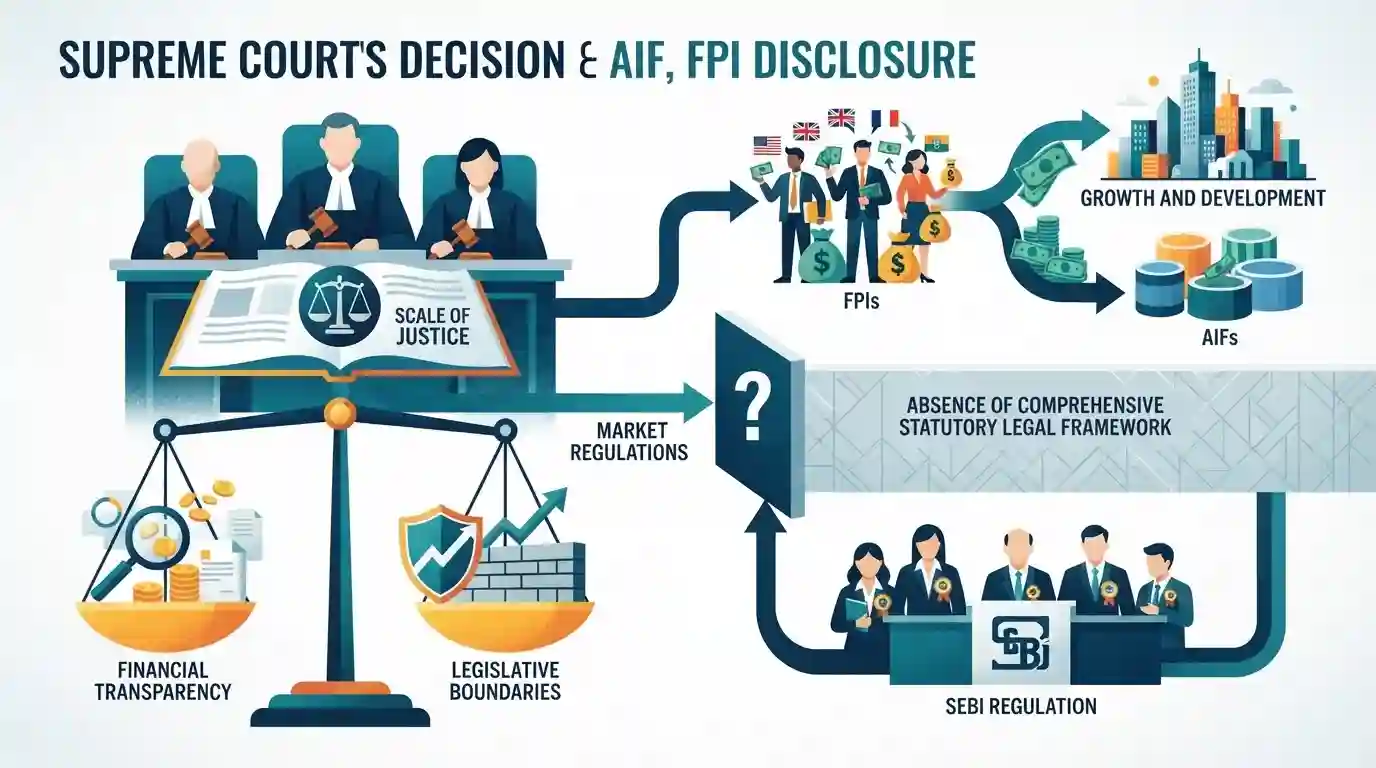
The Supreme Court declined to mandate full public disclosure of the ultimate beneficial owners of Alternative Investment Funds (AIFs) and Foreign Portfolio Investors (FPIs) in the absence of a comprehensive statutory legal framework, balancing financial transparency with market regulations and legislative boundaries.
মূল বিষয়
- The Supreme Court refused to order full public disclosure of the ultimate beneficiaries of Alternative Investment Funds (AIFs) and Foreign Portfolio Investors (FPIs) without an established legal framework.
- The court emphasized that judicial mandates cannot bypass legislative and regulatory frameworks governing financial markets and privacy/transparency balances.
- The issue relates to corporate governance, prevention of shell companies or opaque structures channeling funds into Indian markets, and SEBI's regulatory oversight.
গুরুত্বপূর্ণ শব্দ
Supreme Court

The apex judicial body of India, responsible for interpreting constitutional law, safeguarding fundamental rights, and maintaining judicial review over legislative and executive actions.
UPSC context
UPSC Paper II (Polity & Constitution): Tests knowledge of judicial review, separation of powers, and the limits of judicial intervention in policy matters.
SEBI
The statutory regulatory body established under the SEBI Act, 1992, to regulate India's securities market, protect investor interests, and promote market development.
UPSC context
UPSC Paper III (Economy): Tests understanding of financial market regulators, institutional frameworks, and capital market governance.
সংযুক্ত স্থির ধারণা
What are the three distinct categories of Alternative Investment Funds (AIFs) recognized by SEBI?
- Category I: Venture capital, SME funds, social venture funds, and infrastructure funds investing in startups or early-stage ventures with positive economic externalities.
- Category II: Funds that do not undertake leverage or specific special incentives, including private equity (PE) funds and debt funds not covered in Category I or III.
- Category III: Funds that employ diverse or complex trading strategies, including hedging, derivatives, and PIPE (Private Investment in Public Equity) transactions.
আন্তঃবিষয় প্যাটার্ন
FPI Transparency + PMLA & Shell Companies
The debate over beneficial ownership transparency bridges financial market regulation with anti-money laundering frameworks and foreign investment policy.

SEBI's regulatory perimeter vs legislative mandates for AIF/FPI disclosure will appear as a statement-based prelims question.
সংযুক্ত PYQ · 2
সংযুক্ত PYQ · 2
- 2020MainsGS2
Judicial Legislation is antithetical to the doctrine of separation of powers as envisaged in the Indian Constitution. In this context justify the filing of large number of public interest petitions praying for issuing guidelines to executive authorities.
- 2019MainsGS2
Do you think that Constitution of India does not accept principle of strict separation of powers rather it is based on the principle of 'checks and balance'? Explain.
