Supreme Court Upholds Stray Dog Removal Order in Public Institutions
Source:The Hindu ↗
Why It Matters
This ruling is crucial for understanding the expanding horizons of Article 21 (Right to Life) and how courts resolve conflicts between human rights and animal welfare. It establishes an important precedent on municipal accountability, tort liability for NGOs, and urban governance regarding public safety.
Summary
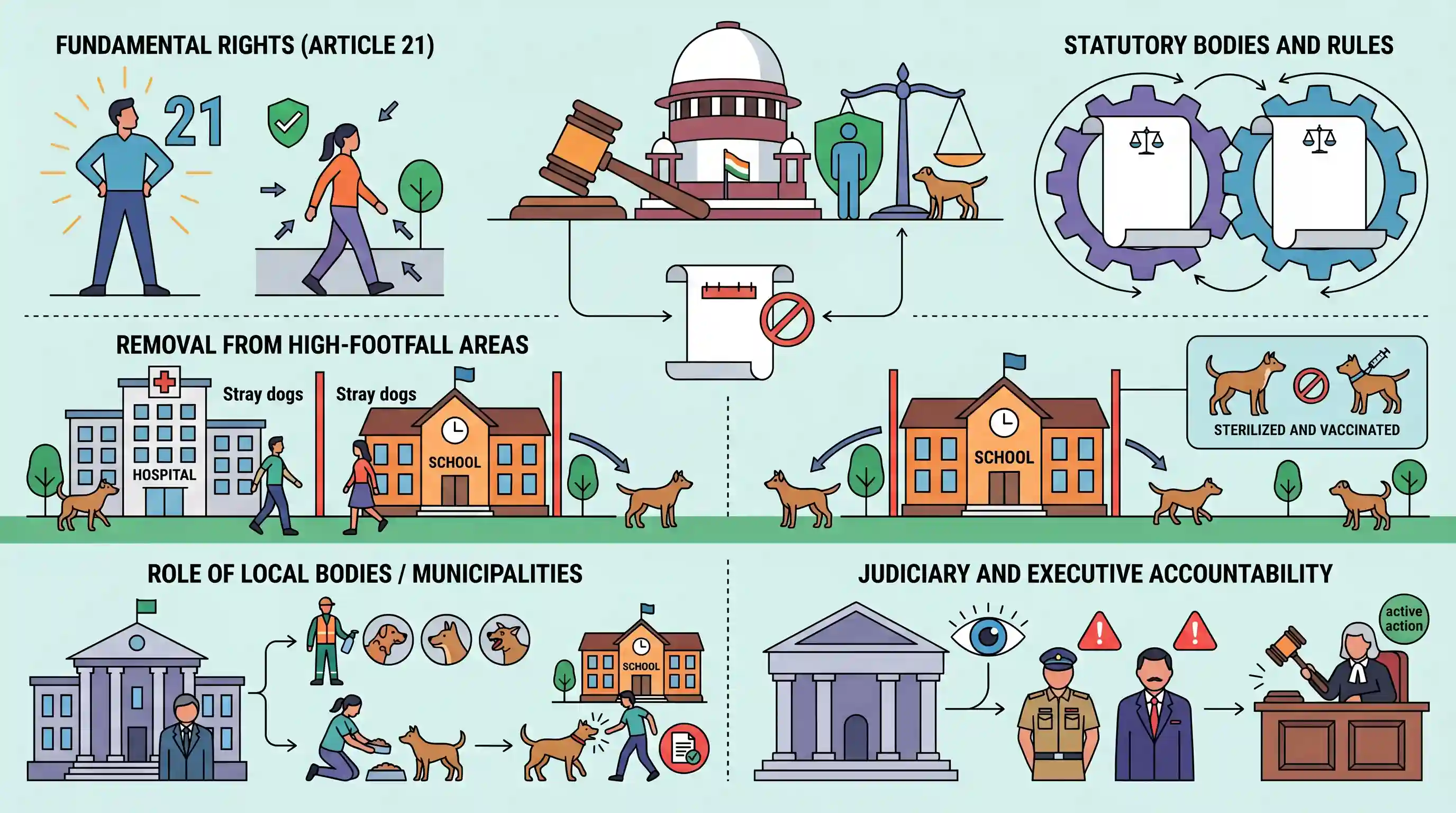
The Supreme Court has upheld its November 2025 ruling prioritizing human life and public safety over the rights of stray dogs. Refusing to modify the order, the Court directed the removal of strays from high-footfall public institutions like hospitals and schools, clarifying that they cannot be re-released into these areas even after sterilization and vaccination. Expanding the scope of Article 21, the Court stated that the right to live with dignity encompasses the freedom to move in public spaces without fear of physical harm from animal attacks. The judgment calls for a harmonious reading of the Animal Birth Control (ABC) Rules, 2023, and the Prevention of Cruelty to Animals Act, 1960. It permits municipal bodies to euthanize rabid, incurably ill, or aggressive dogs and holds animal welfare organizations legally responsible (tortious liability) if they feed dogs that subsequently attack people in institutions. Additionally, High Courts have been authorized to take suo motu action against non-compliant officials.
Key Points
- The Supreme Court refused to modify its November 2025 order, prioritizing human safety over the rights of stray dogs in high-footfall public institutions like schools and hospitals.
- Expanding the interpretation of Article 21, the Court ruled that the right to live with dignity includes the freedom to navigate public spaces without the fear of stray dog attacks.
- Stray dogs removed from sensitive areas cannot be re-released into those same institutions, even after undergoing vaccination and sterilization.
- Municipal authorities are legally permitted to employ euthanasia for dogs that are rabid, incurably ill, or demonstrably dangerous.
- Animal welfare organizations that feed and shelter dogs within institutional premises must now assume tortious liability for any resulting harm or dog bites.
- State governments and Union Territories must establish at least one fully functional Animal Birth Control Centre in every district.
- High Courts have been empowered to initiate suo motu contempt proceedings against municipal officials who fail to comply with these safety and control directives.
Important Terms
Article 21 of the Constitution

A Fundamental Right guaranteeing the right to life and personal liberty. Recently, the Supreme Court expanded this to include the right to access public spaces without fear of stray dog attacks.
UPSC context
GS Paper II (Polity) - Fundamental Rights. Tests the evolving judicial interpretation of the Right to Life versus public safety.
Animal Birth Control (ABC) Rules, 2023
Notified under the PCA Act 1960, these rules mandate the Capture-Sterilise-Vaccinate-Release (CSVR) model for stray dog population control, prioritizing humane treatment over culling.
UPSC context
GS Paper II (Statutory Rules) & GS Paper III (Environment/Ethics). Tests knowledge of delegated legislation and urban management.
Prevention of Cruelty to Animals Act, 1960
India's primary legislation for animal welfare. It establishes the Animal Welfare Board of India and permits the humane destruction of animals to prevent suffering or for public safety.
UPSC context
GS Paper II (Social Justice/Laws). Tests understanding of environmental legislation and the balance between rights and safety.
Tortious Liability
A legal obligation where a party is held responsible for a civil wrong. The SC ruled that animal welfare groups feeding dogs in institutions must accept this for any attacks.
UPSC context
GS Paper II (Governance/Law). Tests knowledge of legal accountability mechanisms for NGOs and individuals in public welfare.
Municipal Authorities
Urban local bodies (ULBs) responsible for public health and safety. In this case, they are tasked with removing strays from institutions and establishing district-level ABC centres.
UPSC context
GS Paper II (Local Governance). Tests the role and accountability of the 74th Amendment institutions in managing urban crises.
High Courts (Suo Motu Monitoring)
State-level superior courts. The Supreme Court uniquely decentralized the monitoring of stray dog management compliance to High Courts through suo motu proceedings.
UPSC context
GS Paper II (Judiciary). Tests understanding of judicial activism, hierarchical oversight, and the implementation of apex court orders.
Prelims Trap
"The Prevention of Cruelty to Animals Act, 1960 completely prohibits the culling or euthanasia of all stray animals."
Section 11(3) of the PCA Act explicitly exempts the humane destruction of stray dogs (or rabid/incurably ill animals) from being considered a punishable offense of cruelty.
Static Concepts Connected
What are the core regulatory bodies established under the Prevention of Cruelty to Animals Act, 1960?
- AWBI: A statutory advisory body, currently operating under the Ministry of Fisheries, Animal Husbandry and Dairying (shifted from MoEFCC).
- CPCSEA: A statutory committee regulating the use of animals in scientific research and experimentation.
- State Boards: The Act mandates state governments to establish State Animal Welfare Boards to oversee local compliance.
How has the Supreme Court expanded Article 21 regarding public safety and environmental rights?
- Broad Scope: The SC has interpreted 'Right to Life' to include living in a pollution-free environment (Subhash Kumar case) and safety from preventable hazards.
- Right to Safe Spaces: The recent ruling asserts that human dignity encompasses the freedom to navigate public spaces safely, overriding conflicting animal rights in sensitive zones.
Cross-Topic Patterns
Tort liability vs Fundamental Duties
The Supreme Court's application of 'tortious liability' against NGOs feeding strays highlights the legal friction between Fundamental Duties (compassion for living creatures) and civil accountability for public harm.
74th Amendment and municipal capacity constraints
Management of stray populations falls under the 12th Schedule (public health). The court's ruling exposes the capacity constraints of Urban Local Bodies in balancing statutory ABC Rules with municipal safety duties.

Expect a Prelims statement testing the specific exceptions under the PCA Act 1960 (e.g., euthanasia of rabid dogs) and AWBI's nodal ministry.
Linked PYQs · 4
Linked PYQs · 4
- 2023MainsGS2
“The Constitution of India is a living instrument with capabilities of enormous dynamism. It is a constitution made for a progressive society.” Illustrate with special reference to the expanding horizons of the right to life and personal liberty.
- 2024MainsGS2
Analyse the role of local bodies in providing good governance at local level and bring out the pros and cons merging the rural local bodies with the urban local bodies.
- 2022MainsGS4
It is believed that adherence to ethics in human actions would ensure in smooth functioning of an organization/system. If so, what does ethics seek to promote in human life? How do ethical values assist in the resolution of conflicts faced by him in his day-to-day functioning?
- 2022PrelimsGS1
With reference to Indian laws about wildlife protection, consider the following statements : 1. Wild animals are the sole property of the government. 2. When a wild animal is declared protected, such animal is entitled for equal protection whether it is found in protected areas or outside. 3. Apprehension of a protected wild animal becoming a danger to human life is sufficient ground for its capture or killing. Which of the statements given above is/are correct?
